
Product updates are not just a list of changes, they are a promise about continuity. This guide shows how to ship announcements, improvements, and new features with clear reasons, low disruption, and faster adoption.
Most teams treat product updates like a broadcast: a list of what shipped, a few screenshots, and a link to the changelog. Customers experience updates differently. An update lands inside someone’s routine: the way they book appointments, respond to leads, reconcile orders, or run support. When that routine breaks, even a “better” feature can feel like a tax.
That is why the best product updates make a version promise: yes, things changed, and here is why, but your workflow stays safe. This approach turns announcements into trust, improvements into measurable outcomes, and new features into adoption that sticks.
Update fatigue is real. Users do not wake up hoping for new UI labels. They want fewer surprises and more reliability. Updates usually fail for one of these reasons:
In messaging-first businesses, the stakes are higher. A tweak to routing rules, response templates, or lead qualification can change conversion rates overnight. Platforms like Staffono.ai (https://staffono.ai) sit directly in that frontline workflow, so update communication has to be especially precise: customers care about response quality, handoff rules, booking accuracy, and channel coverage, not the internal architecture.
Before you announce anything, map the routines your product touches. A routine map is a short list of the recurring tasks that users rely on:
Now attach your update to the routine it affects. This prevents vague messaging like “We improved the dashboard” and replaces it with “You can now spot unanswered chats in under 10 seconds.” When Staffono.ai ships enhancements to its AI employees, the most useful announcement is not “new model,” but “fewer follow-up messages needed to confirm a booking, because the assistant asks for details in a smarter order.”
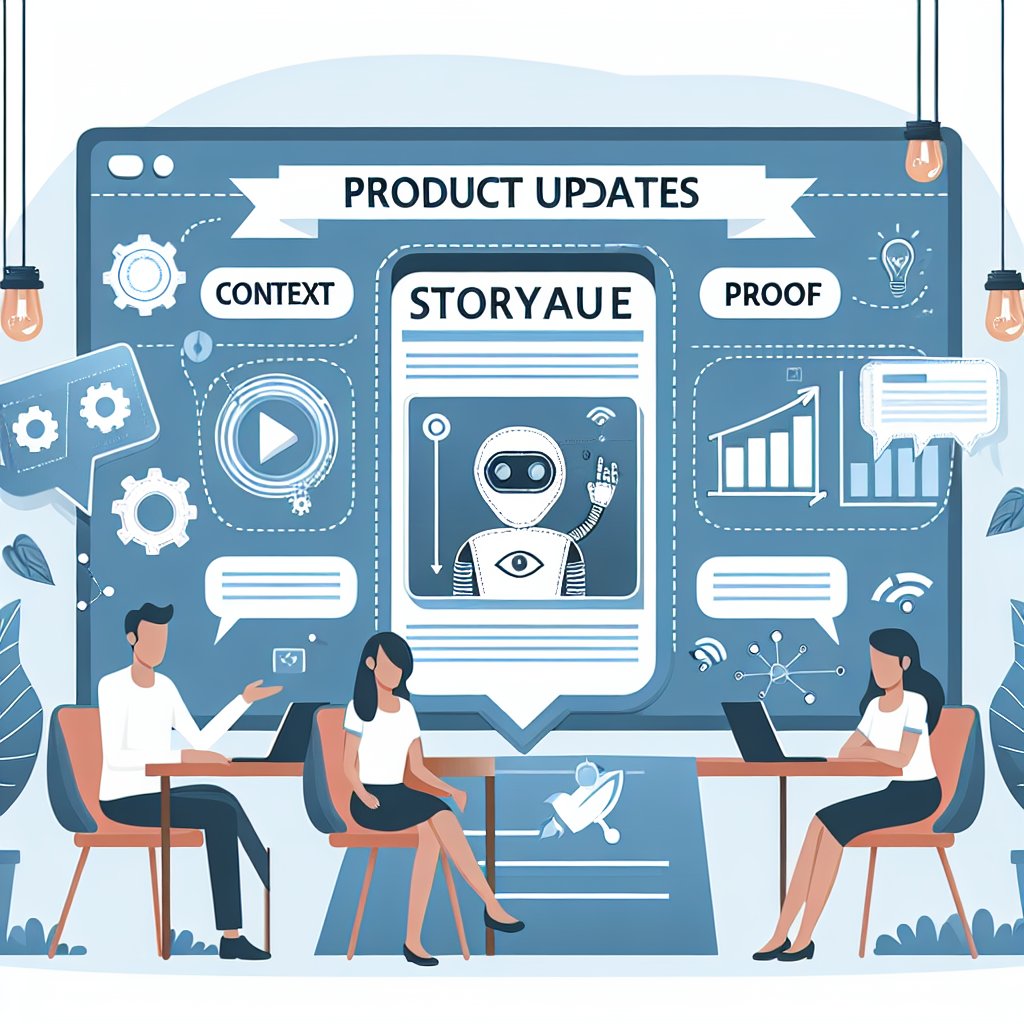
To protect customer routines, structure every update with five parts. You can use this for a big launch or a minor improvement.
Describe what changed in plain language. Avoid internal product names. If the UI moved, say where it moved to. If behavior changed, describe the before and after.
Explain why you made the change. The reason should be a customer problem, not a company preference. “We saw many customers missing leads after hours” is better than “We refactored our pipeline.”
State who is affected and how. Include both the upside and any tradeoffs. If users must reauthorize an integration, say so. If response time improves, quantify it.
Tell users what to do next, if anything. Provide a 60-second path: one link, one setting, one screenshot, one short checklist.
Share a metric, a before-and-after example, or a short customer story. Proof turns skepticism into adoption.
This template is especially effective for automation products. For example, if Staffono.ai introduces a new qualification step for inbound chats, the announcement should include the impact on conversion and the action needed to enable it on specific channels.
Teams often bundle everything into one post, but users process them differently.
Announcements change expectations. Examples: pricing updates, deprecations, permission changes, new compliance requirements, or a new channel rollout. These must be early, explicit, and repeatable across touchpoints (email, in-app, admin console).
Best practice: give a timeline and a no-surprises checklist. If a messaging automation tool adds a new consent requirement for WhatsApp flows, customers need to know what will stop working if they do nothing.
Improvements are adoption accelerators because they do not ask users to learn something new. They should be communicated as “less time, fewer steps, fewer errors.”
Example improvement message: “Fewer missed bookings: the assistant now confirms time zones automatically based on the customer’s number and profile data, reducing reschedule requests.” This is the kind of improvement Staffono.ai customers care about because it directly reduces manual back-and-forth.
New features introduce choice. They need positioning, use cases, and guardrails. A new feature is not “available,” it is “useful when X is true.”
For instance, a new “handoff to human with summary” feature should ship with examples of when to use it (high-value leads, complaints, complex pricing) and when not to (simple booking requests).
Change: Added Telegram as a supported inbound and outbound channel.
Why: Many service businesses receive repeat customers in Telegram groups and wanted consistent automation there.
Impact: Faster first response across channels, unified reporting. Admins may need to connect a bot and define allowed message types.
Action: Connect Telegram in settings, then copy your existing qualification flow.
Proof: Teams that respond within 2 minutes typically see higher booking completion, especially for urgent requests.
This kind of cross-channel capability is a core value of Staffono.ai: one automation layer that works across WhatsApp, Instagram, Telegram, Facebook Messenger, and web chat.
Change: Updated the qualification logic to ask fewer questions upfront and use context from earlier messages.
Why: Users were losing leads when the first interaction felt like a form.
Impact: More conversations reach “qualified” status, fewer drop-offs. Some fields may be collected later in the chat.
Action: Review the default question order and adjust for your business (budget-first vs need-first).
Proof: Monitor the “qualified rate” and “handoff rate” for one week before and after enabling.
Change: Retired an old webhook format and introduced a new event schema.
Why: The old format prevented reliable delivery and limited future features.
Impact: Integrations built on the old schema will stop receiving events after a specific date.
Action: Provide a migration guide, a test endpoint, and a validation tool.
Proof: Show delivery success rates and reduced duplication.
Breaking changes are where trust is earned. Make the migration boring: clear dates, clear steps, and tooling that detects issues early.
Support spikes happen when users learn about changes too late or in the wrong format. A simple distribution plan prevents this:
If your product includes automated conversations, also update your own support automation. Many teams use Staffono.ai to handle inbound customer questions across messaging channels. When you ship an update, your AI employee can proactively answer “What changed?” and guide users through new settings, reducing ticket volume while improving the experience.
A release note is not the finish line. The goal is behavior change. Track:
For messaging automation, two metrics are especially telling: time to first response and handoff quality. Staffono.ai customers often evaluate updates by whether the AI employee resolves more conversations end-to-end without losing the brand tone. That is a measurable promise, not just a feature list.
Users are surprisingly tolerant of change when you treat them like partners. If a new feature is optional, say so. If performance improves but a legacy setting is removed, explain the tradeoff and offer the closest replacement. This honesty reduces churn because it replaces suspicion with predictability.
Here is a lightweight workflow you can run every release cycle:
If you want updates to feel effortless for customers, your communication has to be as automated as your product. That is where platforms like Staffono.ai (https://staffono.ai) can help beyond the core automation: use AI employees to answer update questions instantly, guide users through configuration steps inside their preferred messaging channel, and capture feedback at scale while your team focuses on building.
When you treat each release as a version promise, you stop shipping “news” and start shipping continuity. Customers keep their routines, understand the why, and adopt faster, which is the real point of product updates.