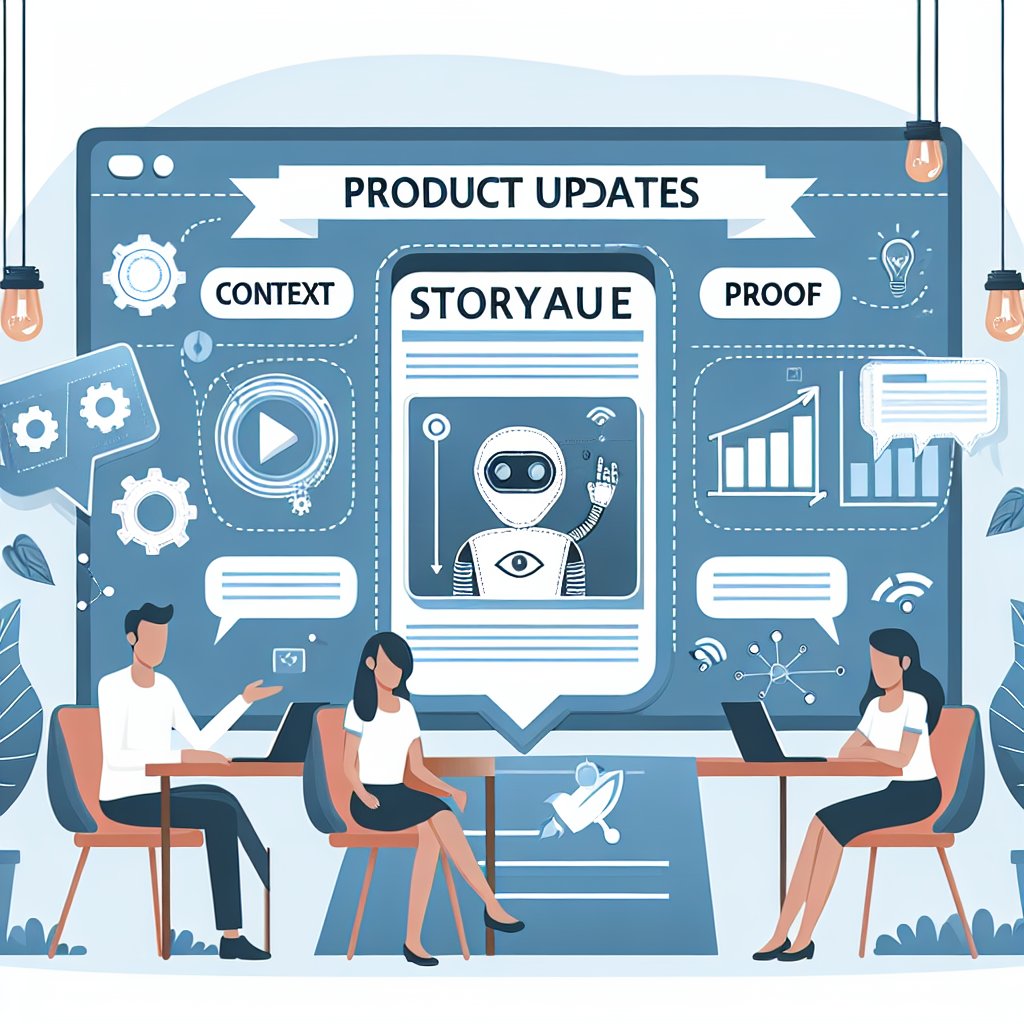


Most product updates fail because they list changes without translating them into outcomes. This guide shows how to announce improvements and new features with a repeatable narrative structure that explains what changed, why it changed, and what users should do next.
Product updates are rarely “just information.” They are a moment of truth: users decide whether your product is evolving in a direction that helps them, or drifting into complexity they did not ask for. Yet many teams still ship announcements that read like internal engineering notes. The result is predictable: low adoption, more support tickets, and a vague sense that “people do not read release notes.”
The fix is not louder announcements. It is clearer meaning. The most effective update posts use a simple narrative stack that turns a list of changes into a guided explanation of value. When you consistently answer what changed and why, users feel respected, safe, and motivated to try the new thing.
Below is a practical framework you can run every release cycle, with examples you can adapt. You can apply it whether you ship weekly, monthly, or quarterly, and whether your product is a B2B platform, a mobile app, or an AI automation tool like Staffono.ai.
Users do not experience your product as features. They experience it as workflows: the steps they repeat to get a result. When a release note says “Added new routing rules,” it forces users to do the translation work. They must ask: Will this break my setup? Does it save time? Do I need to re-train my team?
A strong update answers three user questions in order:
Think of this as the Release Narrative Stack. It is a way to write updates that users can trust and act on.
Start with the benefit, not the feature. Instead of “New booking settings,” lead with “Fewer no-shows with smarter confirmations.” This helps the right users self-select and keeps the post skimmable.
Outcome headlines work best when they are specific and measurable. Even if you do not have perfect metrics, you can still speak in concrete terms: faster, fewer steps, clearer, more control, less manual work.
Users understand change fastest when you contrast old vs new in their workflow language.
Keep this short. Two to four sentences is enough.
The best “why” is not “because we built it.” It is “because your day looked like this.” Cite a pattern you observed: support tickets, onboarding drop-off, users getting stuck, high error rates, or repeated feature requests. This gives users confidence that you are listening and making decisions with intent.
If you build AI-driven features, explain the reason in human terms. For example, if you changed an AI assistant’s conversation flow, say you did it to reduce repeated questions and shorten time-to-resolution, not “we upgraded the model.”
Most update posts skip this, then wonder why adoption is low. Add a mini-playbook:
This is also where you prevent support load by naming common pitfalls up front.
Change introduces risk. Reduce perceived risk with:
This layer is especially important for automation products. If your platform touches customer communication, bookings, or payments, users need to know the blast radius of any update.
Clarity is not the same as completeness. The goal is to include what users need to operate confidently, not every internal detail. A simple way to hit the right level is to group changes into three buckets:
Then add a short “Who benefits” line under each item. This prevents users from scanning a long list that is irrelevant to them.
Raw note: “Added Instagram and WhatsApp unified inbox filters.”
User-ready update: “Find urgent conversations faster across WhatsApp and Instagram. Before, teams had to open each channel to check for replies and missed time-sensitive leads. Now you can filter and prioritize conversations in one view, so high-intent messages get handled first.”
Why it changed: “We saw that response delays were happening when teams juggled multiple apps, especially during peak hours.”
What to do next: “Open your inbox settings, enable Priority filters, and start with one rule: show unanswered conversations older than 10 minutes.”
This is the kind of workflow-first framing that platforms like Staffono.ai are built around. When your AI employees handle multi-channel messaging, the value is not “a filter,” it is shorter response time and fewer missed opportunities.
Raw note: “Improved reminder scheduler and templates.”
User-ready update: “Reduce no-shows with confirmation messages that adapt to the appointment type. Before, reminders were one-size-fits-all, which led to missed confirmations for high-stakes bookings. Now you can set different reminder sequences for consultations, deliveries, and recurring visits, with templates that include the right details automatically.”
Why it changed: “Businesses told us they needed fewer cancellations without adding manual follow-ups.”
What to do next: “Pick your top revenue appointment type, enable two reminders (24 hours and 2 hours), and add a one-tap confirm option.”
If you use Staffono.ai for bookings, this kind of update is most powerful when paired with a real example: the AI employee sends reminders on WhatsApp, handles confirmations, and offers rescheduling in the same thread, so your team is not chasing people manually.
Raw note: “Added CRM export and lead tags.”
User-ready update: “Hand leads to your sales team with context, not just contact details. Before, reps received a name and number but missed the conversation history and intent signals. Now tags and exports include the lead’s topic, timeline, and key questions, so follow-up feels personal and fast.”
Why it changed: “We noticed teams were copying and pasting chat snippets into CRMs, which is slow and error-prone.”
What to do next: “Define three intent tags (Pricing, Availability, Custom request) and map each to the next step in your pipeline.”
High-quality update writing is not only a marketing task. It is a product discipline. To consistently publish useful announcements, adopt a lightweight internal routine:
When a ticket is created, capture the reason in one line: the user pain, the business metric, or the operational cost. Pull quotes from support chats and sales calls. This becomes the backbone of your “why” section.
Before release, write down what happens if users do nothing, what defaults apply, and what might break. This is where many update posts fail, especially for automation workflows.
Every update should have a safe trial. What is the smallest action that lets a user experience value quickly? If you cannot describe that step, you may not be ready to announce the feature.
Product update posts can rank, but only if they answer real queries. A practical approach:
Do not stuff keywords. Search engines increasingly reward posts that demonstrate real use and clear intent.
This is where automation helps: with Staffono.ai, teams can broadcast update summaries through the same messaging channels customers already use, and an AI employee can answer follow-up questions in real time, reducing confusion while boosting adoption.
Your update announcement is a promise: “This change makes your workflow better.” The Release Narrative Stack keeps that promise by translating engineering output into user outcomes, explaining the reason behind the decision, and giving people a safe path to try the new capability.
If you want product updates to drive real usage, consider pairing your announcements with automated, conversational guidance. Staffono.ai (https://staffono.ai) can deliver update messages across WhatsApp, Instagram, Telegram, Facebook Messenger, and web chat, then handle the inevitable “How does this work for my case?” questions 24/7 with an AI employee that can route high-intent leads or complex issues to your team. When your updates are explained clearly and supported instantly, change stops feeling risky and starts feeling valuable.