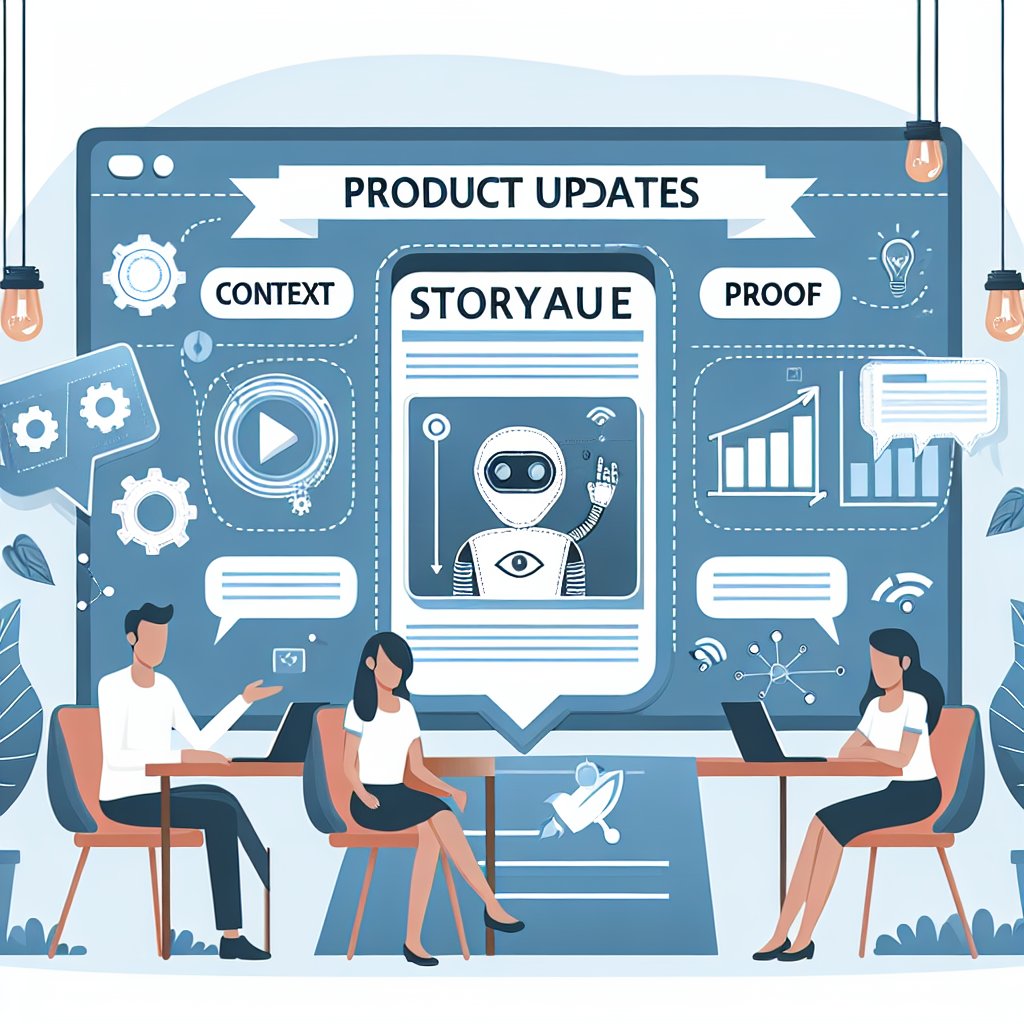


Product updates are not just what you shipped, they are what users now expect, fear, or misunderstand. This guide shows how to announce changes with clarity, connect improvements to real outcomes, and turn release communication into adoption, not confusion.
Most teams treat product updates like a list of facts: new feature, bug fix, improvement. Customers experience them differently. An update can interrupt a workflow, change a habit, or raise a question like “Do I need to retrain my team?” If your announcements only describe what changed, you leave users guessing why it changed and what to do next. That gap is where adoption drops and support tickets rise.
A strong update announcement is really a product change brief. It translates engineering work into customer meaning. It sets expectations, reduces uncertainty, and helps users take the next step. Below is a practical approach to announcing improvements and new features, including examples you can reuse and a structure you can run every release cycle.
When customers scan release notes, they are looking for answers to a different set of questions than product teams expect:
If your update post does not address these, users create their own story. Sometimes it is “This is risky, ignore it,” or “This looks complicated, I will stick to the old way.” Product updates succeed when you control the narrative with clarity and proof.
Use this structure as the backbone of every announcement. It works for big launches, small UI changes, and even behind-the-scenes improvements.
Lead with the user result in plain language. Example: “Faster follow-up on new leads across WhatsApp and Instagram,” is more compelling than “Improved routing logic.” Outcomes are memorable and set context for everything that follows.
People trust updates when they understand why you made the change. Keep it concrete: support patterns, customer requests, performance constraints, or compliance needs. Avoid vague phrases like “to enhance experience.” Instead, be specific: “Teams told us they were missing messages during peak hours because replies were spread across multiple inboxes.”
Give a short list of changes that a user can verify. Separate user-facing behavior from internal changes. If something moved, say where it moved to. If a setting changed defaults, say what the old default was and what it is now.
Always include an action step. It can be as small as “Try it from Settings,” or as big as “Update your workflow.” If there is no action required, say so explicitly. “No action required” reduces anxiety and prevents unnecessary support requests.
Segment the relevance by role or use case. A sales manager wants pipeline impact. A support lead wants response time and SLA impact. An operator wants fewer manual steps. This can be a short bullet list.
If an update changes behavior, include safety information: what to watch for, how to revert a setting, or how to get help. This is especially important for automation features that can affect customer communication.
Below are three example “briefs” that show how to communicate announcements, improvements, and new features. They are intentionally written in a way that makes the “why” and “what to do” obvious.
Outcome: “Capture and respond to leads automatically, even outside business hours.”
Why: “Many teams lose high-intent inquiries at night or during busy periods, then follow up too late. We built this to keep response time consistent and to prevent leads from going cold.”
What changed: “You can now enable an auto-response flow that asks qualifying questions, routes the conversation, and creates a follow-up task.”
What to do: “Turn it on for one channel first, then expand. Start with your highest volume channel.”
Who it is for: “Sales teams, booking-based businesses, and support teams managing multiple messaging apps.”
If you run customer conversations across WhatsApp, Instagram, Telegram, Facebook Messenger, and web chat, platforms like Staffono.ai can make this kind of feature immediately usable. Staffono.ai’s AI employees can handle first response, qualification, and booking flows 24/7, so the announcement is not just a promise, it becomes an operational improvement users feel quickly.
Outcome: “Fewer missed messages and clearer ownership.”
Why: “We saw that teams were duplicating replies or leaving threads unanswered when multiple people handled the same inbox.”
What changed: “Threads now support explicit assignment and status, so each conversation has an owner and a visible state.”
What to do: “Set assignment rules for your top three categories of inquiries. Review the first week of assignments to make sure routing matches reality.”
Guardrails: “If you prefer manual assignment, you can keep rules off and assign per thread.”
In a real automation environment, assignment rules are most powerful when paired with AI-driven triage. With Staffono.ai, an AI employee can tag intent, detect urgency, and route conversations to the right team or complete the task automatically, which reduces the manual coordination that usually follows a workflow change.
Outcome: “More reliable message delivery during peak hours.”
Why: “Higher traffic volumes can expose delays in integrations, especially when multiple channels spike at once.”
What changed: “We improved queue handling and monitoring so message processing stays stable under load.”
What to do: “No action required. If you notice delivery delays, share timestamps with support so we can trace the event.”
Even when changes are infrastructure-related, customers appreciate transparency because it validates their experience and builds trust.
Before you publish, review your draft against this checklist:
Even a perfect announcement can fail if users cannot translate it into action. These tactics reduce friction and increase adoption.
Show the old process and the new process in a few lines. Example: “Before: copy lead details into a spreadsheet. After: AI captures details, creates a record, and schedules follow-up.” When users see steps removed, they are more likely to try the change.
Give users a way to validate the update safely. Example: “Test with 10 conversations, confirm tags and assignments, then enable for all traffic.” This is crucial for messaging automation where mistakes can be public.
If you ship a new automation capability, include a ready-to-use script or flow. Staffono.ai is a good model here: when teams deploy AI employees for lead qualification or bookings, they typically start from proven conversation templates and then customize tone and rules. Templates turn “new feature” into “new habit.”
Product updates should have a success definition. Pick a few measurable indicators based on the change type:
For messaging and sales automation, response time and follow-up consistency are often leading indicators. If you connect your update to outcomes like faster replies, higher booking rates, or fewer missed leads, you can validate quickly. Platforms like Staffono.ai make this measurable by centralizing conversations and automating routine steps, so you can compare performance before and after a change with less noise.
The next time you publish product updates, write them like a brief a busy operator can act on: outcome, reason, change, next step, guardrails. This approach reduces churn risk, lowers support volume, and increases the chance that the work you shipped becomes value users actually feel.
If your updates include new automation in customer communication, bookings, or sales follow-up, it helps to pair the announcement with an implementation path. Staffono.ai (https://staffono.ai) lets you deploy AI employees across WhatsApp, Instagram, Telegram, Facebook Messenger, and web chat, so teams can turn “what changed” into real operational improvement quickly, with measurable response-time and conversion gains.