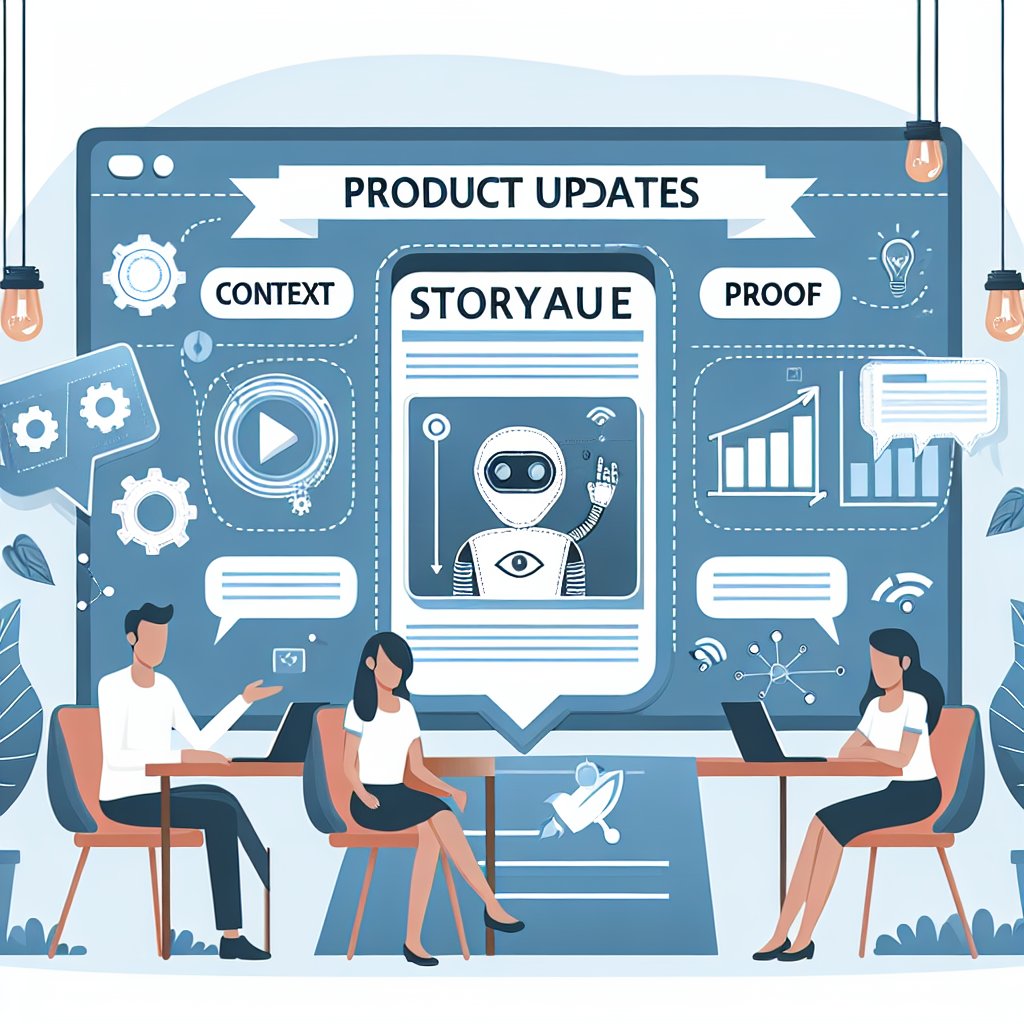


Most product updates fail not because the product is unclear, but because the reason for change is missing. This guide shows a practical framework for announcing announcements, improvements, and new features in a way that reduces support load, increases adoption, and builds trust.
Product updates are not just a record of what shipped. They are a negotiation of attention, trust, and habits. When users read an update, they are silently asking: What changed, why did you touch it, and will this make my day easier or harder?
Many teams publish release notes that list features, fix typos, and move on. The result is predictable: customers miss important changes, support teams repeat the same explanations, and adoption of the best improvements lags behind. The antidote is not more words, it is better structure. You need to communicate the rationale behind change in a way that matches how customers evaluate risk and value.
This article introduces a simple method you can reuse for every release. It helps you announce improvements and new features with clarity, connect changes to real customer outcomes, and explain the why without sounding defensive. Along the way, you will see how platforms like Staffono.ai can automate the distribution and follow-up of updates across WhatsApp, Instagram, Telegram, Facebook Messenger, and web chat so updates become adoption, not just content.
Customers do not experience a product as a roadmap. They experience it as routines: how they respond to leads, how they confirm bookings, how they resolve questions. Any change threatens routine. Even a positive improvement can trigger anxiety if the user cannot quickly answer three questions:
If your update only lists a feature name, users must do the mental work to map it to their world. Most will not. The goal is to do the mapping for them.
The framework below is designed to be reusable. It works whether you ship weekly or monthly, and whether the update is small or major.
Lead with the pain you are solving. This immediately signals relevance and reduces skepticism.
Example opening: “Many teams told us they were losing track of customer replies across multiple channels, especially during peak hours.”
Only after that do you name the change: “To solve this, we redesigned the conversation view and improved message routing.”
Write as if the reader is scanning on a phone. Avoid internal code names and avoid vague claims like “enhanced performance.” Replace them with observable outcomes:
Most “why” explanations fit into three categories. Pick the one that matches reality.
Keep it honest and brief. Users respect clarity more than hype.
Answer: “What should I do now?” This is where most updates fail. Even if the change is automatic, say so.
For sensitive changes, add a reassurance line: compatibility, migration, or rollback plan.
Examples: “Existing integrations continue to work.” “You can switch back for 30 days.” “We migrated historical conversations automatically.”
Below are practical patterns for the three most common update types. Use them as building blocks.
Announcements are about timing and confidence. They are not just marketing. A good announcement includes:
Example: “Starting next Tuesday, booking reminders will be sent from a verified sender ID. If you have custom opt-out text, review it in Settings before Monday.”
If your customers live in messaging apps, announcements should live there too. With Staffono.ai, teams can broadcast update summaries in WhatsApp or Instagram, then automatically handle follow-up questions with an AI employee that pulls answers from your release notes and knowledge base. That reduces the “What does this mean?” load on your human team.
Improvements are often invisible unless you name the benefit. Whenever possible, attach a measurable outcome:
If you cannot measure it, describe the scenario it fixes. “If you manage multiple locations, the calendar now defaults to your last selected location.”
New features need a job to do. Avoid feature tours that read like UI documentation. Instead:
Example workflow: “Capture an Instagram DM, qualify the lead with two questions, then auto-create a booking request for your team to confirm.”
This is also where automation can accelerate adoption. If you use Staffono.ai for customer communication and sales automation, you can package the new feature into a guided chat flow: the AI employee can ask whether the customer wants to enable it, collect the needed settings, and route any edge cases to a human.
Below is a simplified example you can copy and adapt.
User problem: “Teams told us they were missing hot leads because replies came in after hours or got buried among support conversations.”
What changed: “We added priority routing based on intent signals like pricing questions, availability, and booking keywords.”
Why: “This is user-driven and reliability-driven: customers asked for better visibility, and we wanted fewer missed opportunities.”
What to do: “Admins can enable Priority Routing in Settings - Inbox Rules and choose which keywords trigger alerts.”
Safety: “No existing rules are removed, and you can disable it anytime.”
Even the best update fails if it is posted in the wrong place. Most products have at least four audiences:
Create one core update, then produce “cuts” for each audience. A short in-app banner for operators, an email for admins, a one-paragraph executive digest, and a sales-friendly blurb.
For messaging-first businesses, omnichannel delivery matters. Staffono.ai can help you push the right version of an update through the channels your customers actually use, then automate the next step: confirming that a user understood the change, offering a quick setup, or creating a support ticket if they are stuck.
Product updates should have success criteria, not just publish dates. Track:
A practical tactic is to include a one-click “Was this clear?” prompt and a short reply option. If you communicate via chat, an AI employee can collect those responses at scale and tag them by theme for your product team.
When you consistently explain what changed and why, customers feel respected. They stop fearing updates and start looking forward to them. Your team benefits too: fewer repetitive tickets, faster rollout of improvements, and clearer feedback loops.
If you want product updates to travel further than a changelog page, connect them to the channels where customers already talk to you. With Staffono.ai, you can distribute update summaries across WhatsApp, Instagram, Telegram, Facebook Messenger, and web chat, and let AI employees answer questions, guide setup, and route edge cases to your team 24/7. That turns “we shipped it” into “customers use it,” which is the only product update metric that really matters.