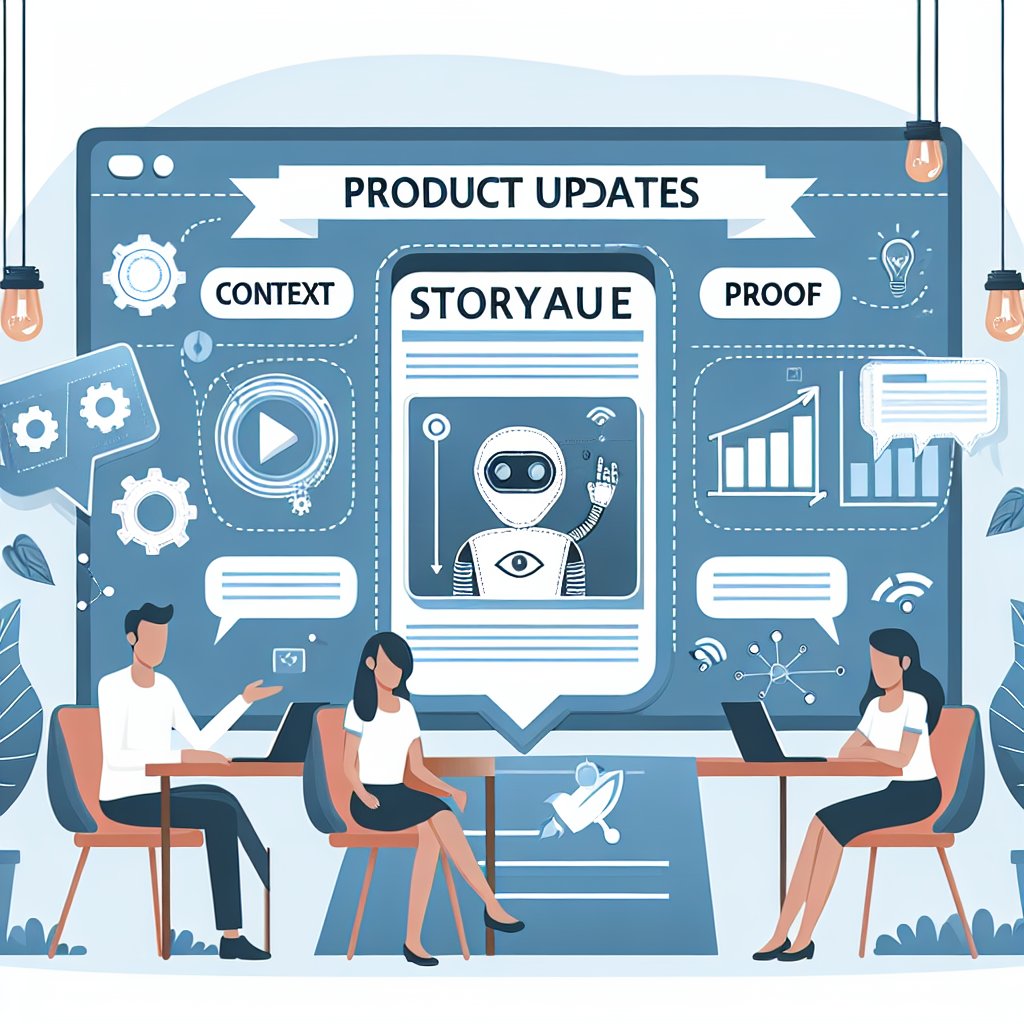


Most product updates fail not because the change is wrong, but because the reasoning is invisible. This guide shows how to turn announcements into a lightweight decision log that explains what changed, why it changed, and what users should do next.
Product updates are often written like a list of facts: new feature, improved flow, bug fix. The problem is that facts alone rarely change behavior. Users do not just want to know what shipped, they want to understand the logic behind it: what problem you saw, what trade-offs you chose, and what outcomes they can expect.
A useful way to think about updates is as a decision log. A decision log is not a long internal document. It is a short, user-facing explanation that makes your choices legible. When you do this consistently, updates stop feeling like interruptions and start feeling like progress users can trust.
When an update lands, users quickly ask three questions, even if they never type them out:
If your announcement only lists what changed, users fill the gaps with assumptions. Sometimes those assumptions are generous. Often they are not. A decision-log approach reduces uncertainty by making the “why” visible.
You can communicate most changes with a consistent structure. It works for big launches and small improvements, and it keeps teams from over-writing.
Open with the real-world trigger. Not the internal roadmap item, but the situation users recognized.
This signals that the update is anchored in observed problems, not random changes.
State the decision in one sentence. Keep it concrete and non-marketing.
This is the section most updates skip, and it is the section that builds trust. Explain the trade-off you chose.
Rationale does not require oversharing. One or two sentences are enough to show you made a deliberate choice.
Be explicit about the blast radius. Users appreciate clarity more than optimism.
Close with a small, clear action, or state that no action is required.
An announcement is often about timing, availability, or policy, not just functionality. The decision-log approach helps you prevent speculation.
Example: You are expanding support to another channel. Instead of saying “Now on Telegram,” explain the context and the operational reason: users asked for it, it reduces missed leads, and it creates a single place to manage conversations.
This is where platforms like Staffono.ai become relevant. If your audience manages multiple messaging channels, an announcement should address the operational reality: different channels create fragmented response processes. Staffono.ai’s multi-channel AI employees (WhatsApp, Instagram, Telegram, Facebook Messenger, and web chat) are a practical example of a product direction that is easy to justify with user outcomes: fewer missed inquiries, faster replies, and consistent answers 24/7.
Improvements are rarely exciting on their own, but they are powerful when you connect them to time saved, errors reduced, or friction removed.
Example improvement write-up:
This format turns a small UI tweak into a measurable story.
New features are tempting to describe with every capability. Users do not think in capabilities. They think in jobs: book appointments, answer FAQs, qualify leads, route requests, and close deals.
Example: If you launch automated booking confirmations, do not lead with “supports templates and variables.” Lead with the job: “Reduce no-shows by confirming details automatically, with a human fallback when needed.”
Staffono.ai is a helpful reference point here because it frames features around outcomes. A 24/7 AI employee is not just “AI chat,” it is a way to keep lead response time low across channels, qualify inquiries consistently, and book appointments without waiting for staff availability. When you write updates, borrow that outcome-first language.
Context: “We saw a spike in inquiries arriving between 7 pm and 9 am, with slower first responses.”
Decision: “We added an after-hours reply mode that captures intent and offers the next available booking slot.”
Rationale: “We chose speed and clarity over long explanations, because late-night users want an immediate path forward.”
Impact: “All accounts with bookings enabled. Customers receive a confirmation message and options.”
Action: “Set your business hours and confirm your booking link or calendar integration.”
How to make it actionable: include one screenshot or a 20-second walkthrough. Then add a metric you will monitor, such as “first response time” and “bookings per 100 conversations.”
Context: “Support agents answered the same pricing and availability questions repeatedly.”
Decision: “We introduced saved answers with context-based suggestions.”
Rationale: “We optimized for consistency and speed, even if it reduces personalization in the first reply.”
Impact: “Support and sales teams. End users will see faster, more consistent answers.”
Action: “Create three saved answers for your top questions and tag them by intent.”
For businesses running high volumes across WhatsApp and Instagram, tools like Staffono.ai can take this further by letting AI employees answer common questions automatically and escalate edge cases. In your update, that “escalation rule” is the decision that users care about: when does automation stop and a human take over?
Not all rationales are equally credible. The strongest “why” is grounded in observable evidence. Use one of these sources:
Avoid vague rationales like “to improve the experience.” Replace them with something measurable: “to reduce time-to-first-reply,” “to increase booking completion,” or “to prevent duplicate conversations.”
If you can check these off, your update will read like a decision log, not a changelog dump.
The publication is not the finish line. Adoption comes from follow-through:
If your business relies on messaging for sales and bookings, message-based nudges can be the highest leverage. Staffono.ai’s automation approach is a good model: meet users where conversations already happen (WhatsApp, Instagram, web chat), and guide them to the next step with minimal friction.
Pick one update per month and write it using the decision-log format. Keep it short, ship it, and measure confusion. Over time you will build a library of clear reasoning that new customers can trust and existing customers can follow.
If you want product changes to translate into faster responses, better lead capture, and smoother bookings, connect your updates to the operational layer. Platforms like Staffono.ai help teams operationalize change by automating customer communication across channels with 24/7 AI employees, so improvements are not just announced, they are felt in everyday workflows. When you are ready, explore how Staffono can support your next rollout by reducing response delays, standardizing answers, and turning more conversations into booked appointments.