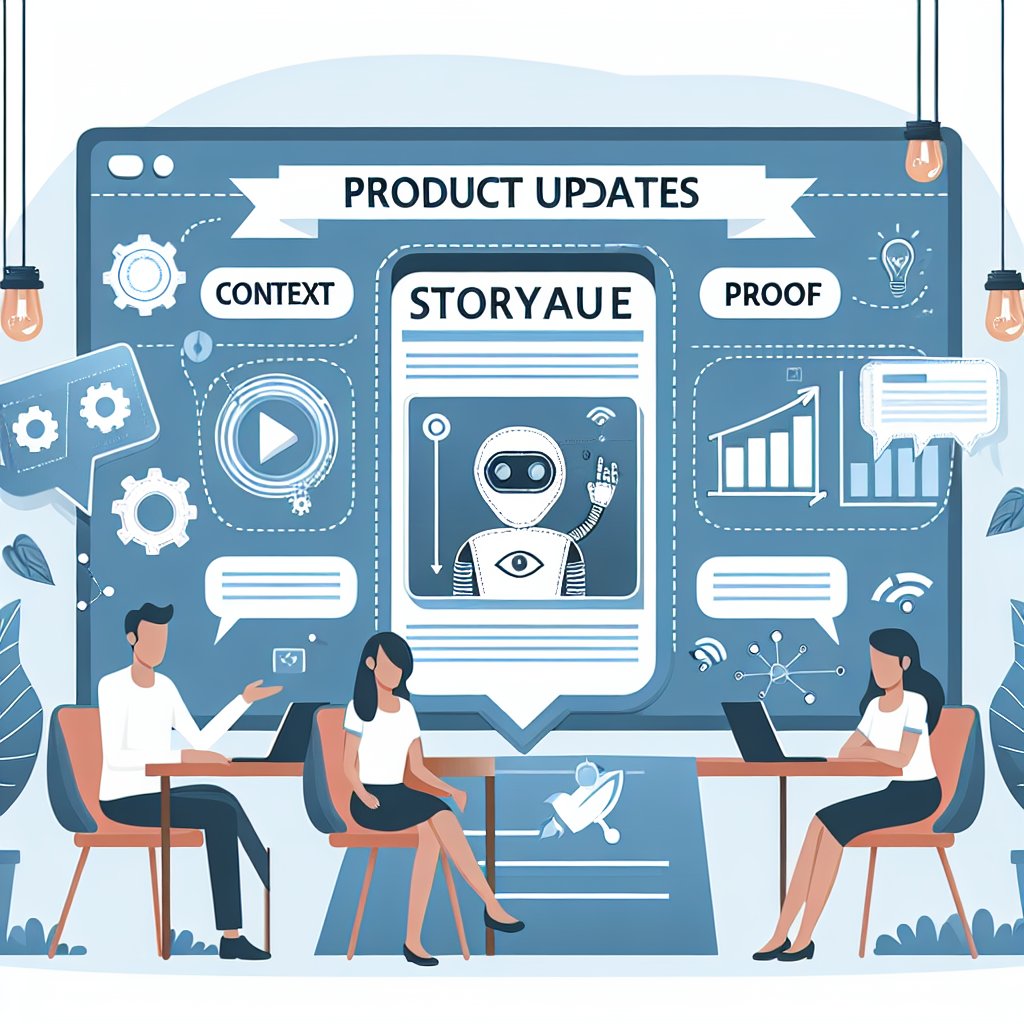


Product updates are not just a list of changes, they are a promise to customers that your product will keep getting better without disrupting their work. This guide explains how to announce announcements, improvements, and new features in a way that builds confidence, reduces confusion, and drives adoption.
Most teams treat product updates like a technical artifact: ship code, post release notes, move on. Customers experience updates differently. To them, every change is a promise that the product will be more useful tomorrow than it was yesterday, and that the vendor will not break the workflows they rely on today. That is why the best product update communication is not “what we shipped,” but “what you can now do, why it matters, and how to transition safely.”
This matters even more in messaging-first businesses. If your product touches customer conversations, bookings, or lead capture, a small UI tweak or routing rule can change outcomes immediately. Platforms like Staffono.ai (https://staffono.ai) live in that world: automations run across WhatsApp, Instagram, Telegram, Facebook Messenger, and web chat, and updates can influence how fast leads are answered, how appointments are booked, and how revenue is captured. The goal is to update quickly without making customers feel like the ground moved under their feet.
A professional update should answer three questions, in this order:
This framing prevents the most common failure mode: a technically accurate update that still creates anxiety. Customers do not fear change itself, they fear surprise. Your job is to eliminate surprise by translating the change into predictable outcomes.
When you announce “new feature,” “improvement,” and “fix,” customers often cannot tell what is safe to ignore and what requires attention. A better approach is to package changes by intent. Here are five intent buckets that customers understand immediately:
Even if you keep a standard changelog, leading with intent makes the update readable by decision-makers, operators, and support teams alike.
Many updates are technically non-breaking but still behavior-changing. Treat “what changed” as a mini migration guide:
Example: “Previously, inbound Instagram DMs were assigned to the first available agent. Now, they are routed by language when a language is detected. If you use multilingual support, verify your language tags are set for each team member.”
This reduces support tickets because customers can self-check instead of guessing.
“We’re always improving” is not a reason. A credible “why” typically comes from one of these sources:
Evidence makes customers feel included in a learning loop rather than subjected to random changes.
A new feature announcement often fails because it does not tell customers how to start. Add a short “first run” path that takes 5 to 10 minutes. It should include:
Example for messaging automation: “Try the new lead qualification flow on your website chat first. Success is when a visitor is tagged as ‘Qualified’ and a meeting is offered within 60 seconds. Pitfall: If your business hours are not set, the system may offer times outside your schedule.”
If you are using Staffono.ai, this approach maps naturally to deploying an AI employee on one channel first, validating the conversation outcomes, then expanding to WhatsApp and Instagram once the workflow is proven. Customers appreciate a controlled rollout instead of a big-bang switch.
When you introduce a new capability, ship a sane default. Then offer customization for advanced teams. Customers want to benefit immediately, not configure endlessly.
If something must be removed, announce it early, repeat it, and provide an alternative. Include dates, not vague “soon” language. Provide a quick export or migration tool if data is involved.
Feature toggles, legacy modes, or opt-in settings can preserve momentum. If you cannot keep old behavior, then give customers a simulator, preview, or sandbox to practice.
What changed: You can now automatically detect lead intent in WhatsApp and route the conversation to sales or support.
Why: Many teams told us high-intent leads were waiting in the same queue as general questions, lowering close rates.
What to do: Enable intent routing for one inbox, map intents to your teams, and review the first 20 conversations to confirm the routing matches your expectations.
What changed: Booking links now show only available time slots, based on your real calendar availability.
Why: Customers reported fewer no-shows when they could choose confirmed times, not tentative ones.
What to do: Connect your calendar and run a test booking from Instagram DMs.
What changed: We fixed duplicate message notifications when multiple agents opened the same chat.
Why: This caused confusion and occasionally double replies.
What to do: No action required, but you can confirm by opening a shared chat from two devices.
Product updates should not live only on a blog. Use multiple layers:
This is where Staffono.ai can play a practical role beyond automation. Many businesses use Staffono.ai to handle customer communication 24/7. The same AI employee concept can be extended internally: an always-available assistant in web chat or Telegram that explains new features, points to setup steps, and reduces the burden on your support team right after a release.
Shipping is not success. Communication is successful when customer behavior changes in the intended direction. Track metrics like:
For messaging automation updates, one of the clearest indicators is response time and conversion. If a change improves routing or qualification, you should see faster first replies and a higher percentage of chats that reach a booked meeting or a qualified lead. Staffono.ai users often monitor these outcomes per channel, because WhatsApp and Instagram audiences behave differently and can reveal where an update truly helps.
A simple fix is to end every update with “How to confirm everything is working,” including one to three checks that take less than five minutes.
A product update is a customer promise. When you communicate changes with outcomes, evidence, and a safe path to adoption, you turn releases into trust-building moments. Customers feel supported, your support team stays sane, and adoption becomes a predictable process instead of a hope.
If your business depends on customer messaging, bookings, and lead generation across multiple channels, consider using Staffono.ai (https://staffono.ai) not only to automate conversations, but also to keep customers informed during change. An AI employee that can explain new flows, guide setup, and respond instantly to questions can turn the stressful post-release window into a smooth, confidence-building experience. Explore Staffono.ai to see how always-on automation can help your team ship improvements while keeping customer trust intact.