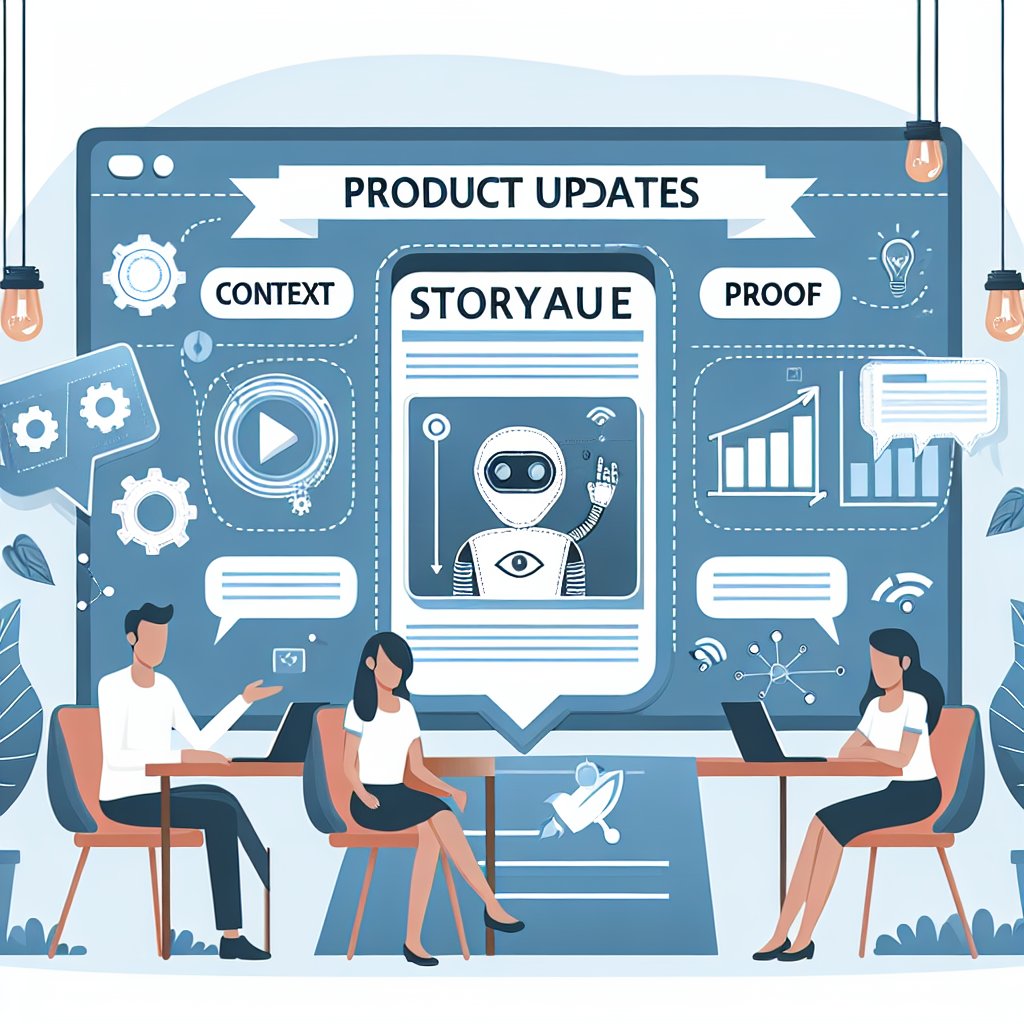


Most teams treat product updates like a broadcast, then move on. The higher-leverage approach is to treat every announcement as a feedback loop that starts with real user friction and ends with measurable adoption, retention, and revenue impact.
Product updates are often written as if the goal is simply to inform: “We shipped X.” But customers do not buy information. They buy outcomes: faster work, fewer errors, higher conversion, better service, lower cost. The most effective product update programs are designed like feedback loops, not press releases. They explain what changed and why, but they also connect the change to a job the customer is trying to get done, validate whether the change worked, and feed new learnings back into the roadmap.
This matters even more in automation and AI products, where a small tweak to routing, prompt logic, or integrations can change day-to-day operations. If you run customer communication across WhatsApp, Instagram, Telegram, Facebook Messenger, and web chat, a release note is not “just content.” It is operational guidance. Platforms like Staffono.ai sit directly in the message stream, so updates can materially improve response time, lead qualification quality, and booking completion rates. That makes it essential to communicate changes with context and measurement in mind.
A strong product update begins before anything ships. It starts with a hypothesis about customer friction and a clear definition of success. Then it moves through implementation, announcement, adoption support, and measurement. The update itself is one step in that loop.
When customers read an announcement built on this structure, they feel two things: confidence that you understand their reality, and clarity about what to do next.
Customers rarely wake up hoping for “new filters” or “performance improvements.” They wake up trying to answer leads faster, stop missing appointments, or reduce the back-and-forth in DMs. So the top half of your update should map the change to a job-to-be-done.
Example: if you improved an AI assistant’s ability to recognize intent across multiple languages, don’t lead with “Enhanced intent classification.” Lead with “Fewer missed leads when customers message in mixed languages or shorthand.” For businesses using Staffono.ai to handle inbound conversations 24/7, that difference is not cosmetic. It affects how many conversations become booked appointments or qualified opportunities.
The hidden cost of product updates is uncertainty. Customers worry about broken workflows, retraining staff, and the time it takes to re-learn a tool. Your announcement should answer the questions they are afraid to ask.
If you ship improvements to automation logic, be explicit about defaults. For example, “New conversations will follow the updated routing rules, existing conversations will continue with the previous flow.” Customers running messaging operations through Staffono.ai care deeply about continuity, because a single misrouted conversation can mean a lost lead or a frustrated customer.
Many updates are “quality improvements” that engineering teams love but customers barely notice. That is a communication challenge and a measurement challenge. If something is hard to perceive, you must translate it into a visible outcome.
In AI messaging automation, a common invisible improvement is better disambiguation: distinguishing “I want to reschedule” from “I want to cancel.” Customers feel this as fewer wrong replies and fewer escalations. If you are using Staffono.ai to automate bookings and customer communication, include a simple checklist for validating the improvement in the first week, such as reviewing 20 conversation logs and counting how many required human correction.
Shipping a feature is not the hard part. Getting it used is. The fastest way to adoption is to design your update content around a “first value” path: what a customer can do immediately that proves the feature is worth their attention.
For example, if you introduce a new lead qualification flow, your update can include a sample script: “Ask budget range, timeline, and preferred channel for follow-up.” If the customer uses Staffono.ai, they can deploy that flow across WhatsApp, Instagram, and web chat without building separate processes for each channel, which reduces setup friction and speeds up time to value.
Generic announcements feel like marketing. Real examples feel like guidance. Include at least one scenario that mirrors the customer’s day.
A clinic receives messages across Instagram and WhatsApp: “Do you have availability tomorrow?” The old flow asked too many questions before offering times, causing drop-off. The new update changes the order: propose available slots first, then collect details. The “why” is that customers want immediate confirmation before they invest in a longer conversation.
Actionable insight: measure the percentage of conversations that reach “slot proposed” within the first three messages. If that number rises, you should also see improved booking completion. Staffono.ai users can monitor these conversation milestones and adjust the automation logic without losing 24/7 coverage.
To prove that a change mattered, you need a small set of metrics that connect to outcomes. Avoid vanity metrics like “announcement opens.” Track behavior and results.
Then close the loop by reporting back. A short follow-up message like “Here’s what we learned since the release” builds trust and teaches customers how to measure success themselves.
Customers are not the only audience. Sales, support, and success teams need release information in a format they can use. If you do not provide it, they will invent it, and consistency will suffer.
For automation products like Staffono.ai, support teams also benefit from “conversation examples” showing expected bot behavior after the update. That reduces time-to-resolution and prevents conflicting guidance across channels.
Finally, the feedback loop is incomplete without customer input. But long surveys rarely work. Use lightweight prompts tied to the new behavior.
If your product manages messaging, you can collect feedback in the same channels where value is delivered. Staffono.ai can help operationalize this by automating follow-ups after key events (like a completed booking or a resolved support conversation), ensuring you gather insights without creating more manual work.
Product updates should not feel like interruptions. When structured as feedback loops, they become a compounding asset: clearer expectations, faster adoption, better outcomes, and better roadmap decisions. The most mature teams treat every release as a measurable experiment with a narrative that respects customer time.
If you want product updates that translate directly into faster responses, higher booking rates, and more qualified leads across WhatsApp, Instagram, Telegram, Facebook Messenger, and web chat, consider building your communication and automation workflows together. Staffono.ai helps teams deploy AI employees that handle conversations 24/7, while giving you the tools to measure what changed and why it matters in real operational terms. When your updates and your automation platform reinforce each other, every release can move the business forward.