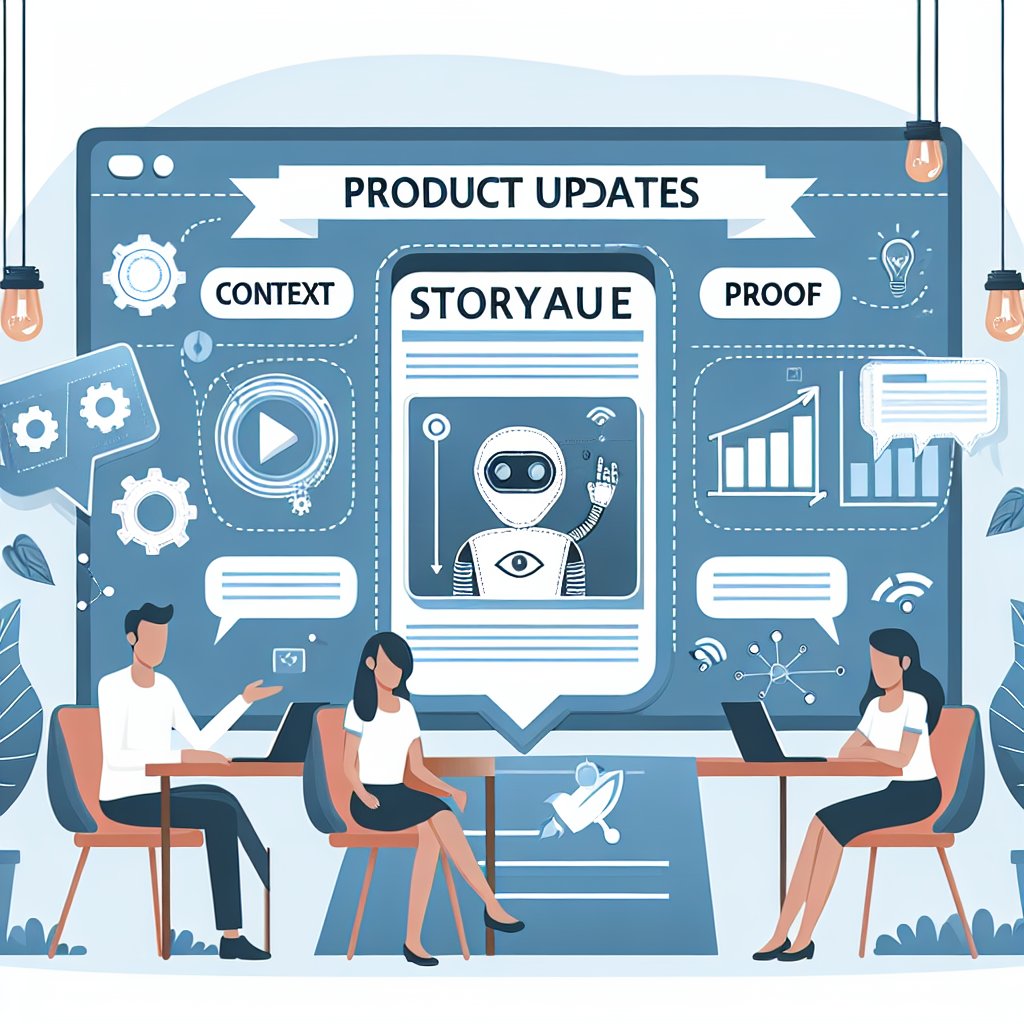

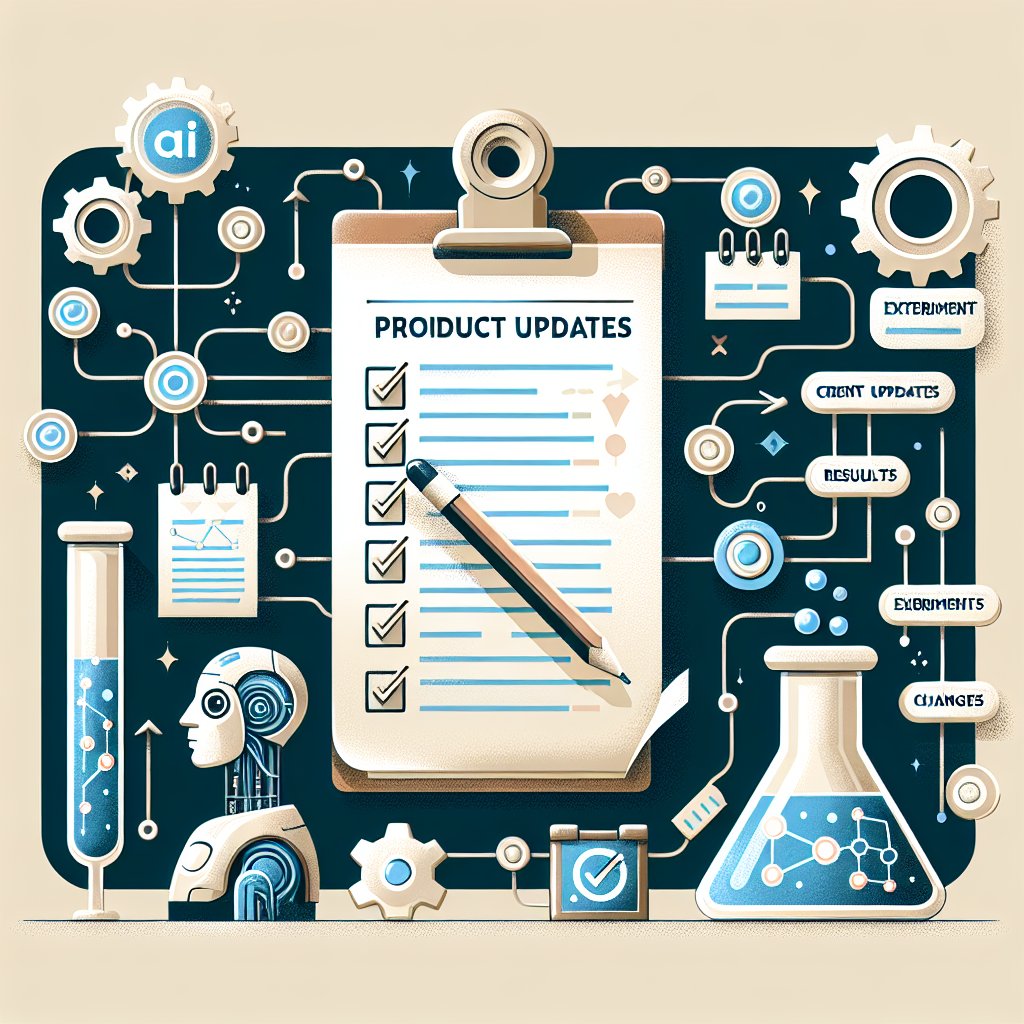
Most product updates tell users what shipped, but not what was discovered, avoided, or improved behind the scenes. This post shows how to frame announcements as a simple experiment log that explains what changed and why, reduces confusion, and increases adoption across channels.
Product updates are one of the few moments when every customer briefly looks up from their workflow and asks a simple question: “Does this help me?” The problem is that many announcements answer a different question: “What did the company build?” That mismatch creates noise, even when the changes are genuinely valuable.
A stronger approach is to treat every release as an experiment log written for customers. Not a scientific paper, not internal Jira notes, just a clear record of the hypothesis, the change, what you learned, and what happens next. When users can see the reason behind an improvement, they feel safer adopting it. When they can see what you measured, they trust the direction. And when they can see what’s coming, they plan instead of panic.
“What changed and why” is a solid starting point, but it often stops at intent. Customers also care about outcomes: what problem the change solved, what edge cases were considered, and what tradeoffs were made. If you only share intent, users fill in the blanks, usually with suspicion.
Think of the difference between these two messages:
The second one builds confidence because it includes the underlying learning: people were missing urgent messages, and you optimized for speed and clarity.
You can apply a lightweight structure to every announcement without making it long. Use these sections as a mental checklist and include only what’s relevant.
State the user-facing friction you observed, not the feature you wanted to build. Avoid vague claims like “improve usability.” Be specific: delays, errors, confusion, missed messages, drop-offs, duplicated work.
Example: “Teams managing WhatsApp and Instagram DMs were losing context when switching between channels, leading to repeated questions and slower resolutions.”
Describe the change in plain language, anchored to what users will notice. If it’s a behind-the-scenes improvement, say so explicitly and explain the visible impact.
Example: “We added unified conversation history across channels, so you can see prior messages from WhatsApp, Instagram, Telegram, and web chat in one thread.”
This is the missing ingredient in most product updates. Share one of the following:
Example: “In early access, teams resolved repeat inquiries faster because agents didn’t re-ask for order numbers. We also learned that some businesses need separate views per brand, which is coming next.”
Tell users what to do, who it affects, and when. This is where you prevent churn caused by surprise. Include migration steps, toggle locations, and the rollback path if relevant.
Example: “The new view is available in Settings. If you manage multiple brands, keep the legacy layout enabled until brand-level filters arrive next month.”
Product updates are also support management. Every unclear sentence turns into tickets, chat pings, and account manager calls. These tactics consistently reduce that burden.
Customers don’t think in feature taxonomy. They think in moments: “when I’m closing the month,” “when customers ask for delivery,” “when my team hands off shifts.” Open with that scenario.
Instead of: “New automation rules builder.”
Try: “When a customer asks ‘Is this in stock?’ you can now route that message to the right team automatically, without manual forwarding.”
Uncertainty is expensive. Add a short line: “This affects users who…” or “This is only for accounts that…”
For billing, permissions, and data handling, reassure users explicitly. One sentence can prevent escalation.
Below are examples you can adapt. Notice how each one includes problem, change, and learning, not just a list of features.
Problem: Customers messaging after hours expected quick answers, but teams could not staff 24/7.
Change: We expanded automated replies to cover order status, appointment availability, and FAQs across WhatsApp, Instagram, Telegram, Facebook Messenger, and web chat.
Learning: The biggest drop-off happened in the first 10 minutes. Fast acknowledgement increased the chance customers stayed in the conversation until a human followed up.
Next: We are adding smarter escalation rules so high-intent leads get prioritized automatically.
This is where a platform like Staffono.ai fits naturally: Staffono.ai provides 24/7 AI employees that handle customer communication and capture intent across channels, so the “after hours” gap stops being a revenue leak. When you announce improvements to message handling, connect them to the operational reality: fewer missed leads, faster bookings, fewer repetitive questions.
Problem: Customers abandoned booking when they had to re-enter details already shared in chat.
Change: The booking form now pre-fills from the conversation and confirms details in the same thread.
Learning: Users trusted the process more when they could see their own words reflected back (“You asked for Tuesday afternoon at the Downtown location”).
Next: We will add rescheduling via a single tap inside the chat.
If your business uses Staffono, this style of update pairs well with how Staffono.ai automation works: the AI employee can collect the necessary booking fields conversationally, confirm them, and then hand off cleanly to your calendar or CRM. Your update becomes a story about reducing friction, not adding a new form.
Even a perfect announcement fails if it never reaches the customer, arrives too late, or appears in the wrong place. Distribution is part of “why.”
Write one canonical update page (release note, help article, or changelog entry). Then produce channel-specific versions:
For messaging-led businesses, announcements inside the same channels customers use daily can outperform email. Staffono.ai can help here by delivering update messages contextually in WhatsApp or web chat, answering follow-up questions instantly, and routing complex concerns to a human. That turns a broadcast into a conversation, which is where adoption actually happens.
Don’t announce a change when users are least able to adapt. Match timing to usage patterns:
If you cannot tell whether the update worked, you cannot credibly explain “why” next time. Track a small set of adoption metrics:
Then reference one metric in the next release note to build trust: “We saw a 22% reduction in first-response time” or “Booking completion increased after pre-fill.”
Use this as a copy-ready framework:
When you treat product updates as an experiment log, you stop sounding like a company broadcasting news and start sounding like a partner improving a shared workflow. Customers do not need every detail, but they do need the reason, the impact, and the next step.
If your updates involve messaging, lead handling, bookings, or sales follow-up, it helps to pair the announcement with automation that makes the benefit immediate. Staffono.ai (https://staffono.ai) is built for exactly that: 24/7 AI employees that can answer customers across WhatsApp, Instagram, Telegram, Facebook Messenger, and web chat, qualify leads, book appointments, and reduce repetitive workload. When the next improvement ships, you can communicate it where customers already talk to you, and let Staffono handle the questions that inevitably follow so adoption feels effortless.