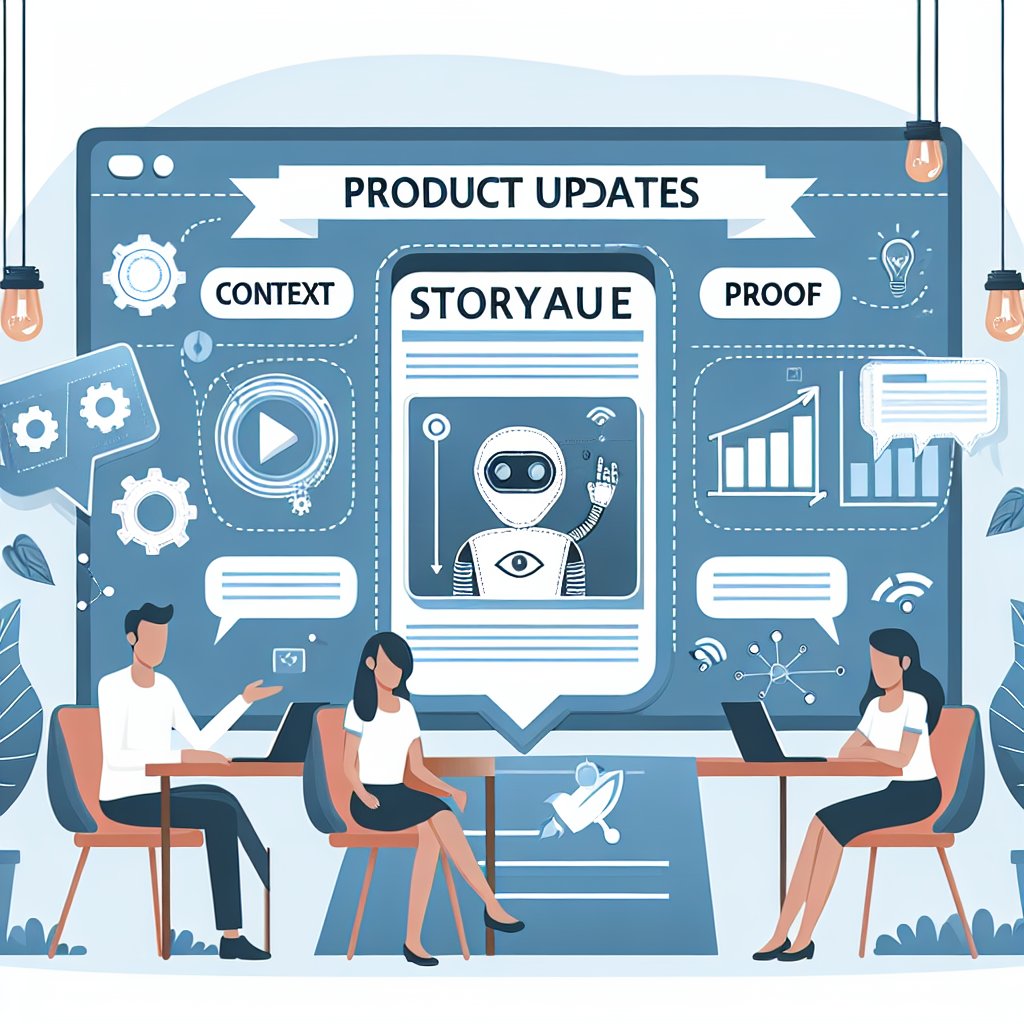


Most product announcements tell users what changed, but fail to move behavior. This post shows how to write product updates as briefings that connect improvements and new features to real outcomes, reduce confusion, and create measurable adoption.
Product updates are rarely the problem. The way they are communicated is. Teams ship improvements, announce them, and then wonder why customers do not notice, do not adopt, or open a support ticket because something “moved.” The gap is not effort, it is translation: turning change into clarity, confidence, and a next step.
A strong update does three jobs at once. It explains what changed, why it changed, and what the user should do now. When those three elements are missing or buried, updates become noise. When they are structured like a briefing, they become a lever for retention, expansion, and trust.
This article gives you a practical framework for announcements, improvements, and new features, including examples you can reuse and a workflow that scales. You will also see how tools like Staffono.ai (https://staffono.ai) can help you deliver updates across messaging channels and turn “new” into “used.”
Teams typically publish release notes because it feels responsible, not because it is tied to a behavioral goal. That leads to predictable failure modes:
In other words, announcements often ship information, not adoption.
Think of every update as a briefing your customer can skim in 20 seconds or explore in 2 minutes. A briefing has a predictable structure that respects attention and reduces cognitive load. Here is the core template:
This format works because it answers the questions users are already asking in their head: “Is this about me? Is it safe? Is it worth my time?”
Not all updates are equal. Users process improvements differently than brand-new capabilities. Write them differently.
Improvements are about speed, reliability, accuracy, and fewer steps. The best announcement highlights the before and after without sounding defensive.
Example improvement briefing:
Note that the improvement is expressed as time saved, not as “we refactored indexing.”
A new feature should be positioned as a completed job, not a new menu. Users adopt when they see a clear “this helps me do my work” moment.
Example new feature briefing:
If you use Staffono.ai to automate customer communication and bookings across WhatsApp, Instagram, Telegram, Facebook Messenger, and web chat, this kind of briefing can be delivered inside the conversation itself, right where the user is already active. That is often more effective than hoping they read a changelog later.
Many updates fail because they feel risky to customers. Change can imply new work, new training, or new chances to make mistakes. Your job is to reduce perceived risk while still being transparent.
Messaging-based support is especially powerful here. If your customers are already engaging through chat, an AI employee can answer “Does this affect my account?” instantly. Staffono.ai is built for that kind of always-on, multi-channel conversation handling, which means your update announcement can include a “Reply with ‘help’ to learn how this applies to you” option that scales without burdening your team.
One of the biggest mistakes is treating distribution as a single step: “Send email.” Instead, use a channel mix based on what you changed.
For businesses that run customer journeys through messaging, announcements inside WhatsApp or Instagram can outperform email. With Staffono.ai, you can automate those notifications, segment them by intent (for example, users who asked about pricing, or users who recently booked), and keep the tone consistent with your brand voice.
Below are three “what changed and why” scenarios with concrete next steps. Adapt them to your product.
What changed: You updated the booking flow so customers select a service before choosing a time slot.
Why: It prevents double-booking and ensures the right duration is reserved.
Action: Provide a 20-second walkthrough: “Pick service, pick staff member, pick time.”
Automation idea: If you use Staffono.ai for bookings, your AI employee can proactively guide users through the new step in chat, reducing drop-offs and avoiding “I cannot find times” messages.
What changed: New plan limits or bundled features.
Why: You aligned pricing with usage patterns and added capacity where customers needed it most.
Action: Provide a simple “Which plan fits me?” decision tree.
Automation idea: Route plan questions to an AI employee that asks 2-3 questions and recommends the right option, then books a call only when needed.
What changed: Faster message delivery, fewer failed webhooks, improved uptime.
Why: These are trust features. The benefit is fewer missed leads and smoother operations.
Action: Share measurable impact: “Average response time improved by 35%.”
Automation idea: Use the announcement to invite users to enable notifications or dashboards so they can see the reliability gains.
Adoption is observable. Tie each update to a metric before you publish. Good default metrics include:
Also measure comprehension. A simple method: after the announcement, ask one question. “Was this clear?” with quick replies. If you run communications via messaging, Staffono.ai can collect those responses automatically, tag them, and surface patterns so you know what to clarify in the next iteration.
You do not need a huge process. You need consistency.
This is where automation helps. Instead of manually sending segmented messages and replying to repetitive questions, Staffono.ai can deliver announcements across multiple channels, answer common “how do I use this?” questions instantly, and hand off to a human when the conversation becomes complex.
Customers do not want a stream of changes. They want progress they can understand. When your announcement makes the “why” obvious and the “next step” easy, you reduce hesitation and increase usage. Over time, that builds trust: users believe updates will help them, not surprise them.
If you want product updates to land where your customers actually pay attention, consider integrating them into your messaging journeys. Staffono.ai (https://staffono.ai) can act as an always-on AI employee that announces relevant changes to the right users, answers questions in WhatsApp, Instagram, Telegram, Facebook Messenger, and web chat, and guides people to the new workflow so improvements turn into measurable adoption.