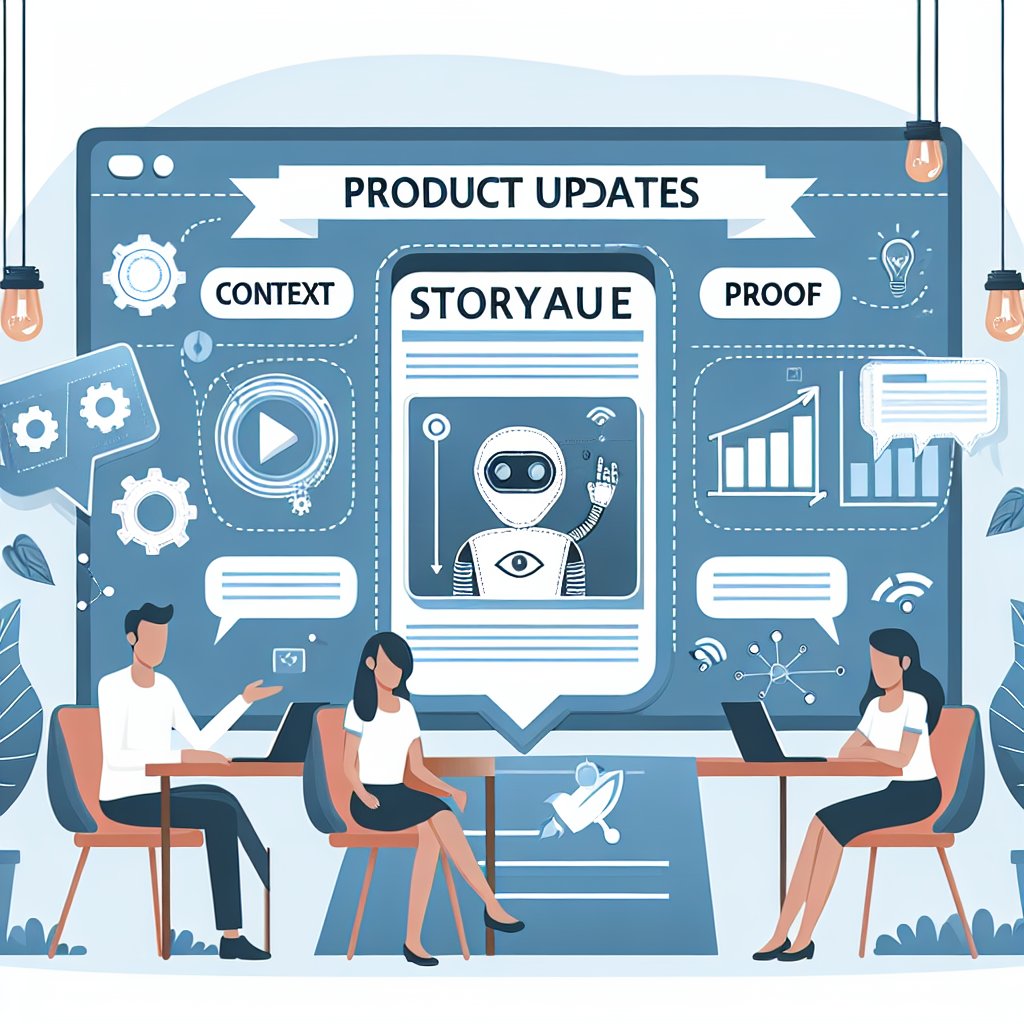


Product updates are not just what shipped, they are a promise about reliability, outcomes, and trust. This post shows a practical framework for announcing changes, explaining the “why,” and helping customers adopt improvements quickly without overwhelming them.
Most teams treat product updates like a list: fixed bugs, added features, improved performance. Customers often read it the same way: quickly, skeptically, and with one question in mind, “Does this affect me?” If your updates do not answer that question clearly, you miss the real opportunity: strengthening confidence, reducing support load, and accelerating adoption.
A strong product update is a small piece of customer success. It connects what changed to why it matters, what to do next, and what to expect. This is especially important in AI-powered automation, where users care about consistency and predictability as much as new capabilities. Platforms like Staffono.ai (https://staffono.ai), which runs 24/7 AI employees across WhatsApp, Instagram, Telegram, Facebook Messenger, and web chat, see firsthand how communication quality shapes adoption. When you explain updates well, customers use the product more, ask fewer repetitive questions, and expand into more workflows.
Updates fail when they are written for internal teams rather than end users. Engineering wants completeness. Marketing wants excitement. Support wants fewer tickets. Customers want clarity and control.
In practice, customers look for four answers:
If your announcement hits all four, you can keep it concise and still be trusted.
Use a repeatable template that works for major releases and small improvements. Here is a system you can adopt immediately.
Instead of “New routing rules,” lead with “Faster responses by sending high-intent leads to the right person instantly.” The outcome anchors attention, and the feature details become supportive rather than confusing.
The “why” should be specific. Avoid generic lines like “We’re always improving.” A better “why” connects to observed friction: slow handoffs, unclear statuses, duplicate conversations, or missed follow-ups.
Example: “Teams told us that leads were getting lost when multiple channels were active. This update reduces duplicate threads and makes ownership visible.”
Before/after is the fastest way to remove uncertainty. It also makes updates feel real, not abstract.
This style mirrors how automation platforms like Staffono.ai are deployed: a clear “before” (manual work) and “after” (automated outcomes), with measurable improvements.
Not every user needs the same instructions. Segment actions into:
This reduces anxiety and avoids unnecessary support tickets.
Announcements include pricing changes, policy updates, channel availability, or upcoming deprecations. They should be calm and precise. Provide dates, who is affected, and what to do.
Practical checklist:
If you run messaging automation, “blast radius” matters. A small change in message templates or routing can impact revenue. When Staffono.ai customers roll out new conversation flows, the best results come from clear timelines and a short testing window with measurable KPIs like response time, booking rate, and qualified lead rate.
Many improvements are under the hood: performance, stability, model tuning, reliability. Customers still want to know why it matters. Tie improvements to a metric.
You do not need to overshare technical details. You do need to prove the improvement is real and beneficial.
When you ship a feature, the biggest risk is “feature blindness.” Users see it, do not understand where it fits, and ignore it. Ship one primary workflow with steps.
Example first-use-case format:
Staffono.ai is built around this kind of practical deployment: AI employees that handle customer communication, bookings, and sales. When you announce a new capability, pair it with a ready-to-run flow so customers get value immediately.
Below are three examples that show how to explain changes without overwhelming readers. These are not tied to any single vendor, they are patterns you can reuse.
What changed: Conversations can now be routed based on intent and customer type (new lead, existing customer, VIP).
Why: Teams reported that urgent requests and high-intent leads were waiting in the same queue as low-priority questions, delaying revenue-impacting responses.
What to do: Recommended to create one rule for “pricing” and “book now” intents that routes to your sales flow or sales rep. No action needed if you prefer the current queue.
What changed: Booking confirmations now include a fallback step if the customer does not respond, plus clearer reschedule prompts.
Why: Missed confirmations were a top driver of no-shows and schedule gaps.
What to do: Review your confirmation message template and add a single-tap confirmation option where available.
What changed: Dashboards now separate “messages received,” “conversations started,” and “qualified leads” to avoid inflated counts.
Why: Teams were measuring success with the wrong number, which made optimization harder.
What to do: Update weekly reports to focus on qualified leads and booked meetings as primary KPIs.
Customers do not all read email, and not all log into your product daily. A reliable distribution plan uses multiple touchpoints:
This is also where automation becomes a growth lever. With Staffono.ai, you can use AI employees to answer “What changed?” questions 24/7 inside the channels customers already use, and guide them to the exact setting or workflow they need. Instead of dumping a long release note, you can let users ask in plain language and get a targeted explanation.
Do not measure success by opens or page views alone. Track adoption and support impact:
In messaging-led businesses, a practical metric is “time to first meaningful reply.” If an update improves routing or automation, you should see faster responses, more booked calls, or fewer abandoned conversations. Staffono.ai deployments often start with baseline metrics like response time and booking rate, then compare after a workflow change to validate ROI.
Before you publish any update, run this quick checklist:
If you want product updates to create confidence instead of confusion, make them interactive. Let customers ask questions where they already communicate, get guided to the right setting, and see the impact in metrics. Staffono.ai (https://staffono.ai) can help by placing AI employees in your messaging channels to explain changes, route requests, and even automate the updated workflows like lead qualification, booking, and follow-up, so every release turns into measurable adoption rather than a forgotten announcement.