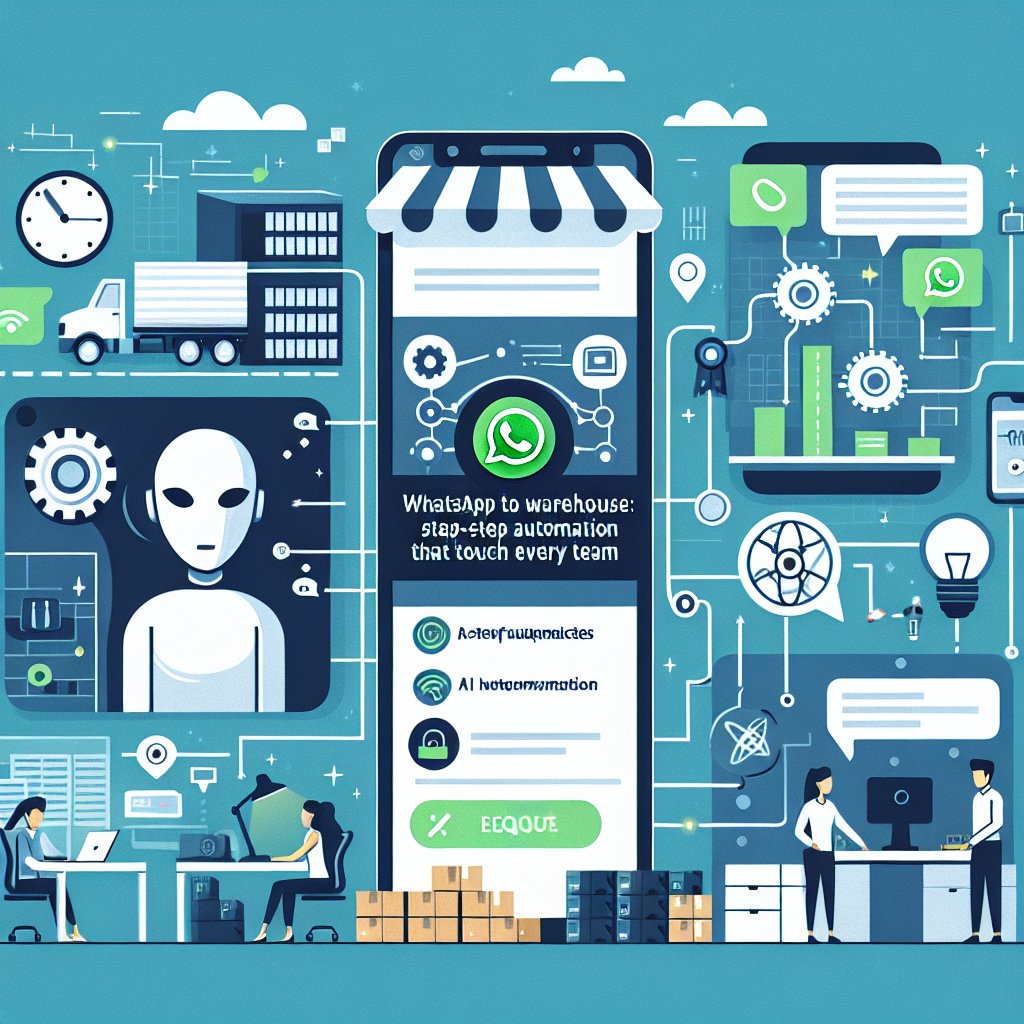
Most automation ideas fail because they stop at the chat. This guide shows real, cross-team use cases where a message triggers a complete workflow, from sales and support to ops and finance, with clear steps you can implement.
Many businesses start automation with a single goal: reply faster in messaging. That is useful, but it is only the surface. The real wins appear when a customer message does not just get an answer, it triggers a reliable chain of actions across teams: sales, operations, delivery, finance, and customer success.
This article focuses on practical use cases that connect messaging to the work behind the scenes. Each scenario includes a step-by-step workflow you can implement in a week, even if you are not rebuilding your tech stack. You will also see where an AI employee like Staffono.ai (https://staffono.ai) fits naturally: capturing intent, collecting the right data, routing tasks, and keeping customers updated 24/7 across WhatsApp, Instagram, Telegram, Facebook Messenger, and web chat.
Before you build: a simple pattern for cross-team workflows
Every use case below follows the same backbone. If you keep this structure consistent, you can add new automations faster without creating chaos.
- Trigger: a message, form submission, or keyword intent (for example, “need a quote” or “change delivery”).
- Data capture: the minimum fields required to act (name, order ID, address, preferred time, product SKU).
- Decision: rules that choose the next step (in-stock vs out-of-stock, within service area vs outside, VIP vs standard).
- Action: create records, notify humans, schedule, charge, or update systems (CRM, Google Sheets, calendar, helpdesk).
- Confirmation: customer gets a clear, specific status message and next step.
- Escalation: when confidence is low or exceptions happen, hand off with context.
Staffono.ai is useful here because it can run the trigger and data capture steps conversationally, then push structured data to your tools, and keep the customer informed while your team works.
Use case 1: Quote-to-invoice for service businesses (cleaning, repairs, clinics)
Scenario: A lead asks for pricing in WhatsApp. Your team replies, then someone manually builds a quote, follows up, and later creates an invoice. Leads go cold in the gaps.
Workflow you can implement
- Intent detection: Customer writes “How much for a deep clean?” Staffono recognizes “request quote.”
- Guided questions: Collect service type, address area, size/units, preferred date window, special notes, photos if relevant.
- Rule-based estimate: Pull pricing rules from a sheet (base price + add-ons + travel). If complexity is high, route to a human estimator.
- Quote delivery: Send a clear summary with optional add-ons and two booking options.
- Deposit or confirmation: If your policy requires a deposit, Staffono sends a payment link and confirms once paid.
- Auto-create job: Create a calendar booking, internal task, and CRM record with captured details.
- Invoice trigger: After job completion, send invoice automatically or prepare draft for approval.
What to measure
- Time from first message to quote sent
- Quote acceptance rate
- No-show rate (before and after deposits)
With Staffono.ai, the “pricing conversation” becomes structured intake. Instead of an agent typing paragraphs, your AI employee gathers the minimum data and outputs a quote-ready summary for the team.
Use case 2: Stock check and alternative recommendations for retail
Scenario: Customers ask “Do you have size M in black?” Your team checks inventory, replies late, and loses the sale or forgets to suggest alternatives.
Workflow you can implement
- Intent detection: “Availability” intent recognized across Instagram DMs or WhatsApp.
- Product identification: Ask for product link, name, or photo. Confirm variant needs (size, color).
- Inventory lookup: Check stock via integration or a synced sheet.
- Branch logic: If in stock, offer purchase link or reserve option. If out of stock, recommend closest alternatives and offer back-in-stock alert.
- Reservation flow: Collect name, phone, pickup location, and hold time. Create a reservation task for the store team.
- Status updates: Send “reserved,” “ready for pickup,” or “shipped” messages automatically.
What to measure
- Conversion rate from availability questions
- Revenue recovered via alternatives
- Time saved per store associate
This is where 24/7 matters. Staffono.ai can answer at night when customers are browsing, then hand off the reservation details to your staff in the morning without losing momentum.
Use case 3: Delivery reschedule and exception handling (the hidden cost center)
Scenario: “My package did not arrive” or “Can you deliver tomorrow instead?” These messages create internal ping-pong between support, dispatch, and drivers.
Workflow you can implement
- Intent detection: “Reschedule,” “late delivery,” “wrong address,” “missed call.”
- Order verification: Collect order ID and phone, or match by name and last 4 digits.
- Policy check: Confirm reschedule window, fees, and cutoff times.
- Dispatch action: Create a dispatch ticket with new time window and notes. If your system supports it, update delivery date directly.
- Customer confirmation: Send new ETA and what to expect (driver call, contactless option).
- Escalation rules: If repeated failures or high-value order, notify a supervisor with full conversation context.
What to measure
- Reduction in support tickets related to delivery changes
- First-contact resolution rate
- Repeat exception rate per route or driver
Because Staffono.ai works across channels, a customer who starts in Facebook Messenger and later sends an order ID in WhatsApp can still be handled consistently, with the same rules and status language.
Use case 4: B2B lead intake that routes to the right salesperson (not the loudest one)
Scenario: B2B inquiries arrive via website chat and WhatsApp. A rep grabs the lead, but it is not their territory or segment. The buyer experiences delays and repetition.
Workflow you can implement
- Qualification questions: Company name, industry, number of seats/locations, timeline, budget range if appropriate.
- Routing rules: Assign by country, language, segment size, or product line.
- Calendar options: Offer meeting times based on the assigned rep’s calendar.
- CRM creation: Create lead with source channel, transcript, and key fields.
- Pre-meeting pack: Automatically send a short deck, case study, or pricing overview based on segment.
- Follow-up automation: If no booking, send a helpful check-in and one question to move forward.
What to measure
- Speed to first qualified response
- Meeting booking rate
- Show rate
Staffono.ai can act as the front-line qualifier so your sales team gets fewer “what is your price?” chats and more ready-to-advance opportunities with clean context.
Use case 5: Customer onboarding that prevents churn in the first week
Scenario: Customers buy, then do not use the product correctly. Support gets repetitive questions, and churn appears before you can intervene.
Workflow you can implement
- Welcome trigger: Purchase or signup triggers a welcome message in the channel the customer used.
- Setup checklist: Staffono walks the customer through 3 to 5 steps, asking for confirmations (for example, “Have you connected your account?”).
- Micro-training: Send one short tip per day for the first week based on their plan.
- Health signals: If they are stuck (no confirmations, repeated confusion), create a success ticket or offer a quick call.
- Feedback loop: Ask one question: “What are you trying to achieve this month?” Save it to CRM for personalization.
What to measure
- Activation rate within 7 days
- Support tickets per new customer
- Churn or refund rate
Onboarding works best when it feels like a conversation, not a PDF. Staffono.ai can deliver that conversational guidance 24/7 and keep your team focused on edge cases.
Implementation checklist: build these workflows without breaking operations
To avoid partial automation that creates more work, use this checklist for each use case.
- Define the “done” outcome: What is the final result? A booked job, a paid invoice, a dispatched reschedule, a qualified meeting.
- Limit required fields: Ask only what is needed to proceed. Everything else is optional and can be collected later.
- Create templates: Use consistent confirmation messages, summaries, and internal handoff notes.
- Set exception paths: Low confidence, missing order ID, out-of-policy request, angry customer.
- Instrument metrics: Track time to resolution, conversion, and escalation volume.
- Run a 7-day pilot: Pick one channel and one team, then expand once the workflow is stable.
Common pitfalls and how to avoid them
Automating a broken process
If your pricing rules change daily or your inventory is not updated, automation will expose the inconsistency. Fix the data source first, even if it is just a shared sheet with clear ownership.
Collecting too much too early
Long intake forms inside chat feel like interrogation. Use progressive profiling: get the minimum to take action, then ask follow-up questions after momentum is secured.
No clear handoff
When humans need to step in, they should receive a structured summary: intent, key fields, and transcript. Staffono.ai can package this automatically so the agent does not re-ask everything.
Putting it into motion
If you want automations that actually touch every team, choose one workflow where messaging currently creates internal friction, then build it end-to-end with a clear definition of “done.” Start with the most common request type, because volume creates fast ROI.
Staffono.ai (https://staffono.ai) is designed for exactly these cross-team scenarios: an AI employee that can handle conversations across WhatsApp, Instagram, Telegram, Facebook Messenger, and web chat, collect structured data, and trigger the next operational steps while keeping the customer updated. If you want to turn your most frequent message types into reliable workflows this month, explore Staffono.ai and map your first use case from trigger to completion.
Stop losing customers
Your competitors reply in seconds. Do you?
Staffono.ai replies to every customer message on WhatsApp, Instagram, and Telegram instantly - 24/7. Automate support, bookings, and sales while you sleep.