
x
New members: get your first week of STAFFONO.AI "Starter" plan for free! Unlock discount now!
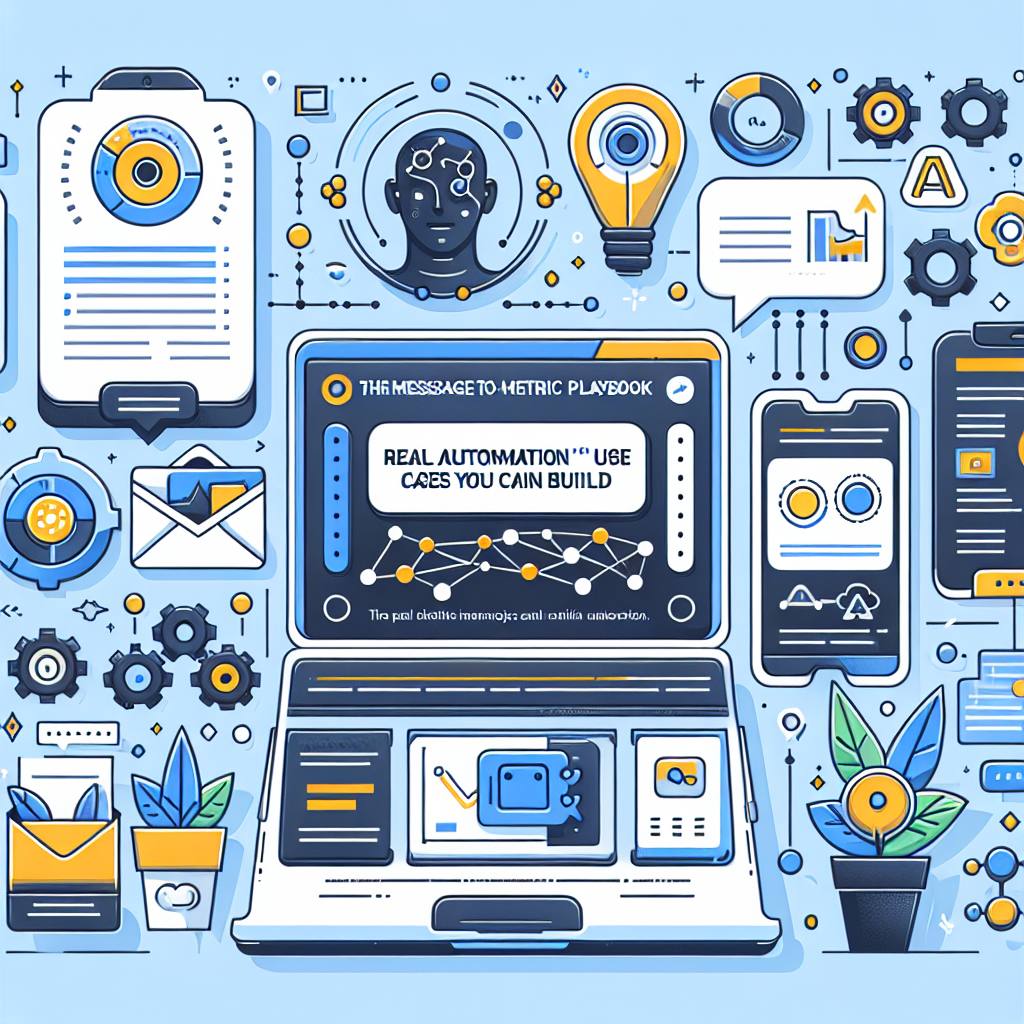
The Message-to-Metric Playbook: Real Automation Use Cases You Can Build Today

The Message-to-Metric Playbook: Real Automation Use Cases You Can Build Today

Most automation ideas die because they are framed as features, not measurable outcomes. This playbook turns everyday messages into step-by-step workflows you can implement quickly, then prove with metrics like response time, booked appointments, and revenue per conversation.

“We should automate more” is not a plan. Real automation starts when you can point to a repeated message pattern, map what the business must do next, and tie it to a metric that matters: booked meetings, qualified leads, fewer refunds, faster resolution, or higher conversion. This is the difference between building a chatbot and building an operating workflow that pays for itself.

Below are practical, real-world use cases built around the messages teams already receive on WhatsApp, Instagram, Telegram, Facebook Messenger, and web chat. Each one includes a step-by-step workflow you can implement with an AI employee, plus what to measure and where teams commonly get stuck. Platforms like Staffono.ai are designed for exactly this kind of work: 24/7 AI employees that handle conversations, bookings, and sales across channels, while integrating with your tools so outcomes are measurable and repeatable.

How to choose the right use case (so it ships)

Before you build anything, pick a workflow that matches three criteria:

  • High frequency: it happens daily or weekly, not quarterly.
  • Clear “next step”: a booking, a quote, a ticket, a payment link, or an escalation.
  • Observable success metric: something you can track from message to outcome.

If a use case fails any of these, it is usually better as documentation or training, not automation.

Use case 1: 24/7 appointment booking with pre-qualification

Scenario: A clinic, salon, gym, or professional service receives messages like “Do you have availability tomorrow?” and “How much is a consultation?” After-hours messages often go unanswered until morning, and many prospects vanish.

Step-by-step workflow

  • Trigger: New incoming message contains booking intent (availability, appointment, schedule, consult, “can I come in”).
  • Collect essentials: Service type, preferred date/time, location (if multiple branches), and whether the person is a new or returning customer.
  • Pre-qualify: Ask one or two key questions that reduce cancellations (for example, “Any preferences for specialist?” or “Is this for a first-time visit?”).
  • Offer slots: Pull available times from your calendar or booking system, then present 3 to 5 options.
  • Confirm and reserve: Create the booking, send confirmation, and include reschedule/cancel instructions.
  • Reduce no-shows: Automatically send reminders at set intervals, plus a short prep checklist.
  • Escalate edge cases: Complex requests or urgent health/safety messages go to a human immediately.

What to measure

  • Time-to-first-reply (especially after hours)
  • Booking conversion rate per channel
  • No-show rate (before vs after reminders)
  • Average messages per booking (lower is better)

Where Staffono.ai fits: Staffono.ai can run this flow across WhatsApp, Instagram, and web chat with consistent logic, so availability, confirmations, and reminders happen even when your team is offline. The key is not just replying faster, but consistently moving the conversation to a confirmed booking.

Use case 2: Quote-to-invoice pipeline for service businesses

Scenario: Home services, agencies, and B2B providers get “How much would it cost?” requests. The back-and-forth to gather details is slow, and leads go cold before receiving a quote.

Step-by-step workflow

  • Trigger: Price/quote intent detected.
  • Structured intake: Ask a short sequence to collect scope (dimensions, location, timeline, photos, preferred materials, budget range).
  • Auto-categorize: Map the request to a service template (basic, standard, premium) or route to a specialist queue.
  • Generate estimate: Provide a range with assumptions, plus optional add-ons.
  • Offer next step: Book an inspection, request a deposit, or send a formal proposal link.
  • Create CRM record: Log contact details, scope, and stage (new, quoted, negotiating).
  • Follow-up sequence: If no response, send a helpful follow-up with a deadline and a one-click booking option.

What to measure

  • Lead-to-quote time
  • Quote acceptance rate
  • Revenue per conversation
  • Drop-off point in the intake (which question causes churn)

Implementation tip: Keep the first response lightweight. Offer “quick estimate” vs “exact quote” paths so you do not force every lead into a long form.

Where Staffono.ai fits: With Staffono.ai, your AI employee can collect photos and details in chat, then push structured data into your CRM and notify sales when a lead meets your criteria. This turns messy conversations into consistent quote-ready records.

Use case 3: “Where is my order?” resolution without tickets piling up

Scenario: E-commerce and delivery businesses spend a huge share of support time on shipping status, address changes, and delivery windows.

Step-by-step workflow

  • Trigger: Order status intent (tracking, delivery, “has it shipped?”).
  • Authenticate lightly: Ask for order number or phone number, then verify.
  • Fetch status: Pull tracking events and translate them into plain language.
  • Handle common fixes: Address correction, delivery instructions, or reschedule if your carrier supports it.
  • Set expectations: Provide next update time and what happens if it is late.
  • Escalate exceptions: Lost package, damaged item, fraud indicators route to a human agent with full context.
  • Close loop: Confirm resolution and collect quick feedback.

What to measure

  • Self-serve resolution rate
  • Average handle time
  • Repeat contact rate within 7 days
  • CSAT after status updates

Common failure mode: Over-automation without exception paths. The workflow must recognize when “status” is actually a complaint or refund request.

Use case 4: Lead capture from social DMs that actually reaches sales

Scenario: Instagram and Facebook Messenger are full of high-intent messages: “How much?”, “Can you ship?”, “Do you have this in stock?” Many never become leads because details are not captured and the handoff to sales is inconsistent.

Step-by-step workflow

  • Trigger: New DM containing purchase intent.
  • Answer the first question: Provide product info, availability, price range, delivery time.
  • Collect lead fields: Name, city, preferred contact method, and what they want to buy.
  • Qualify: Use 2 to 3 questions that correlate with closing (quantity, timeframe, budget).
  • Offer action: Payment link, checkout link, or a booking for a demo.
  • Handoff: If qualified, notify sales with transcript and summary, and set SLA for follow-up.
  • Nurture: If not ready, add them to a low-frequency follow-up with helpful content.

What to measure

  • DM-to-lead rate
  • Qualified lead rate
  • Speed of handoff to sales
  • Close rate by channel

Where Staffono.ai fits: Staffono.ai is built for omnichannel messaging, so your AI employee can capture lead details consistently across Instagram, WhatsApp, and web chat, then route the right leads to the right person without losing context.

Use case 5: Refund and return triage that reduces churn

Scenario: Returns are expensive, but a slow or confusing process creates chargebacks and negative reviews. Many requests are simple: wrong size, late delivery, changed mind.

Step-by-step workflow

  • Trigger: Refund/return intent detected.
  • Policy guidance: Explain eligibility in plain language and confirm purchase details.
  • Collect evidence: Photos for damage, reason codes, preferred outcome (refund, replacement, store credit).
  • Offer retention options: Size exchange, discount on replacement, store credit bonus when appropriate.
  • Generate return label: Provide instructions and timeline.
  • Escalate risk: High-value items, repeated refunds, or fraud flags go to a human.
  • Post-resolution follow-up: Confirm receipt and ask for feedback.

What to measure

  • Refund cycle time
  • Percentage converted to exchange/store credit
  • Chargeback rate
  • Review sentiment after resolution

Implementation tip: Be transparent about timelines. Most frustration comes from uncertainty, not the return itself.

How to implement these workflows step by step (a practical build order)

Start with a message audit

Export a week of conversations and group them by intent: booking, quote, status, refund, product questions. Pick one cluster that is frequent and measurable.

Write the “happy path” and three exceptions

Define the shortest path to completion, then add exceptions like “no order number,” “angry customer,” and “complex custom request.” This prevents your automation from getting stuck.

Decide what the AI can do vs what it should hand off

A strong workflow is not fully automated, it is correctly automated. Hand off when the request is high risk, emotionally sensitive, or requires judgment beyond your policies.

Instrument your metrics

Make sure each workflow logs outcomes: booked, quoted, resolved, escalated, abandoned. Without this, you cannot improve it.

Putting it into motion

You do not need a massive automation program to see results. Choose one use case, implement it across your highest-volume channel, and watch the metric move. Then duplicate the same logic across channels and departments.

If you want a faster path from idea to live workflow, Staffono.ai helps you deploy AI employees that work 24/7 across WhatsApp, Instagram, Telegram, Facebook Messenger, and web chat, while keeping conversations measurable from first message to outcome. When you are ready, start with one workflow like booking or quote intake, then expand once you can prove the impact in response time, conversion rate, and operational load.


Category: