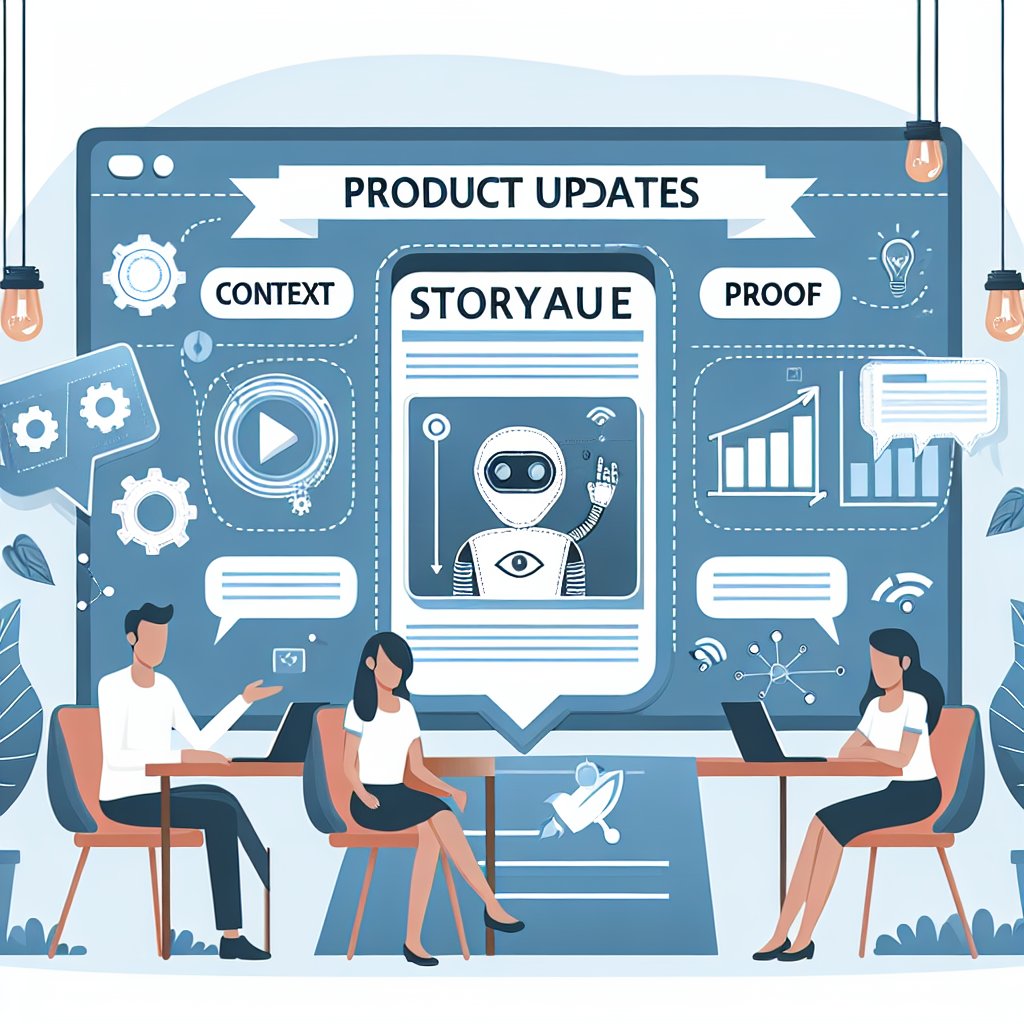


Product updates are not just a list of changes, they are a public explanation of how your product is evolving and what customers should do next. This guide shows how to announce improvements and new features with clarity, credibility, and measurable adoption.
Most product updates fail for a simple reason: they sound like internal notes. Customers do not experience your product as a roadmap, a backlog, or a set of tickets. They experience it as a routine that helps them do their job. When you ship changes, you are effectively stepping in front of a microphone and answering the same questions every customer is thinking: What changed, why did you do it, how does it affect me, and what should I do now?
Thinking of updates as a press conference changes the quality of your communication. A good spokesperson does not bury the lead, does not assume context, and does not hide tradeoffs. They connect the change to a real customer problem, show proof, and make next steps painless. Below is a practical way to structure announcements for improvements and new features, plus examples you can reuse and operational tips for shipping updates across messaging channels.
Customers are not looking for excitement. They are looking for certainty. In practice, that means your update must help them quickly decide one of three things: adopt now, adopt later, or ignore safely.
Strong updates consistently deliver:
If you cover these five elements, you will reduce confusion, increase adoption, and lower support load without making the update longer than it needs to be.
Use this structure for every announcement, whether it is a new feature, a performance improvement, or a behavioral change.
Start with what users can observe. Avoid internal terminology like “refactor,” “migration,” or “v2.”
Example: “You can now confirm appointments directly inside the chat without opening a separate page.”
Pick a scenario that is common and specific. This signals you understand actual workflows, not just features.
Example: “When a customer messages you on WhatsApp at 9:30 pm, your team often replies the next morning. By then, the customer has booked elsewhere. This update reduces that drop-off by letting the conversation complete the booking in the same thread.”
Impact can be time saved, fewer clicks, fewer mistakes, faster response, or better reporting. If you have numbers, use them. If you do not, use a measurable proxy.
Tell users exactly what they need to do. If the answer is “nothing,” say so explicitly. If there are options, give a recommended default.
If something might surprise users, name it. If there is a rollback plan, say it. If there are compatibility notes, include them.
Example: “If you use custom tags in exports, column names are unchanged. Only the order is updated to match the on-screen view.”
Not all updates deserve the same level of detail. The trick is to scale the message without losing clarity.
For new features, the “why” should focus on the job-to-be-done and the moment of use.
This is also where Staffono.ai fits naturally: if your customers are adopting automation features, connect the update to real multi-channel work. Staffono.ai helps businesses respond and sell across WhatsApp, Instagram, Telegram, Facebook Messenger, and web chat, so new routing, booking, and AI reply capabilities are easiest to understand when framed as “fewer handoffs, faster answers, more conversions.”
Improvements are often invisible but valuable. Translate them into outcomes, not engineering.
If you run a platform where speed affects lead capture, tie it to revenue. “Faster load means faster response, which means fewer lost prospects.” This is especially relevant for automation platforms like Staffono.ai, where the goal is to keep conversations moving even after hours.
This is where trust is won or lost. Be direct. Provide timelines and alternatives.
Even in a “press conference” style update, avoid drama. Customers do not want persuasion. They want a clean migration path.
Below are three mini-announcements written in a reusable format. Adapt the nouns to your product.
What changed: You can now propose three available time slots in one message and let customers choose with a single tap.
Why: In scheduling conversations, back-and-forth is the main source of drop-off. Customers often stop replying after the second clarification.
What it means: Fewer messages per booking, faster confirmation, and fewer manual checks.
What to do: Turn on “Multi-slot proposals” in Booking settings. If you use Staffono.ai, you can connect this to your AI employee so it offers slots automatically across WhatsApp and web chat, then confirms the chosen time without handing off to a human.
What changed: New lead forms can be triggered inside chat when a customer asks about pricing or availability.
Why: Many conversations end without contact details, which makes follow-up impossible and reporting inaccurate.
What it means: Cleaner CRM entries and more recoverable leads.
What to do: Choose the two fields you always need (for example, name and phone). In Staffono.ai, you can route completed forms to your sales pipeline and set an automatic follow-up cadence if the lead goes quiet.
What changed: Message delivery status is now shown for each channel and conversation.
Why: Teams were unsure whether a customer received a critical response, especially when switching between Messenger and WhatsApp.
What it means: Better visibility, fewer duplicate messages, and easier troubleshooting.
What to do: No action required. If you manage multiple channels in Staffono.ai, this status view becomes a quick operational dashboard for your team to spot stuck conversations.
Posting release notes on a website is not distribution, it is storage. Customers will not “check” your updates. You must bring the update to where work already happens.
This is one place automation pays off immediately. With Staffono.ai, businesses can deliver consistent update messages across WhatsApp, Instagram, Telegram, Facebook Messenger, and web chat, and answer follow-up questions instantly using an AI employee that is trained on the announcement and the relevant help articles.
A press conference is judged by what the public does next, not by how polished it sounded. Attach your update to a small set of observable metrics:
If adoption is low, do not assume the feature is bad. Often the announcement did not provide a clear action, or the “why” did not match how customers think about their work.
The announcement is not the end. It is the first message in a thread. Plan for questions, edge cases, and “how do I use this for my situation?” moments. The fastest way to protect adoption is to answer those questions where they occur.
If your business runs on messaging, this is exactly where Staffono.ai can help. You can publish the update once, then let an AI employee handle the repetitive follow-ups 24/7 across channels, direct users to the right settings, and hand off complex cases to a human with full context. If you want your next update to be understood and used, not just read, explore Staffono.ai at https://staffono.ai and build an update flow that turns announcements into action.