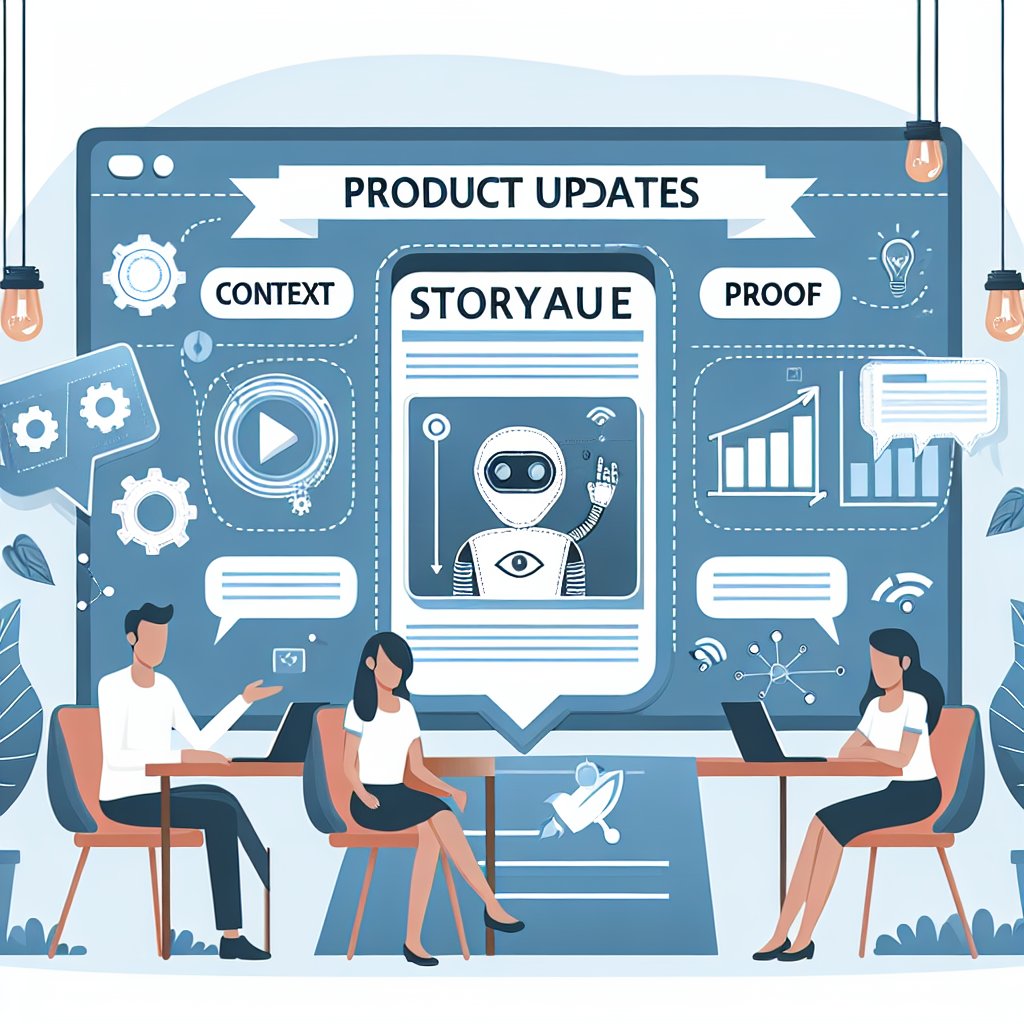


Product updates succeed only when people actually adopt them, not when they merely ship. This guide shows how to announce improvements and new features in a way that protects workflows, reduces confusion, and turns “what changed?” into “got it, I’ll use it.”
Shipping is the easy part. The hard part is making sure customers, prospects, and internal teams understand what changed, why it matters, and what to do next. If your product updates feel like a dense changelog, people will skim, miss the key points, and keep using the old workflow. If your announcements feel like marketing, users may distrust them and support will get flooded with “Where did the button go?” messages.
An adoption-first product update is a communication artifact designed to move behavior. It explains announcements, improvements, and new features with enough context to build confidence and with enough specificity to guide action. Below is a practical approach you can use repeatedly, plus examples and a way to operationalize the process using automation.
Before you write a single sentence, define the adoption target. Product updates are not just “what we built.” They are “what we want users to do differently now.” That could be:
Once the behavior is clear, you can decide what to include and what to leave out. Not every change deserves equal attention. Adoption-first updates prioritize what changes decisions, time-to-value, or risk.
Almost every product update has three audiences:
You can serve all three by using a layered structure: lead with the user impact, add a short “why,” then include an optional “details” section with specifics, limits, and links.
Many update posts fail because they skip one of these four elements. The simplest reliable template is:
Example (feature improvement):
What changed: You can now reschedule bookings directly from the confirmation message.
Why: Customers told us the old flow required too many steps and caused missed appointments.
Who: All accounts using bookings on WhatsApp and web chat.
Now what: Open any booking confirmation and tap “Reschedule” to choose a new time.
This format also helps your internal teams. Sales can explain the value quickly, and support can immediately see scope and expected behavior.
Adoption increases when users can complete a first successful action in under two minutes. So instead of announcing a feature as a concept, announce it as a short guided run:
Example (new capability):
If you launched a new multi-channel inbox, don’t just say “Unified inbox is live.” Say: “Go to Inbox, select ‘All channels,’ reply once, and we will keep the thread linked across WhatsApp, Instagram, and web chat.” The user now has a clear first run.
This is also where platforms like Staffono.ai become relevant. If your update introduces a new messaging workflow, Staffono can automate the first run by greeting users, answering “how do I” questions 24/7, and routing edge cases to a human. Instead of hoping users read the announcement, the system helps them complete the new behavior in the moment.
“We improved performance” is vague. Users want to know what that means for them. Whenever possible, anchor the why to a measurable outcome:
If you do not have numbers yet, use credible specifics: “We removed two steps,” “We added auto-save,” “We changed the default to prevent accidental sends.” Evidence builds trust and reduces support tickets.
One of the fastest ways to prevent confusion is to state what remains the same. This is especially important for UI updates and workflow changes. Add a short “No change to” list:
Users fear hidden breaking changes. When you remove that fear, adoption becomes easier.
Improvements should focus on relief. New features should focus on opportunity. Announcements should focus on risk and timing. Mixing these tones makes updates feel incoherent. Try this framing:
For example, if you improved search, lead with the pain you removed. If you launched AI summarization, lead with the new workflow it enables. If you are deprecating an endpoint, lead with dates and migration steps.
Most teams default to email and a blog post. Adoption-first communication uses channels that match the user’s moment of need:
If your customers primarily interact via messaging, announcing updates inside those channels can outperform email. With Staffono.ai, you can deliver update snippets through WhatsApp, Instagram, Telegram, Facebook Messenger, and web chat, then automatically answer follow-up questions like “How do I enable it?” or “Does this affect my plan?” without forcing users to leave the conversation.
Imagine you changed how leads are assigned. Previously, leads went to a shared queue. Now they route based on region and availability.
“We improved lead routing for better performance.”
What changed: New leads are now assigned automatically based on region and agent availability.
Why: Shared queues caused slow responses during peak hours and duplicate outreach.
Who: Sales teams using the default assignment mode; custom rules are unaffected.
Now what: Go to Settings, Assignment to review your region map. If you want to keep the shared queue, switch to “Manual.”
No change to: Lead sources, CRM sync, and reporting.
Expected result: Faster first response and fewer duplicates.
Notice how this reduces anxiety and gives a clear action. It also arms support with the exact place to check when someone asks, “Why didn’t I get that lead?”
Publishing is not the finish line. Decide how you will know the update landed. A simple measurement set includes:
Automation helps here too. If you announce via messaging, you can capture intent in real time: users who reply “not sure,” “help,” or “how” should be routed to education. Staffono can do this automatically, tagging conversations and escalating only the cases that truly need a human, which keeps your team focused while still supporting adoption.
Users do not want to study your product. They want to accomplish something. When your product updates are adoption-first, they read like assistance: clear scope, clear reason, clear next step. That is how you announce improvements and new features without overwhelming people.
If you want to make this process scalable, especially across messaging-heavy customer journeys, consider using Staffono.ai to deliver updates inside the channels customers already use, guide them through the first run, and handle follow-up questions 24/7. Done right, your updates become a steady engine for adoption, retention, and growth rather than a monthly blast that disappears into inboxes.