

Most product updates fail not because the feature is weak, but because the announcement creates uncertainty. This guide shows how to communicate announcements, improvements, and new features in a way that reduces risk, sets expectations, and drives adoption with clarity.
Product updates are rarely judged on code alone. Customers judge the experience of change: whether it feels predictable, respectful of their time, and aligned with the job they hired your product to do. When announcements, improvements, and new features are communicated poorly, the result is not just lower adoption. It is a quiet erosion of trust: confusion in support, hesitation in sales cycles, and friction inside customer workflows.
A strong product update is a trust-building ritual. It tells customers, “We saw what you needed, we changed something intentionally, and we will help you succeed with it.” That is very different from a list of changes. Below is a practical framework for what changed and why, along with examples and steps you can reuse for every release.
Even improvements can trigger resistance because customers are managing risk. They fear that something will break, that a familiar flow will move, or that their team will need retraining. In B2B, the product may be embedded in operations, and any surprise becomes a cost.
Before you write a single line of release communication, identify the risk your update introduces. Common risk categories include:
When you explain what changed and why, your job is to reduce perceived risk faster than you introduce novelty.
Every product implicitly makes a promise. For a scheduling tool, it is “bookings are easy and reliable.” For an automation platform, it is “messages get handled correctly, all day, every day.” Product updates should be framed as protection of that promise.
Try this sentence as your internal anchor: “This release protects or strengthens our promise by…” It forces you to connect the change to an outcome customers care about, not an internal roadmap milestone.
For example, if your promise is speed-to-lead, an update is not “new routing rules.” It is “faster and more accurate handoff so leads do not wait.” That shift changes how customers interpret the release.
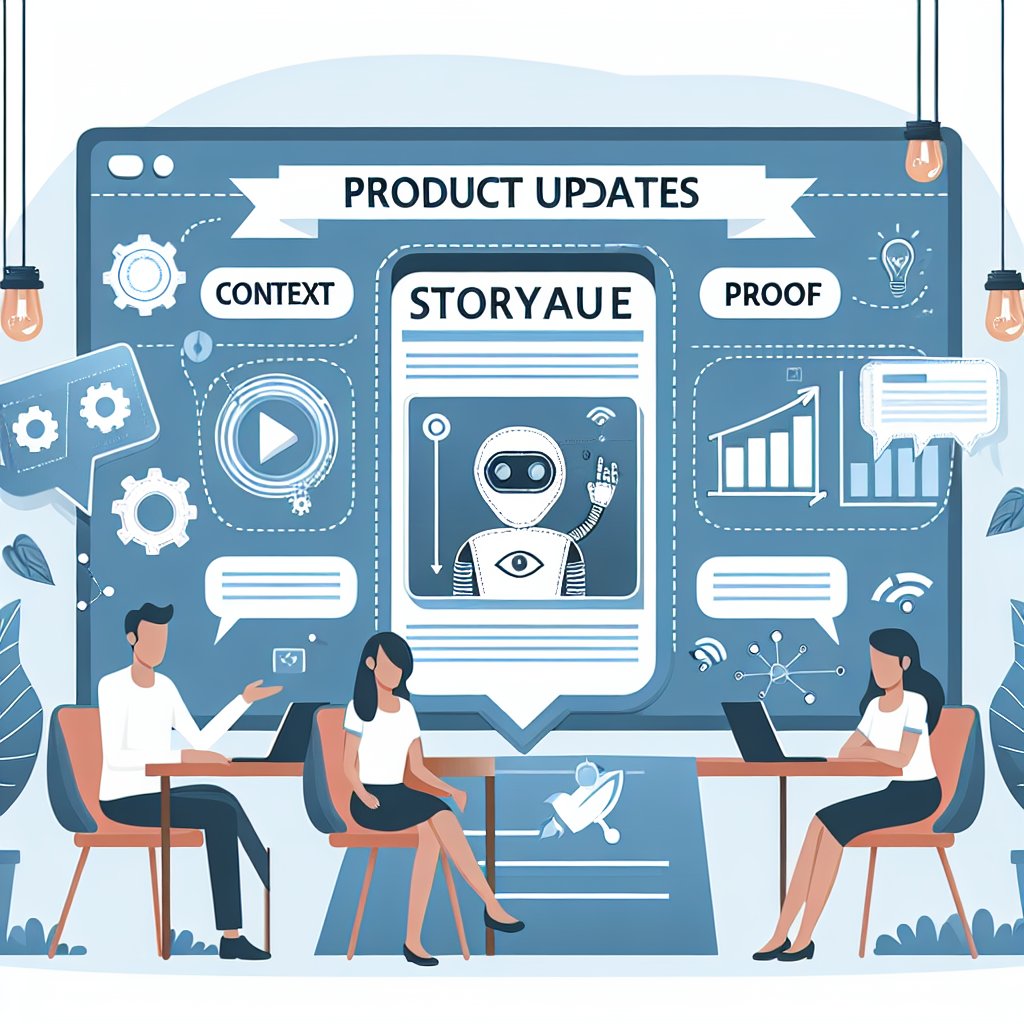
Most teams either write too much (a changelog dump) or too little (a vague announcement). A balanced announcement typically needs five parts:
State the user pain in plain language. Avoid blaming the user or implying they used the product “wrong.”
Explain the reasoning behind the change. Not every technical detail, but the tradeoff you made.
Describe what is new, what moved, and what stayed the same. If nothing breaks, say so. If something breaks, say exactly what and when.
What will be better now, and how should the user measure it? Provide one or two metrics or signals.
Tell users what to do today: try a new toggle, update a setting, share with a teammate, or do nothing.
This structure works whether you are shipping a major feature or a small improvement, because it respects the customer’s need for context.
Imagine you updated message routing for inbound leads across WhatsApp and web chat. The old flow occasionally assigned the same conversation to multiple reps, causing duplication and delays.
Here is how you might communicate it:
Notice what is missing: hype. Customers do not need excitement. They need certainty.
Announcements sent by email or social are easy to miss. The best place to explain a change is where the change is experienced. In-product messaging can be lightweight, but it must be precise and timely.
Use three layers of visibility:
This is also where automation helps. With Staffono.ai, teams can deploy AI employees that answer “what changed?” questions 24/7 across WhatsApp, Instagram, Telegram, Facebook Messenger, and web chat. Instead of forcing customers to search release notes, Staffono can explain the update in the same channel where customers are already asking for help, and it can route complex cases to a human when needed. That reduces anxiety, support load, and time-to-adoption.
One announcement cannot serve everyone. The CFO, the admin, and the front-line user have different concerns. Segment by impact, not by persona alone.
A practical segmentation model:
Write a core “truth” about the release, then tailor the framing. For example, direct users need “what to click now,” admins need “what to configure,” and prospects need “what outcome improved.”
Teams often fear explaining why because they worry customers will disagree. But silence creates a bigger debate in the customer’s head. The trick is to share the rationale as a tradeoff, not as a verdict.
Use language like:
Avoid absolutes like “This is better for everyone.” Not every update is.
A confident announcement is backed by operational readiness. Before you hit publish, confirm:
This is where Staffono.ai can act as connective tissue. Because Staffono handles customer communication and lead capture across messaging channels, it can also collect real questions and objections about the update in real time. Those conversations become a live feedback stream: what confused users, what they tried to do, what they expected. That is often more honest than surveys.
Do not measure success by opens or likes alone. Measure whether customers experienced less friction and more value. Useful signals include:
If you use Staffono.ai for messaging automation, you can tag and analyze update-related conversations across channels. For example, you can detect repeated questions like “Where did X go?” and proactively send a short clarification to affected users, or trigger an in-chat guide that walks them through the new steps.
Safety comes from consistency: announce, guide, listen, and iterate.
When you treat product updates as trust-building rituals, your communication becomes part of the product. Customers feel guided rather than surprised. Support teams spend less time translating changes. Sales can confidently explain what is new without fear of edge cases.
If you want to make that experience scalable across every messaging channel, Staffono.ai (https://staffono.ai) helps by providing 24/7 AI employees that answer questions, route issues, and assist with bookings and sales while your team ships. Instead of hoping customers read an announcement, you can meet them where they are, in WhatsApp, Instagram, Telegram, Facebook Messenger, and web chat, and explain what changed and why in a way that keeps momentum and protects trust.
The best product updates do not just add features. They reduce uncertainty. Make your next announcement a moment where customers feel, clearly and immediately, that your product is becoming a safer place to do business.