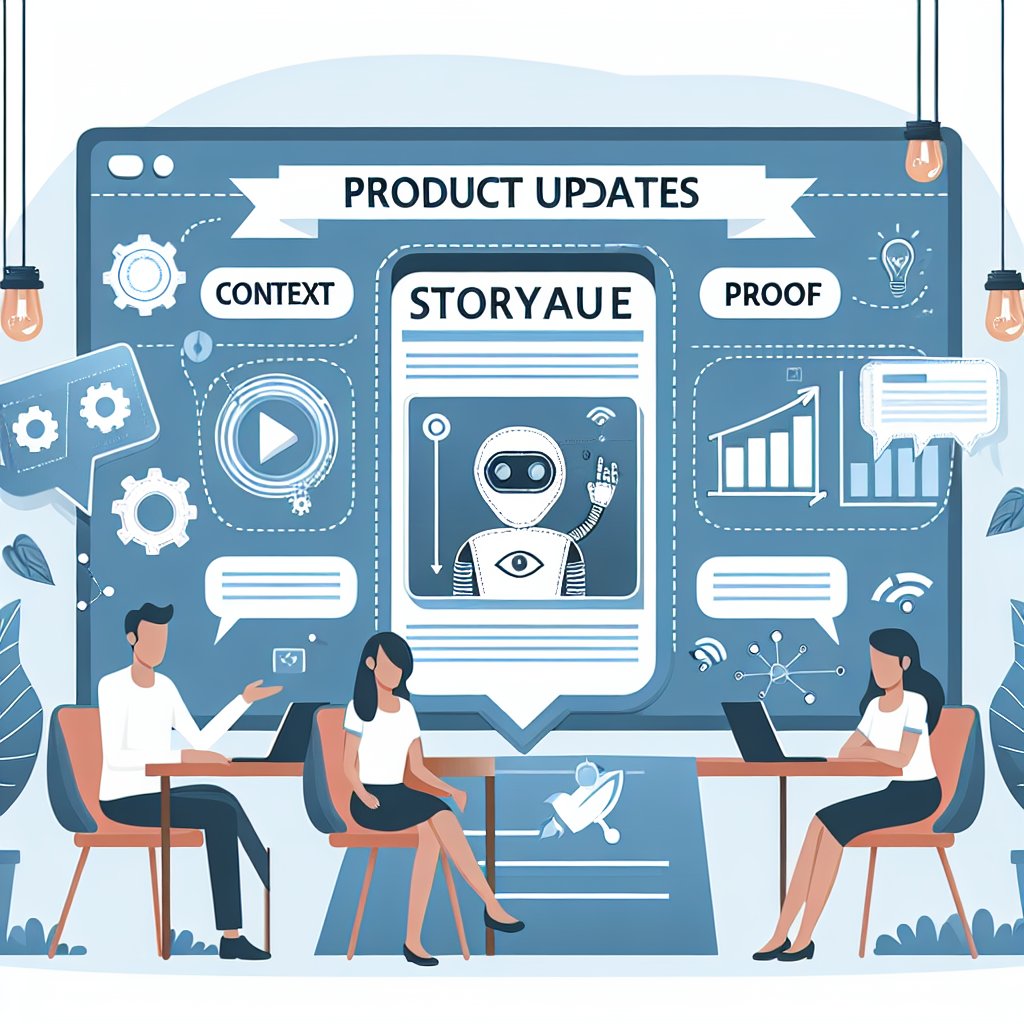


Product updates are not just a log of changes, they are signals about where your product is going and how seriously you take customer outcomes. This guide explains what to announce, how to explain improvements without noise, and how to make new features measurable in adoption and revenue.
Most teams treat product updates like paperwork: list what shipped, push it to a changelog, and hope customers notice. But in practice, every announcement is a market signal. It tells customers (and prospects) what you value, which problems you are solving, and whether you can be trusted to keep improving without breaking their workflow.
This matters even more in messaging-first businesses, where customers expect instant clarity. If your update message lands at the wrong moment or with vague wording, it can trigger confusion, extra support volume, and stalled conversions. The goal is not to “say more.” The goal is to say the right things so customers understand what changed and what they can do now that they could not do before.
Below is a practical approach to product updates: how to structure announcements, improvements, and new features, what changed and why, and how to turn the release into adoption and growth.
Customers do not buy features. They buy outcomes: faster response times, fewer missed leads, easier reporting, fewer handoffs, better compliance. When you frame updates around “the job,” your release notes stop sounding like internal engineering achievements and start sounding like customer progress.
Try this simple framing in your draft:
Example: instead of “Added WhatsApp routing rules,” write “If you get WhatsApp inquiries that need different teams, you can now route chats by keyword, time, or customer type so no lead waits in the wrong queue.”
“Announcements, improvements, and new features” is a helpful trio because it matches how customers experience change.
Announcements include policy changes, pricing updates, deprecations, new limits, major UI changes, and availability in new regions. The key is to communicate impact clearly, with dates and actions.
Include:
If you use Staffono.ai for customer communication across WhatsApp, Instagram, Telegram, Facebook Messenger, and web chat, announcements can be delivered consistently in the channels customers already use. That prevents the “we sent an email, nobody saw it” problem and reduces last-minute confusion when a change goes live.
Improvements are performance upgrades, reliability fixes, better defaults, UX cleanups, and quality-of-life enhancements. Customers love improvements, but they are often hard to notice. Your job is to translate “technical better” into “daily life better.”
Use language like:
A practical example: if a booking business sees drop-offs because customers ask the same questions repeatedly, an improvement might be a smarter suggestion engine for FAQs. In Staffono.ai, AI employees can handle repetitive questions 24/7 and keep conversations moving toward booking, so improvements that reduce friction in those flows should be described in terms of reduced drop-off and faster time to appointment.
New features should come with an opinionated “first use” path. If you do not show customers what to do first, your feature becomes shelfware.
Include:
Customers want to understand why things changed, but they do not want a manifesto. Keep the “why” practical and tied to outcomes.
Good “why” statements usually fall into a few buckets:
Avoid “why” statements that sound like internal convenience: “We refactored the backend.” If it matters, connect it to customer impact: “This change improves message delivery reliability during high traffic.”
One of the fastest ways to reduce support tickets after a release is to publish a simple change map. It is not long, but it is specific.
Structure it like this:
Example:
This is especially effective in conversational businesses. When customers are interacting through chat, a concise change map can be delivered as an in-product message or via your Staffono.ai AI employee, who can answer “what changed?” questions instantly and guide users to the right setup screen.
Teams often celebrate shipping and forget to measure usage. Every update should have a measurement plan, even if lightweight.
If your product touches messaging and sales operations, these metrics are not abstract. For example, Staffono.ai customers often track response time and conversion from inbound chats. A feature that improves routing or qualification should translate into measurable uplift: fewer missed leads, faster handoff, higher booked meetings per channel.
What changed: a legacy integration is being retired in 60 days.
Why: the provider is discontinuing the endpoint and reliability has dropped.
What to do: switch to the new integration path, with a checklist and a migration date.
Support deflection: publish a short FAQ and add an automated helper in chat. With Staffono.ai, your AI employee can answer common migration questions 24/7, share the checklist, and escalate only the edge cases to a human.
What changed: inbox load time reduced for high-volume accounts.
Why: teams were losing time during peak inquiry periods.
What customers do now: nothing, but you recommend checking peak-hour workflows.
Proof: share before-and-after metrics and the scenario (peak hour, 10k conversations).
What changed: a configurable lead qualification flow that asks 3 to 5 questions and routes to sales.
Why: sales teams needed fewer low-intent calls and faster qualification.
First use path: enable it for one channel (Instagram), pick three questions, and set a meeting link.
Success metric: increase qualified meetings per 100 chats.
This is exactly the kind of workflow that a platform like Staffono.ai is built for, since its AI employees can qualify leads across messaging channels, capture context, and book meetings automatically while keeping the conversation natural and on-brand.
A release message that nobody sees is not communication, it is documentation. Use multiple touchpoints, but keep the content consistent.
If your customers live in WhatsApp or Instagram, treat those as primary channels. Staffono.ai can deliver update notices in the same conversational surface where customers ask questions, and it can immediately handle follow-ups like “Does this affect my account?” or “How do I enable it?”
When you treat product updates as a market signal, your communication becomes part of your product. Customers see consistency, clarity, and respect for their time. Prospects see evidence that you ship, listen, and improve in ways that matter.
If you want your updates to land inside the channels where customers actually pay attention, and you want questions answered instantly without adding support headcount, Staffono.ai can help. With 24/7 AI employees across WhatsApp, Instagram, Telegram, Facebook Messenger, and web chat, Staffono makes it practical to announce changes, guide users to the right setup, and turn new features into real adoption and booked revenue conversations. Explore Staffono.ai to see how automated messaging and workflow orchestration can make every release easier to understand and easier to use.