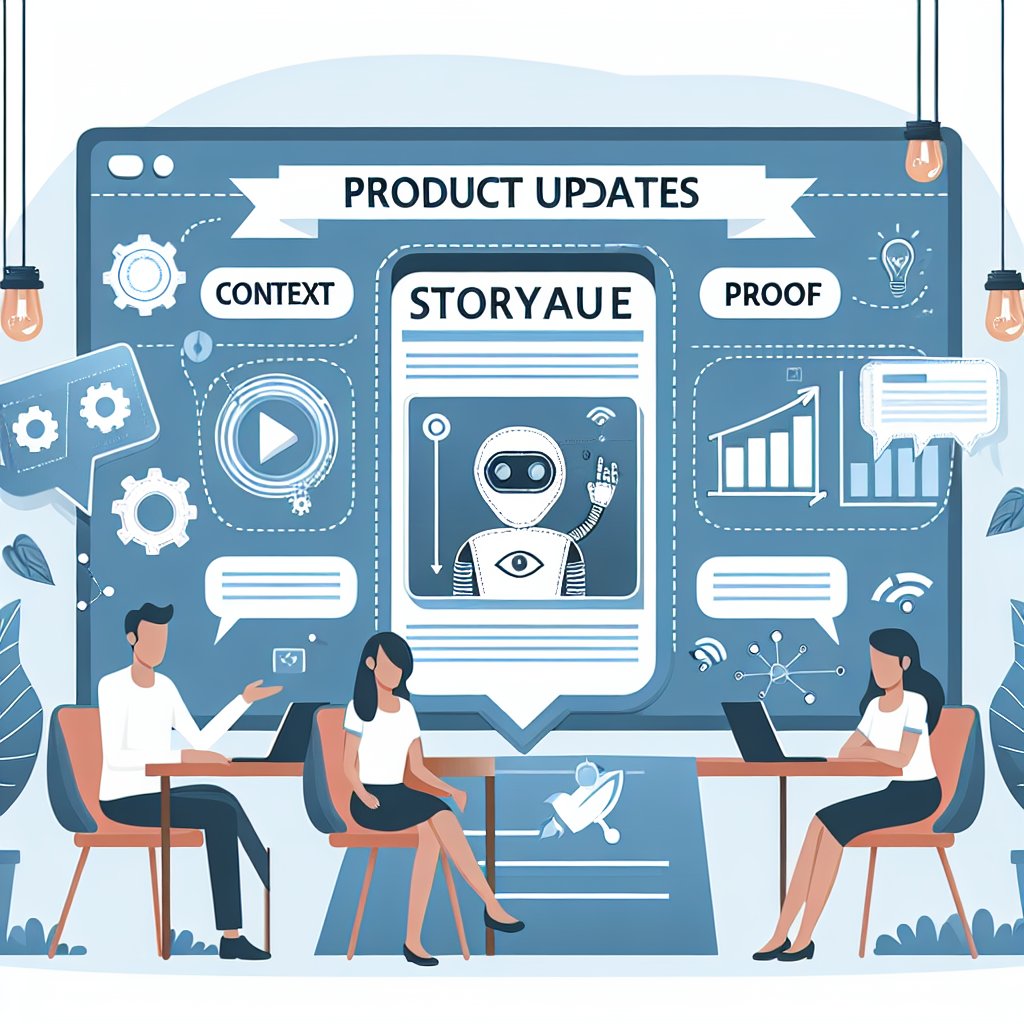

Most product updates fail for one simple reason: users do not understand the story behind the change. This playbook shows how to announce improvements and new features with context, proof, and next steps so customers actually adopt what you ship.
Product updates are not just a list of shipped tickets. They are a communication moment where you either build confidence or create uncertainty. When teams publish “what’s new” without explaining why it changed and how it affects daily work, users skim, postpone, and forget. The result is familiar: low adoption, more support questions, and features that never produce ROI.
A better approach treats every update as a small narrative: the user problem, the decision you made, the impact on workflows, and the simplest path to value. This matters even more in AI automation products where behavior can evolve quickly as models, integrations, and policies change. In this article, we will break down how to announce product updates, improvements, and new features in a way that creates clarity and momentum, with practical examples you can reuse.
Users do not adopt features because they exist. They adopt features because they believe the change will make their work easier, safer, faster, or more profitable. A plain changelog answers “what,” but adoption requires answers to four more questions:
When you consistently answer these, your updates become a product education channel. Over time, customers trust that reading them will save time and reduce risk.
Not every update needs a long post, but it should follow a clear pattern. Use this structure whether you are writing a release note, in-app message, email, or a customer success brief.
Instead of “We added a new routing engine,” lead with “Faster replies by automatically sending messages to the right team.” Outcomes are easier to understand and easier to share internally.
Give one sentence on what caused the change. Examples: rising message volume, a new compliance requirement, repeated customer requests, or an internal reliability initiative. This shows intention and prevents users from guessing.
Keep the description concrete. If there is a new setting, say where it lives. If there is a behavior change, say what is different from before. Avoid jargon unless your audience expects it.
Adoption improves when users have one or two actions to take. Do not overload them. If there is no action required, say so explicitly.
Even one data point helps. “Reduced failed sends by 22%,” “Cut average first response time by 18 seconds,” or a short before-and-after workflow example.
“Product updates” usually include three categories, and each needs a slightly different communication style.
Announcements should focus on discovery and quick activation. The tone is forward-looking. Avoid listing every edge case. Your goal is to help customers try it within minutes.
Example announcement outline:
Platforms like Staffono.ai are a great reference point here because messaging automation features are only valuable when people activate them correctly. If an AI employee is available 24/7 across WhatsApp, Instagram, Telegram, Facebook Messenger, and web chat, your announcement should clearly show how to turn that availability into booked appointments, faster support, or more closed deals.
Improvements are not “less exciting,” they are often where the ROI lives. Users care about fewer manual steps, fewer mistakes, and more predictable outcomes. Make the before-and-after obvious.
Example improvement story: “Previously, agents had to copy order numbers from chat into a tool. Now the system detects the order number automatically and pre-fills the lookup, so agents can answer faster.”
In AI automation, improvements often relate to accuracy, routing logic, knowledge base relevance, or monitoring. If you use Staffono.ai to handle customer conversations, improvements might mean the AI employee recognizes intent more reliably, escalates edge cases faster, or logs conversations into your pipeline with cleaner data.
New features can overwhelm users if they look like extra complexity. Translate them into capability statements: “You can now do X without Y.” Also clarify whether the feature replaces an old approach or sits alongside it.
Example capability framing: “You can now confirm bookings automatically in chat, without manually checking a calendar, by connecting your scheduling tool.”
Below are three sample mini-updates written in a user-centered way. They are intentionally short, because most teams need concise templates that scale.
Outcome: More reliable handoffs to humans when the conversation is urgent.
Why: We saw cases where customers used short messages like “help” or “urgent,” and routing needed to be faster.
What changed: Messages with urgency signals now trigger an immediate escalation to a human agent if no resolution happens within two AI replies.
What to do: If you want a different threshold, update the escalation rule in your routing settings.
How to confirm: Check your inbox labels for “Urgent Escalation” and review response times.
Outcome: Cleaner lead records, fewer duplicates.
Why: Teams reported duplicates when a lead contacted them on two channels.
What changed: Lead creation now merges identities based on phone number and social handle when available.
What to do: Ensure your forms and chat flows request at least one stable identifier.
How to confirm: Compare weekly new lead counts to unique conversations.
Outcome: More booked meetings from messaging channels.
Why: High-intent prospects often drop off when scheduling takes more than a few messages.
What changed: You can now offer time slots inside the chat and confirm instantly.
What to do: Connect your calendar and choose rules for business hours and buffer time.
How to confirm: Track bookings that originated from WhatsApp or Instagram conversations.
Even well-written updates fail if the right people never see them. Use multiple surfaces, but keep the core message consistent.
For messaging-first businesses, this is where platforms like Staffono.ai can be especially useful. If your customers interact through WhatsApp, Instagram, or web chat, you can use automated messaging flows to notify users about relevant changes, answer questions instantly, and route complex concerns to a human team. That turns updates into conversations instead of one-way announcements.
Product updates should have their own success metrics. Otherwise, you cannot tell whether your communication is improving adoption or just adding noise.
For AI automation updates, add quality metrics like escalation rate, customer satisfaction, and containment rate (how often the AI resolves the issue without human intervention). If you are using Staffono.ai AI employees for customer communication and sales, these metrics are directly tied to operational cost and revenue throughput.
The goal is not to craft a perfect post once. The goal is to build a system where every release teaches users how to win with your product. When you consistently explain what changed and why, you reduce uncertainty. When you provide simple activation steps, you increase adoption. When you connect updates to outcomes, you make value visible.
If your business depends on messaging, bookings, and fast lead response, consider using Staffono.ai to turn product changes into immediate operational wins. Staffono’s 24/7 AI employees can help you announce updates through the channels your customers already use, answer questions in real time, and guide users to activate new capabilities without adding load to your team. When updates become interactive, adoption stops being a hope and starts becoming a process.