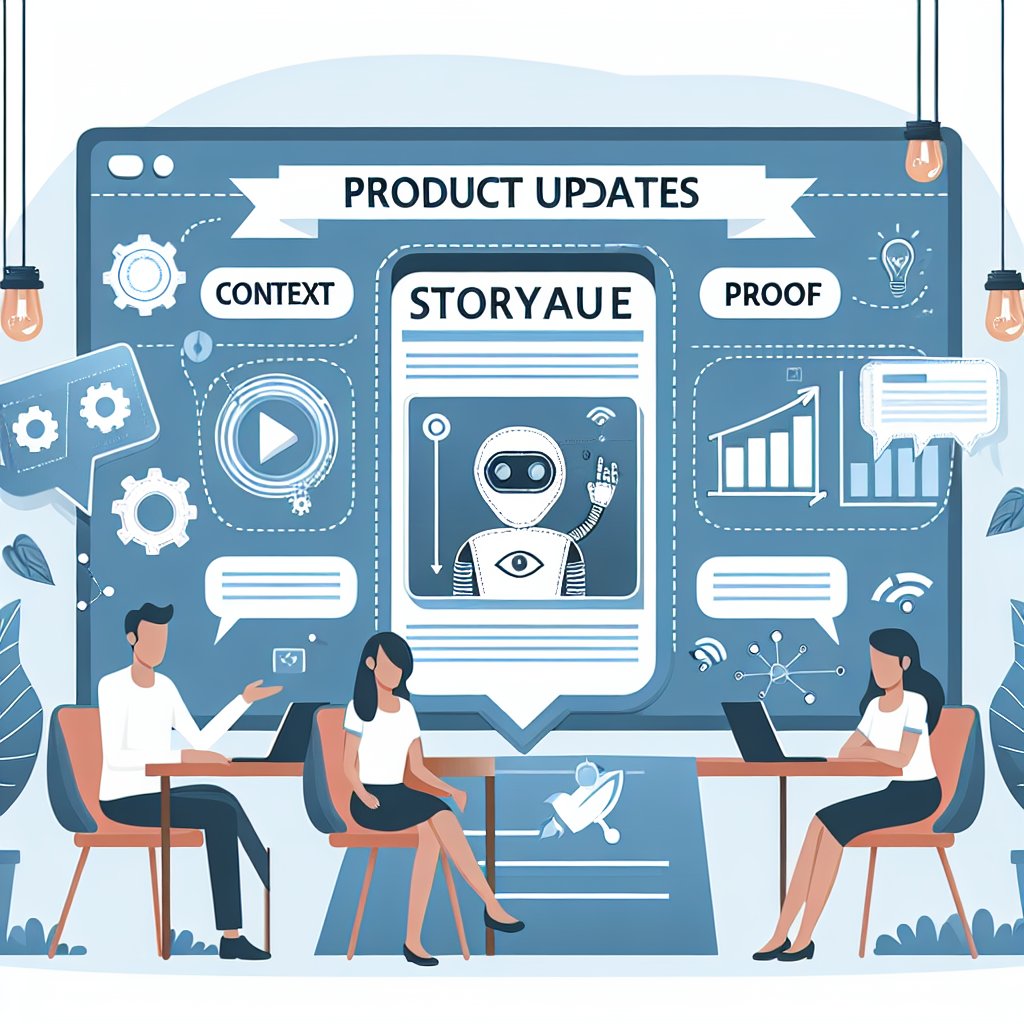


Most product updates fail because they read like internal notes, not customer communication. This guide shows how to announce improvements and new features with clear context, practical examples, and messaging that drives real adoption across every channel.
Product updates are not just a record of what shipped. They are a moment of truth where customers decide whether your product is getting easier to use, safer to rely on, and more valuable over time. If your announcements feel like a changelog copy-paste, users miss the point, support gets the same questions, and your best work quietly expires in a corner of the UI.
A strong product update announcement answers three things in plain language: what changed, why it changed, and what the customer should do next. When you consistently deliver that brief, you reduce confusion, increase feature usage, and build trust that the product is being improved responsibly.
Most teams already have release notes. The problem is that release notes are written for people who already understand the system. Customers often do not. They need context: what problem is being solved, what behavior should change, and whether anything breaks their existing workflow.
Here are the common failure modes that make announcements ineffective:
Instead of publishing a single block of text, think of each update as a short brief designed to move a customer from awareness to confident usage.
Use a structure that stays consistent across every announcement. Consistency is what makes users trust the message and quickly scan for what matters.
State the update in one sentence, avoiding internal project names. If it is a new feature, name the user capability, not the technical component.
Example: “You can now reschedule bookings directly from the confirmation message, without calling support.”
Explain what you observed and what you optimized for. Reasons that land well are tied to friction, risk reduction, or time saved.
Example: “We saw that most reschedules happened within 24 hours of the appointment, and the old flow required multiple steps and manual confirmation.”
Clarify who is affected and what changes in their day-to-day. Also include any constraints: availability, permissions, or rollout timing.
Example: “Available to account owners and admins today. Operators will see the reschedule button once an admin enables it in Settings.”
Give a single action to try, plus a fallback link for details. If the feature is optional, say so and explain when it is useful.
Example: “Try it on your next booking confirmation, or enable it now in Settings - Bookings - Rescheduling.”
Not all updates are equal. Improvements, new features, and behavior changes need different language. When you match the message to the type of change, you prevent surprise and increase adoption.
New features are about capability. Users ask, “What can I do now that I could not do before?” Lead with a scenario, not a spec list.
Practical example: If you launched a new “lead qualification” step, you might announce it like this: “You can now qualify new inquiries automatically by asking 3 quick questions before a human steps in. We built this to reduce back-and-forth and help your team focus on high-intent conversations.”
If you use Staffono.ai for messaging automation, this is also where you connect the feature to real operations. For instance, Staffono.ai AI employees can qualify leads in WhatsApp, Instagram, Telegram, Facebook Messenger, and web chat, then route only qualified conversations to your team. In your announcement, that becomes an immediately understandable outcome: fewer repetitive questions, faster responses, and cleaner pipelines.
Improvements are about friction removal. Users ask, “Does this make my usual workflow faster or safer?” Use measurable language when possible.
Practical example: “Message templates now support saved variables for location and service type. This reduces manual edits and helps teams keep consistent replies. Your existing templates still work, and you can gradually add variables when you update them.”
Teams using Staffono.ai can go a step further by automatically surfacing the improvement in the same place users work. If your customers interact through messaging, Staffono can proactively send a short, personalized note to admins about the improvement, and offer a guided setup link. That turns an improvement into actual usage, not just awareness.
These are the most sensitive updates because they can break habits. Users ask, “What do I need to change, and by when?” Do not hide the deadline in fine print.
Practical example: “Starting March 15, the old export format will be retired. We updated exports to include conversation source and agent type, making reporting more accurate. Download the new format today, and if you have a custom spreadsheet, follow the 3-step mapping guide.”
If you have a high volume of customer questions, this is where automation matters. With Staffono.ai, your AI employee can answer “What does this mean for me?” in real time, detect whether the user is an admin or operator, and provide the correct migration instructions in the channel they already use. That reduces support tickets during change windows while keeping customers confident.
Even a perfect announcement fails if customers do not see it. A good distribution plan matches urgency to channel and avoids spamming.
Messaging is increasingly where customers actually respond. If your audience is active on WhatsApp or Instagram, a short product update message with a “Reply with 1 to enable” style interaction can outperform email. Staffono.ai is designed for this reality: it can deliver product update announcements via chat, handle follow-up questions automatically, and route complex cases to a human with full context.
Users trust updates more when they can see the source of the decision. You do not need to expose every internal detail, but you should show evidence that the change is grounded in real usage.
Ways to communicate “why” without overexplaining:
This is also useful internally. When your sales and support teams understand the reason, they can explain it consistently. If you use Staffono.ai to automate customer communication, you can embed the reason and the next step into your automated replies, ensuring every customer gets the same clear explanation, 24/7.
Below is a reusable template you can copy into your product update workflow:
Write the FAQ before you publish. It forces you to confront confusion points while you still have time to clarify.
Do not measure success by views alone. Good product updates change behavior. Pick 1 to 2 metrics per announcement:
If you distribute updates in messaging, you can measure reply intent as well: how many users asked for setup help, requested a demo, or enabled the feature. With Staffono.ai, those interactions can be tracked and routed automatically, turning a product update into an operational workflow instead of a one-way broadcast.
Announcements, improvements, and new features are only valuable when customers understand them and act. A strong product update brief makes the change clear, makes the reason credible, and makes the next step easy. When you do that consistently, your product feels dependable, your teams stay aligned, and customers keep discovering value instead of stumbling into surprises.
If you want product updates to reach customers where they actually pay attention and to handle the inevitable “How does this affect me?” questions at scale, Staffono.ai (https://staffono.ai) can help. Staffono’s AI employees can deliver update announcements across WhatsApp, Instagram, Telegram, Facebook Messenger, and web chat, answer follow-ups instantly, and guide users to activation steps so your releases turn into real adoption, not just noise.