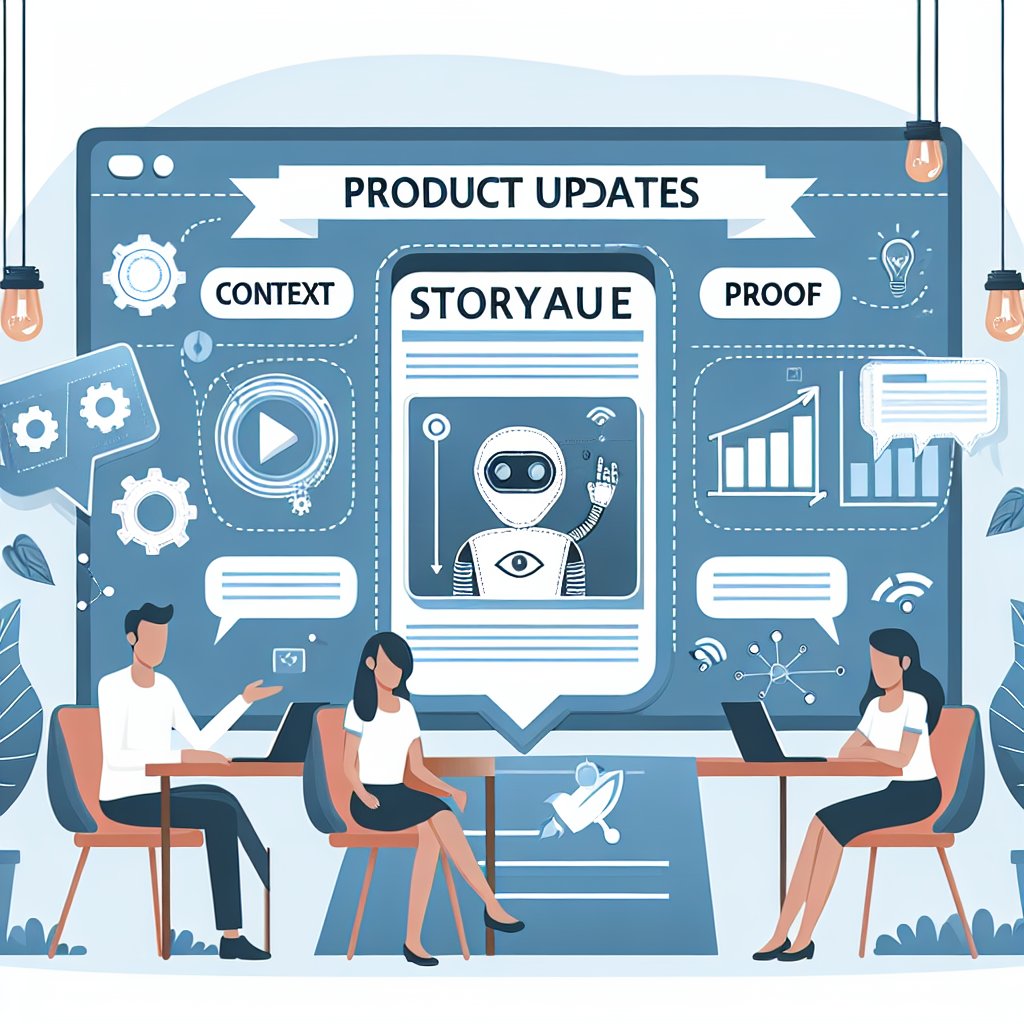


Most product updates fail because they describe change but never translate it into customer outcomes. This guide shows how to announce improvements and new features in a way that clarifies impact, reduces confusion, and drives real adoption across teams and channels.
Product updates are rarely ignored because customers dislike progress. They are ignored because the announcement does not help anyone make a decision. Users scan for one thing: “So what?” What changed, why it matters to me, and what I should do next.
If your update message reads like a changelog, you may be accurate but still ineffective. Your customers are busy, your support team is bracing for questions, and your sales team is trying to position value without overpromising. The goal is not to publish more information. The goal is to reduce uncertainty and accelerate confident usage.
Below is a practical approach to announcing product updates, improvements, and new features: what changed, why it changed, and how to communicate it so customers act on it. You will also see how AI-driven messaging automation, like Staffono.ai, can help you deliver the right update to the right person across WhatsApp, Instagram, Telegram, Facebook Messenger, and web chat without creating a manual communication burden.
The most effective product update announcement is structured around outcomes, not engineering effort. Customers do not buy “refactored architecture.” They buy faster bookings, fewer errors, clearer reporting, and smoother handoffs.
A useful pattern is:
Example (feature improvement):
Notice how the customer can immediately judge relevance and effort. This is the “So what?” answer in a format people can parse quickly.
“Why” is not a justification, it is orientation. Customers use it to predict whether future changes will help or disrupt them. A strong “why” does three jobs:
A practical “why” can be one sentence. Avoid long backstory. For example: “We simplified the lead form because many teams were abandoning setup at step two.” That tells a story, uses evidence, and signals customer benefit.
If you have multiple audiences, write the “why” in layers:
Customers do not experience your product as “features.” They experience it as moments: first contact, booking, payment, follow-up, handoff to a human, reporting. When you tie an update to a moment, adoption becomes easier.
Try labeling each update internally by the moment it improves:
This is especially useful for businesses that run on messaging. If you ship an improvement to lead routing, the message should reference the exact moment: “When a prospect messages you on Instagram, the conversation can now be routed to the right location automatically.”
Staffono.ai fits naturally into this model because it lives inside the same moments. When your AI employees handle customer communication and bookings 24/7, product updates are not just platform announcements. They directly affect how your business responds, qualifies, and converts leads across channels.
A press release tone is optimized for perception. A playbook tone is optimized for action. Your update post should help three groups immediately:
Include a “how to use it” section even if you already have documentation. Most readers will not click away. Keep it short and concrete.
Example for a new feature: “Saved replies can now include dynamic fields like customer name and appointment time.”
If you use Staffono.ai to automate messaging, connect the update to workflows: “If your Staffono.ai AI employee is set to collect booking details, you can now store the preferred time window as a structured field and reuse it in confirmation messages.” This transforms the update from “nice” to “immediately valuable.”
Many support tickets come from fear, not bugs. Users worry their workflow broke, pricing changed, data moved, or permissions reset. A single paragraph can prevent a wave of confusion.
Add a short reassurance section:
Be specific. Vague reassurance sounds like marketing.
One update post often contains multiple items. That is fine, but the reader should not face five different “next steps.” Pick one primary action and make it easy:
Then add secondary actions for advanced users. This reduces cognitive load and increases follow-through.
For products that touch customer communication, examples should be written as realistic messages, not abstract descriptions. This is where adoption accelerates because users can copy and adapt.
Example (improvement to booking flow):
Before: “Hi, what time works for you?”
After: “Hi Alex, I can book you for Tuesday 11:00-13:00 or Wednesday 15:00-17:00. Which window is better?”
If your business runs on WhatsApp or Instagram DMs, show exactly how the conversation improves. Staffono.ai users can go further by turning these examples into automated scripts for their AI employees, ensuring every lead gets the improved experience instantly, even outside business hours.
“Published” is not a result. A product update is successful when behavior changes. Define a small set of measurable signals:
For messaging-centric teams, you can track “time to first reply,” “lead-to-booking time,” and “missed lead rate.” If you are using Staffono.ai, you can often measure improvements faster because automated conversations are consistent and logged, making it easier to see whether the new flow reduces drop-offs.
When you need to ship updates frequently, a reusable structure keeps quality high. Here is a template that works for announcements, improvements, and new features:
Keep it consistent across releases so customers know where to look.
The best-written post still fails if it is delivered in the wrong place. Many businesses default to email, but modern teams live in messaging apps. If your customers interact with you on WhatsApp or Instagram, they will often notice an in-chat update far faster than an email newsletter.
This is where automation helps. With Staffono.ai, you can distribute product update summaries and help prompts across multiple channels while keeping them consistent. For example, your AI employee can answer, “What changed in the last update?” and link the right help article, or guide a user to enable a new setting step by step inside chat.
The announcement is only half the job. The other half is in-context guidance: a tooltip near the changed setting, a short prompt the first time a user sees the new flow, and a link to a two-minute walkthrough.
If you operate through messaging, you can also offer in-chat guidance. A Staffono.ai AI employee can proactively ask, “Do you want to enable the new reminder timing for your bookings?” and handle the setup conversation, then escalate to a human if the user has custom requirements.
Announcements, improvements, and new features should create momentum, not noise. The difference is whether you translate change into outcomes, connect it to real user moments, and provide a clear next step with reassurance. When you treat product updates as actionable guidance, customers feel oriented, teams feel prepared, and adoption happens naturally.
If you want your updates to reach customers where they actually work, and you want those announcements to turn into guided actions inside chat, Staffono.ai (https://staffono.ai) can help. With 24/7 AI employees handling communication, bookings, and sales across WhatsApp, Instagram, Telegram, Facebook Messenger, and web chat, you can ship changes with confidence and support users in the exact moment they need help.