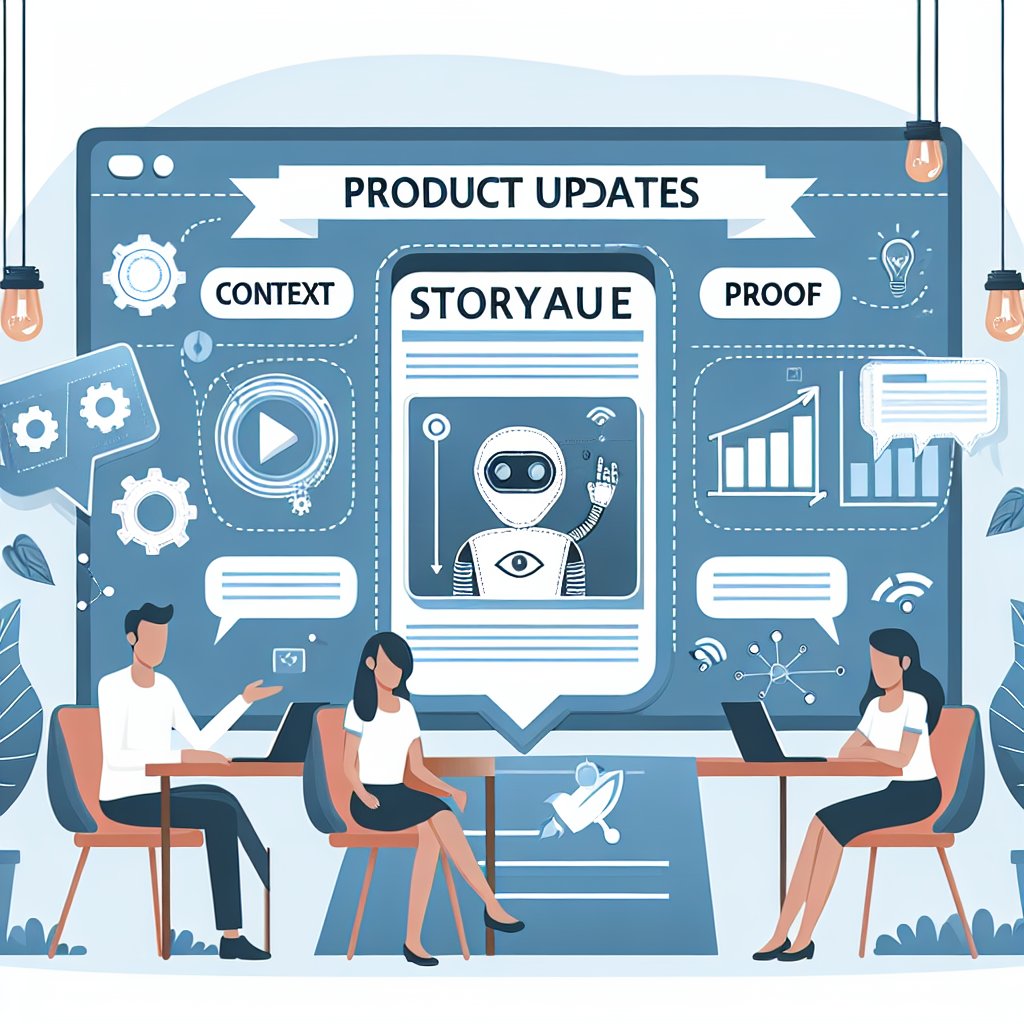


Product updates are not just announcements, they are controlled experiments that either build trust or quietly erode it. This guide shows how to explain what changed and why, using rollout mechanics, user signals, and messaging that drives adoption without overwhelming customers.
Most teams treat product updates like a broadcast: write a changelog, post it, and move on. Customers experience it differently. For them, an update is a disruption to a routine, a new decision to make, or a risk to their workflow. That is why the best product updates are not the loudest or the longest, they are the most controlled and the most explainable.
In this post, we will look at product updates as a system: how you decide what changed, why it changed, how you roll it out safely, and how you communicate it so users actually benefit. You will also see practical examples you can adapt to your own release notes, in-app messages, and support workflows. If your business depends on messaging and fast response times, platforms like Staffono.ai (https://staffono.ai) can make update communication and post-release support far easier, because your AI employees can answer questions, guide users, and capture feedback 24/7 across WhatsApp, Instagram, Telegram, Facebook Messenger, and web chat.
When people ask “what changed and why,” they want two kinds of truth: what they need to do differently, and what you did to reduce risk. That means your update narrative should mirror your rollout mechanics. If you used a gradual rollout, say so. If you introduced a fallback, say so. If you changed a default, explain how to revert it.
Try structuring every update around three statements:
This structure is especially powerful for improvements that are “invisible,” like performance, routing logic, or permission changes. Without the control statement, customers often assume you are experimenting on them. With it, they recognize you are being careful.
Feature flags are usually discussed as engineering infrastructure, but they also improve communication. They let you announce an update without forcing everyone into it on day one, and they give you a clean answer to “why did this change happen to me but not my colleague?”
Here are three rollout patterns and how to explain them:
What changed: “We improved the checkout validation to reduce failed payments.”
Why: “We saw a spike in payment errors during peak traffic.”
Control: “We are enabling it gradually over the next 7 days while monitoring success rates. If you see issues, contact support and we can switch you back temporarily.”
This works well for workflow changes. You avoid forcing behavior changes and you gain high-quality feedback.
Control language example: “Enable the new scheduling view from Settings. You can return to the classic view anytime until March 15.”
Some updates only matter to certain segments. Say that plainly. Customers trust you more when you do not pretend every change is relevant to everyone.
Control language example: “This update affects accounts that use multiple locations. Single-location accounts will not see changes.”
Teams often over-explain the technical reasons and under-explain the user reasons. The best “why” has the right altitude for the reader.
A useful rule is to write the why in one sentence a customer can repeat internally. For example: “We changed the default permission so that team members cannot export data by accident.” That is better than “We refactored RBAC scopes and updated the export endpoint.”
Improvements are often vague: “faster,” “more reliable,” “better experience.” Users do not adopt vague. They adopt specific. The trick is to attach a measurement or a before/after scenario.
Examples of improvement phrasing that drives trust:
If you operate in conversational channels, improvements should reference real-world moments: missed bookings, slow replies, unclear handoffs. Staffono.ai customers often measure improvements through outcomes like faster first response time, fewer missed inquiries, and higher booking completion rates. Those are metrics your release notes can cite when you roll out automation or routing changes.
Customers have limited bandwidth. The goal of an announcement is not to be read, it is to be acted on correctly. That means you should separate updates by action requirement:
When you mix these in one stream, users miss the one line that mattered. Consider a short “Action needed” block at the top of your update message and keep it honest. If nothing is required, say “No action needed.” That sentence alone reduces anxiety.
A new feature is not real until a user completes a first success with it. Your update should include a “first-run path” that fits in 60 seconds.
Template you can reuse:
Example for a messaging automation feature:
This is where Staffono.ai (https://staffono.ai) fits naturally. If your update introduces new automation for sales chats or bookings, your announcement can include a real first-run path: connect WhatsApp or Instagram, set intent categories, and let the AI employee handle qualification and appointment scheduling while your team monitors outcomes.
After release, you need feedback quickly, but customers should not have to hunt for a form. The best feedback loop is embedded in the same places users feel the change.
Conversational businesses can do this even better by using messaging automation. With Staffono.ai, you can route any message that includes keywords like “new update,” “changed,” or a feature name into a dedicated queue, summarize the complaint, and capture structured data (channel, account type, screenshot link) before a human ever joins. That turns reactive support into a measurable feedback pipeline.
What changed: Export permissions are now limited to Admin and Manager roles by default.
Why: We saw accidental exports shared outside teams, creating security risk.
What you need to do: Review roles in Settings if certain team members still require export access.
Safety net: Existing role configurations remain in place for 30 days, then the new default applies to new users only.
What changed: Incoming messages now trigger an immediate acknowledgement and a faster routing decision.
Why: Customers interpret silence as abandonment, especially on WhatsApp and Instagram.
No action needed: This is an automatic improvement.
Proof: In testing, median first response time dropped from 2 minutes to 15 seconds.
What changed: You can now offer booking slots directly inside your chat flow.
Why: Many leads drop off when they need to switch to a separate scheduling page.
How to use it: Enable booking, connect your calendar, choose the services you offer.
Good outcome: A lead selects a time and receives confirmation without staff intervention.
If you want a repeatable system, use this lightweight cadence:
This follow-up is underrated. It proves you listen, and it often turns skeptics into advocates.
Great product updates feel like continuity, not disruption. Customers should sense that you had a reason, you controlled the risk, and you are present after the change to help them succeed. If your updates touch customer communication, booking flows, or lead handling, consider using Staffono.ai (https://staffono.ai) to support the rollout: your AI employees can explain the change instantly in the same messaging channels customers already use, guide them through setup, and escalate edge cases to your team with a clean summary. When release communication becomes a two-way conversation, “what changed and why” stops being a complaint and starts being trust.