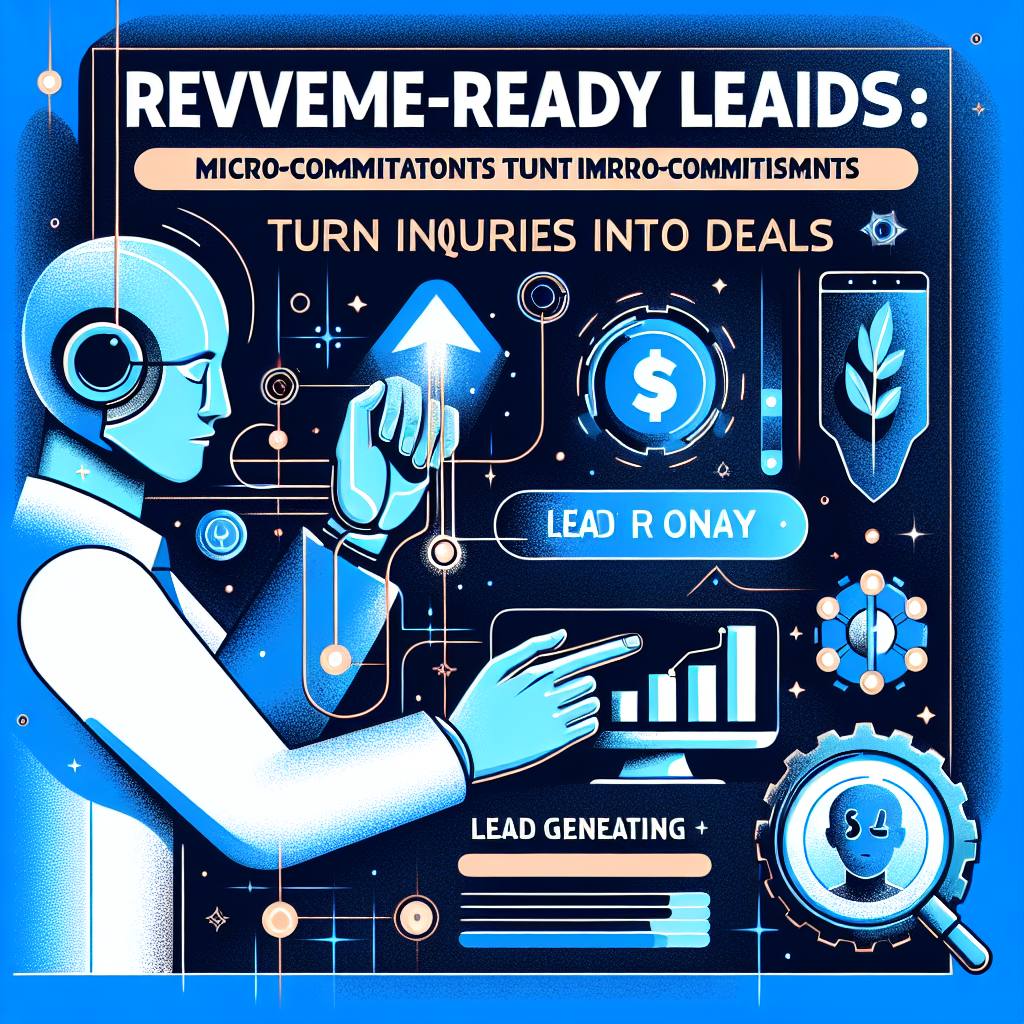


Most lead gen advice focuses on getting more inquiries, but the real revenue comes from moving people up the intent ladder. This guide shows how to capture attention, qualify fast, and convert consistently using messaging, micro-actions, and automation that keeps momentum alive.
Lead generation and sales are often treated like two separate departments with separate tools: marketing “gets leads,” sales “closes deals.” In reality, revenue is created in the handoff moments, the follow-up windows, and the clarity of your next step. The difference between a lead that disappears and a lead that becomes revenue is usually not the ad budget. It is the system that moves someone from curiosity to commitment.
One of the most practical ways to build that system is to think in terms of an intent ladder. Each step up the ladder represents a higher level of buying intent and a smaller level of uncertainty. Your job is to design a path that makes the next step easy, fast, and natural. This article breaks down tactics to capture, qualify, and convert leads into revenue, with examples you can implement immediately.
Intent is not a feeling, it is observable behavior. Someone asking “What’s the price?” is different from someone asking “Can you start next week?” Even better, intent shows up in tiny actions: clicking a WhatsApp button, replying within 5 minutes, sharing a budget range, or selecting a time for a call.
When you track and respond to these behaviors, your funnel becomes less about pushing and more about guiding. The intent ladder typically moves through these stages:
Your tactics should be designed to help the buyer take the next step up the ladder, not to force a leap from Attention to Commitment.
High-converting lead capture today is conversation-first. Forms still work, but the fastest path to qualification is often a message. Prospects want to ask a quick question and get an immediate, relevant answer.
Instead of asking for full contact details, offer a fast starting point:
These are low-pressure prompts that invite engagement. Once the conversation starts, you can gather details progressively.
Different audiences prefer different messaging channels. A B2C service may see higher response rates in Instagram DMs, while local services and appointment-based businesses often convert best in WhatsApp. Staffono.ai supports communication across WhatsApp, Instagram, Telegram, Facebook Messenger, and web chat, which lets you place the right entry point where your audience already spends time.
Many lead magnets attract curiosity but not buyers. Instead, use magnets that signal readiness:
The best magnets help the prospect reduce uncertainty and move toward a decision.
Qualification should not feel like an interrogation. The goal is to quickly determine fit, urgency, and next step, while delivering value in the same conversation.
In most industries, three questions cover most of what you need:
Example for a marketing agency: “What are you trying to increase, leads or sales?” “When do you want to start?” “Do you have a monthly budget range in mind?”
Open-ended questions are useful, but they slow down messaging. Give structured choices to speed replies:
Structured options improve response rates and make scoring easier.
Demographics tell you who they are. Behavior tells you if they will buy. Add points for actions like:
This is where automation becomes a revenue lever. With Staffono.ai, you can keep conversations moving 24/7, ask the right qualifying questions, and route high-intent prospects to your team when they are most engaged, including outside business hours.
Conversion is not a single closing line. It is a sequence: reduce risk, increase clarity, and make the next action simple.
Many leads hesitate because they cannot picture what happens after they say “yes.” Spell out the steps:
When the path is clear, the decision feels smaller.
Generic testimonials are weaker than contextual proof. Create proof snippets by segment:
Example: “For a 3-location clinic, we reduced no-shows by confirming appointments through WhatsApp and automated reminders.” That kind of proof answers “Will this work for me?”
When the price or change is significant, ask for smaller commitments that still move the deal forward:
Each micro-commitment is a rung on the intent ladder.
Most leads do not say “no.” They go silent. Your follow-up system should feel helpful, not pushy, and it should adapt based on the lead’s last signal.
Binary questions are powerful because they reduce effort and force clarity.
Automation should preserve context. The message should reference what the lead asked, where they are located, the product they viewed, or the time they requested. Staffono.ai is designed for conversation workflows that feel natural, so your follow-up can be consistent while still sounding like a real assistant who remembers the details.
Imagine a home cleaning company that gets leads from Instagram and Google. Previously, they used a web form and answered calls during business hours. Many leads came in evenings and weekends, and response delays caused drop-off.
A better system looks like this:
With Staffono.ai acting as a 24/7 AI employee across messaging channels, the company can answer instantly, capture details without friction, and convert more leads into booked jobs while the owner focuses on delivery and quality control.
If you want predictable revenue, track a small set of metrics tied to the intent ladder:
When one metric is low, you know exactly which rung of the ladder needs improvement.
The best lead gen and sales tactics are not secrets. They are habits executed consistently: fast response, clear qualification, relevant proof, and a next step that feels easy. The challenge is doing it every time, across every channel, without burning out your team.
If you want your lead capture and follow-up to run around the clock, Staffono.ai (https://staffono.ai) can act as an always-on AI employee that engages prospects in WhatsApp, Instagram, Telegram, Facebook Messenger, and web chat, qualifies them with structured questions, and routes the best opportunities to your sales team at the right moment. When you combine a strong intent ladder with reliable automation, your pipeline stops depending on luck and starts behaving like a system.