
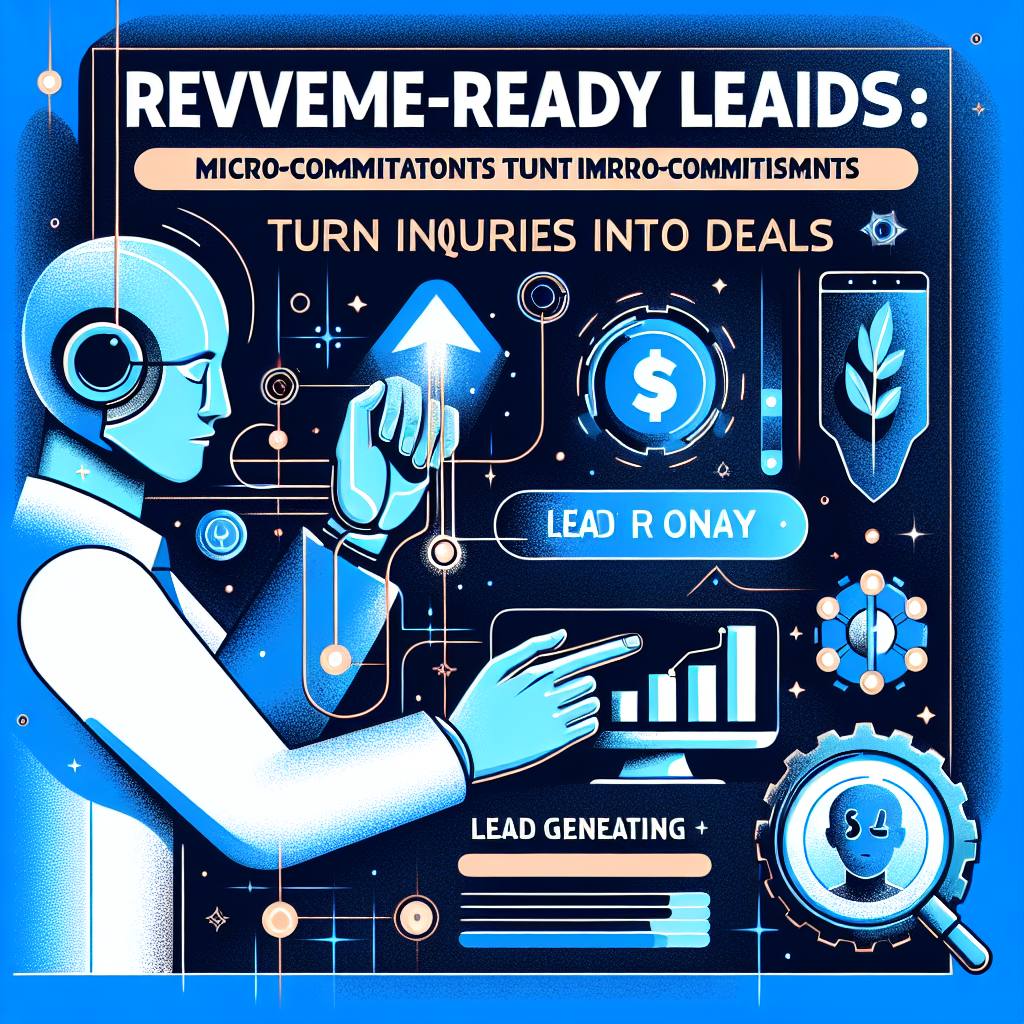
Most lead gen advice focuses on getting more contacts, but revenue comes from getting more yeses. This guide shows how to capture leads in the channels they already use, qualify them without friction, and convert using small, well-timed micro-commitments that build momentum toward a sale.
Lead generation and sales often get treated like separate jobs: marketing “creates demand,” sales “closes,” and the customer is expected to patiently move from one step to the next. In real life, buyers jump channels, ask questions at midnight, disappear for a week, and return with a screenshot from a competitor. If your system relies on perfect handoffs and business-hour responses, you lose revenue in the gaps.
The highest-performing teams win by engineering micro-commitments: small actions that feel easy for the buyer but meaningfully increase buying intent. A micro-commitment can be as simple as choosing a use case, sharing a timeline, confirming a budget range, or booking a 10-minute fit check. Stack enough of these in the right order, and you reduce “ghosting,” shorten the sales cycle, and improve close rates without pushing harder.
Below are practical tactics to capture, qualify, and convert leads into revenue, with examples you can apply across WhatsApp, Instagram, Telegram, Facebook Messenger, and web chat. You will also see where an always-on automation layer like Staffono.ai can keep conversations moving when your team is busy or offline.
“More leads” is not the goal. More conversations with the right people is the goal. The best capture systems do two things well: they reduce effort for the buyer, and they preserve context for the seller.
Forms still work for some industries, but messaging-first capture often outperforms forms when speed and convenience matter. Instead of forcing someone to fill out a long form, invite them into a short chat that immediately returns value.
Tools like Staffono.ai are designed for this reality: a buyer taps, messages, and expects an immediate, helpful reply. Staffono can greet leads 24/7 across popular messaging channels and capture key details without making the experience feel like paperwork.
The first micro-commitment should be low-friction and high-reward. Examples:
Notice what is missing: long explanations about your company. The buyer is asking, “Can you help me?” Your capture flow should answer that quickly.
Qualification fails when it feels like an interview. It succeeds when it feels like a concierge. The secret is to ask questions that naturally follow from what the buyer wants, and to use progressive disclosure: ask only what you need right now, then earn the right to ask more.
This structure keeps qualification short and actionable:
Example in a messaging channel:
This is qualification, but it feels like help.
Many teams over-index on firmographics (company size, industry) and underuse behavioral intent. In messaging, intent shows up fast:
Set a simple internal scoring model (even if it is manual at first). For example, “pricing + timeline + decision maker present” gets routed to sales immediately, while “curious, no timeline” gets nurtured.
With Staffono.ai, you can automate parts of this: the AI employee can ask the right follow-up questions, tag the conversation by intent, and route qualified leads to the right person or calendar without losing context.
Conversion is rarely one big moment. It is a sequence of small yeses that reduce uncertainty. Your job is to design that sequence.
Each one is easy to answer. Together, they create forward motion.
In messaging sales, you cannot just answer questions. You must answer, confirm what it means, and advance to the next step.
This reduces endless back-and-forth and keeps the buyer oriented toward a decision.
Objections are often unasked questions. If you wait for them, you slow the cycle. Instead, place “pre-answers” at the moments buyers naturally worry.
Example: If you sell automation, explain what stays human-controlled. “The AI handles first responses and qualification, but your team can approve templates, set rules, and take over at any point.” That reframes automation from risky to controlled.
Follow-up fails when it is repetitive and self-centered (“Just checking in”). It works when each touch adds value and offers a simple next action.
Staffono.ai can help here as well: when a lead goes quiet, an AI employee can send a polite, context-aware nudge, offer to answer questions, and re-open the scheduling link without your team manually tracking every thread.
Imagine a service business that gets 40 to 60 Instagram DMs per day. The owner replies between appointments, often hours later. Many prospects ask “price?” and disappear.
A micro-commitment-driven system would change the flow:
With Staffono.ai running the first layer, the business responds instantly, collects the minimum necessary info, and hands off only high-intent conversations to a human. The result is not just more leads, it is fewer missed opportunities and more booked revenue.
If you only measure lead volume, you will optimize the wrong thing. Track metrics that reflect momentum and revenue impact:
When you see a weak link, fix the micro-commitment at that step. If qualified leads are not booking, your next-step prompt is unclear. If meetings do not close, your pre-answers and proof are misaligned with buyer concerns.
You do not need a full rebuild to improve results. Start with three changes:
If you want to scale these tactics without hiring a night shift, Staffono.ai can act as an always-on AI employee across WhatsApp, Instagram, Telegram, Facebook Messenger, and web chat, capturing leads, qualifying them with the right questions, and routing the best opportunities to your team. When your pipeline is built on micro-commitments and supported by 24/7 responsiveness, lead generation stops being a volume game and becomes a revenue system.