
Most product updates fail not because the features are weak, but because the message arrives without context, relevance, or a clear next step. This guide shows how to announce improvements and new features in a way that customers, sales, and support can understand instantly, and act on confidently.
Shipping is only half the job. The other half is making sure the change is understood, trusted, and used. Many teams publish “what changed” and assume adoption will follow, but customers experience updates as interruptions to habits, workflows, and expectations. If your announcement does not clearly answer “what changed and why,” users fill in the gaps themselves, usually with caution.
A strong product update is not just a list of items. It is a packaging exercise: you are compressing engineering reality into a message that different audiences can decode quickly. The goal is instant understanding across every channel your customers actually use, from email to in-app banners to WhatsApp.
Updates are ignored for predictable reasons:
When you package updates well, you reduce support tickets, increase feature discovery, and create confidence that your product is moving in the right direction.
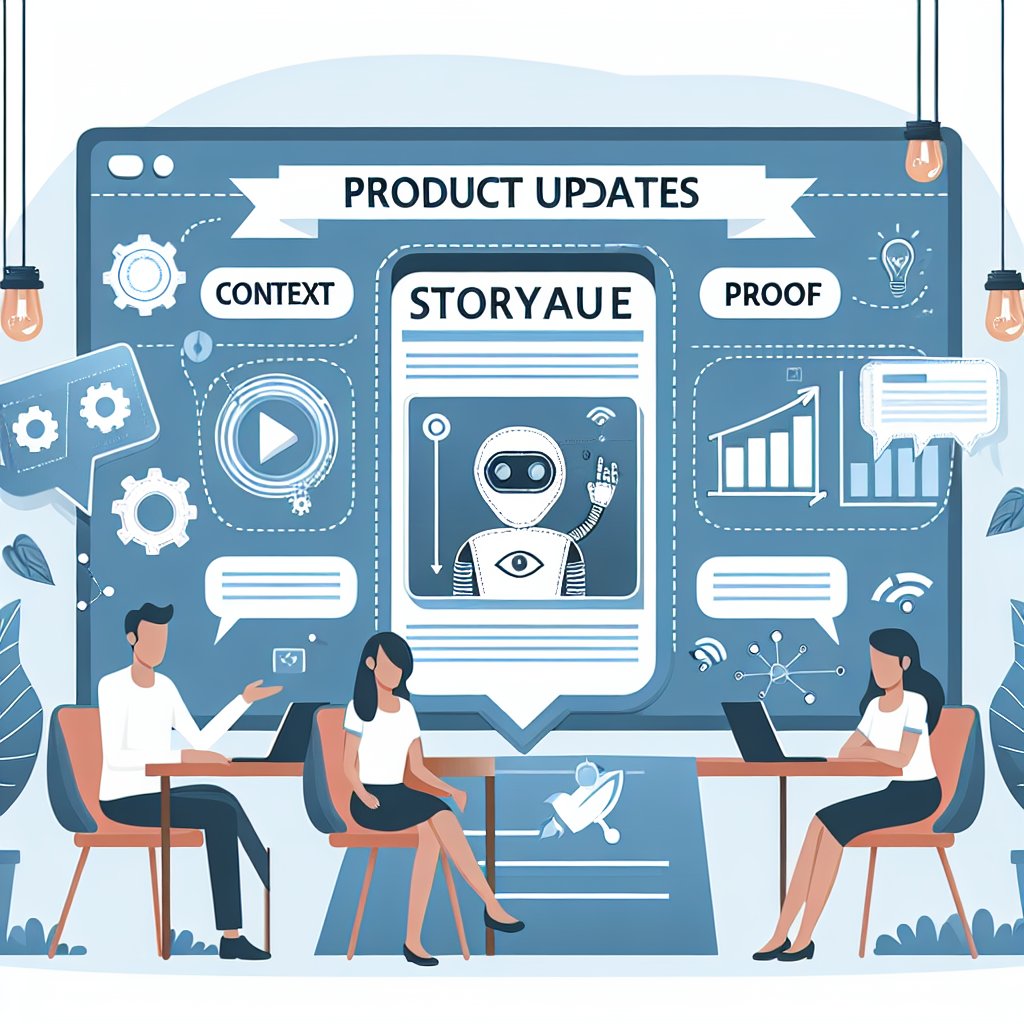
To keep announcements crisp, use four blocks that can be adapted to any channel:
This structure works because it matches how humans scan: impact first, justification second, instructions last.
A single announcement rarely serves everyone. Instead, create three versions of the same update, each optimized for a different audience:
Focus on outcomes, time saved, fewer errors, faster service, more control. Keep it short.
Focus on objections removed, proof points, and which prospects it unlocks. Include one positioning line and one example pitch.
Focus on what might confuse users, what changed in the UI, and what to say when customers ask “why did this move?” Include troubleshooting notes.
When teams skip this split, sales improvises, support guesses, and customers hear conflicting explanations. Packaging is alignment.
Below are examples you can adapt. Notice how each one answers “what changed and why” quickly, then gives a next step.
What changed: “Message delivery is now more reliable during peak hours.”
Why: “We upgraded our queue system to reduce delays when traffic spikes.”
Who: “Businesses that receive high inbound volume on WhatsApp and Instagram.”
Now: “No action needed, but you can view delivery stats in your dashboard.”
What changed: “You can now route conversations by intent (sales, support, bookings).”
Why: “Routing by topic reduces handoffs and shortens response time.”
Who: “Teams with multiple departments sharing one inbox.”
Now: “Enable intent routing, then test with three common customer questions.”
What changed: “We updated permissions for admin roles.”
Why: “This reduces the risk of accidental edits and improves auditability.”
Who: “Organizations with multiple operators or agencies.”
Now: “Admins should review roles in Settings. Existing access remains, unless you choose to tighten it.”
If your customers run their day inside messaging apps, announcing only via email is a miss. B2C and messaging-first businesses often get the best engagement through WhatsApp, Instagram DMs, Telegram, and web chat prompts. Staffono.ai (https://staffono.ai) is built around these channels, which makes it a natural place to deliver updates as short, interactive messages that customers can respond to immediately.
Instead of posting a long announcement and hoping people read it, you can deliver a conversational update:
With Staffono.ai, an AI employee can handle the first layer of questions 24/7, collecting feedback and escalating edge cases to your team. This turns product updates into two-way communication rather than a broadcast.
Customers trust updates when the reason is concrete. Replace abstract statements like “to improve your experience” with a measurable intent:
Even if you do not publish exact numbers, you can still anchor the “why” in a metric direction: fewer errors, faster setup, more control, less back-and-forth.
Scan-friendly updates follow a few rules:
Then add a short “If you do nothing…” line for busy readers. Example: “If you do nothing, your current automations keep running as-is.” That single sentence reduces anxiety and support load.
Great packaging also means operational readiness. Before announcing, confirm:
If you use Staffono.ai to automate customer communication, you can also preload your AI employee with the update context, the “why,” and the approved answers. That way, when customers ask questions in Instagram DMs at 11 PM, they still get a consistent response.
Feedback is valuable, but open-ended requests can produce noise. Guide it with structured prompts:
Messaging-based collection is especially effective. With Staffono.ai, you can ask for feedback in the same place customers already talk to you, then tag responses by topic for your product team.
The best product updates feel like progress customers can immediately benefit from. When you package change for instant understanding, people adopt faster, ask fewer repetitive questions, and trust you more with their workflows.
If your business depends on fast, consistent communication across WhatsApp, Instagram, Telegram, Facebook Messenger, and web chat, Staffono.ai (https://staffono.ai) can help you operationalize product updates as conversations. You can announce improvements, answer questions around the clock, route the right users to the right guidance, and capture feedback automatically, without adding load to your team. When you are ready to make your next update not just heard but acted on, Staffono.ai is a practical place to start.