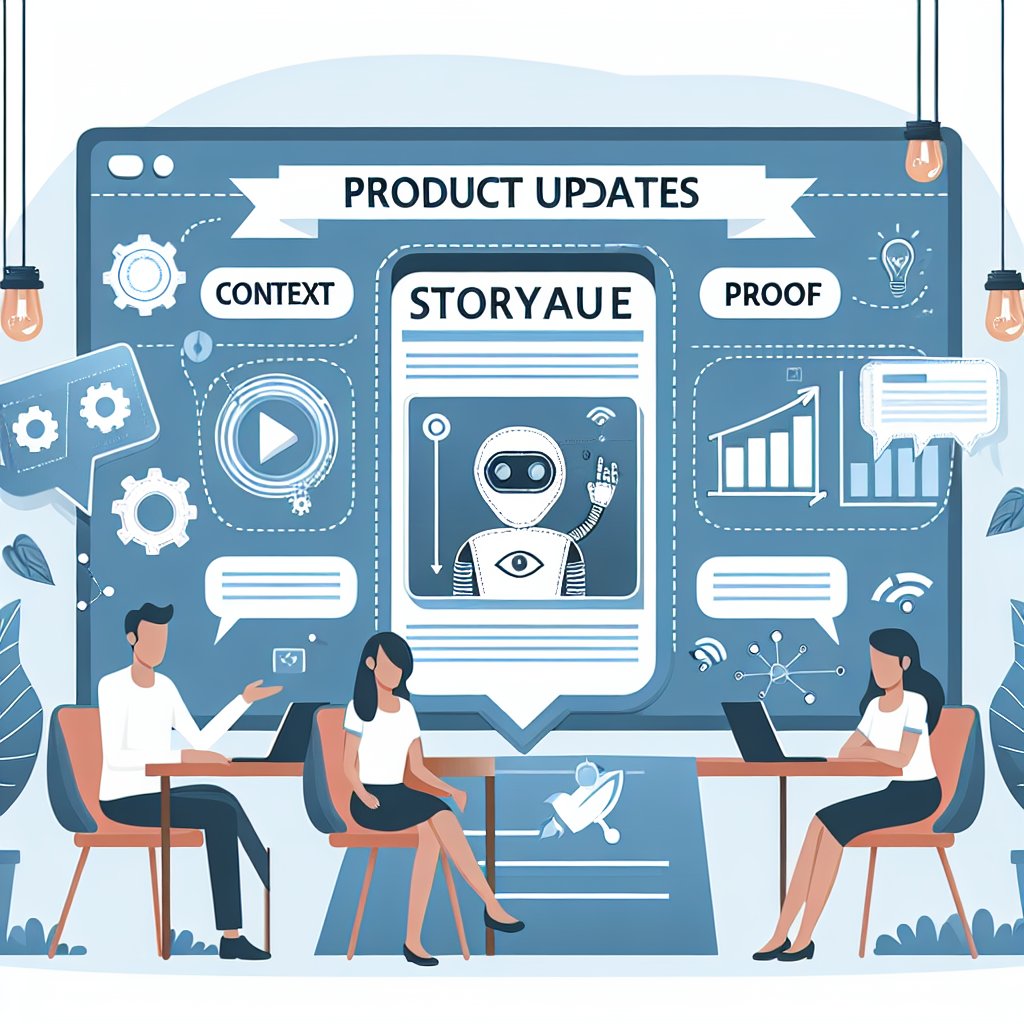


Most product updates fail because they read like a list, not a record of decisions that customers can trust. This guide shows how to announce improvements and new features by explaining what changed, why it changed, who it affects, and what to do next, without overwhelming anyone.
“Product update” often becomes a synonym for “changelog.” But your users are not scanning for engineering progress. They are scanning for risk, opportunity, and whether their daily workflow will still work tomorrow. When updates feel vague, customers create workarounds, support tickets spike, and adoption stalls.
A better model is to treat every release as a decision log. A decision log is not a diary of what you built. It is a compact explanation of the decision, the tradeoffs, the impact, and the next action a user should take. That framing is what turns announcements into confidence, and confidence into usage.
Below is a practical way to write product updates that clearly communicate announcements, improvements, and new features, focusing on what changed and why. You will also see how platforms like Staffono.ai can help you distribute these updates across messaging channels, answer questions 24/7, and guide customers into the right next step automatically.
Users do not experience your product as features. They experience it as habits. A habit could be “copy a link, send it to a client, confirm the booking,” or “tag a lead, follow up on WhatsApp, log the outcome.” When you ship changes, you are either strengthening a habit or breaking it.
That is why the best update notes answer four questions:
When you write like a decision log, you reduce anxiety and speed up adoption. Use this structure for each major item in your update.
Write a headline that includes the outcome and the user benefit. Avoid “We launched” phrasing. Prefer “You can now” or “Now your team can.”
Describe what a user will notice. If it is a UI change, state what moved. If it is a workflow change, state what step is removed or added.
Give the reason in customer language. Ideally include lightweight evidence: volume of requests, support themes, time saved, or conversion lift. You do not need perfect numbers, but you do need a credible reason.
Call out anything that could surprise someone: permission changes, default changes, deprecations, API versioning, or billing implications. If there is no risk, say so plainly.
End with the smallest action that unlocks value: toggle a setting, update a template, train a teammate, or read a short help article.
Below are example blurbs you can adapt. Notice how each one is anchored to a decision and a user habit.
Decision headline: Follow-ups now queue automatically when a lead goes quiet, so fewer opportunities slip through.
What changed: If a lead has not replied within your selected time window, the system creates a follow-up task and suggests a message template based on the last intent.
Why: Many teams told us leads go cold not because they were unqualified, but because the next touchpoint was forgotten during busy hours.
Impact: No changes to existing templates. Admins can set the timing rule in settings. Agents will simply see new queued follow-ups.
Next step: Set your quiet window and choose the default follow-up template for new leads.
Decision headline: One conversation view now supports WhatsApp, Instagram, Telegram, Messenger, and web chat, so context stays intact across channels.
What changed: Messages from supported channels appear in a single thread with unified customer identity, and internal notes are visible to your team regardless of where the customer writes next.
Why: Customers frequently switch channels mid-journey. Losing context increases response time and repeats questions, which reduces conversion.
Impact: Existing channel connections keep working. If you use tags or routing rules, you can map them to the unified identity once.
Next step: Connect any missing channels and review your routing rules for the unified thread.
Many announcements include a generic “We listened to your feedback.” Users have heard it. Credibility comes from specificity and from acknowledging tradeoffs.
Use one of these “why” patterns:
Also state what you did not do. Example: “We did not change pricing,” or “We did not remove the old workflow, it remains available in settings.” That one sentence can prevent a flood of anxious replies.
Even a perfect product update fails if it only lives on a blog. Your audience is fragmented: some will read email, others will notice in-app banners, many will only ask when something breaks.
Plan distribution as part of the update itself:
This is where Staffono.ai fits naturally. If your customers interact on WhatsApp, Instagram, Telegram, Facebook Messenger, or web chat, Staffono can deliver targeted update messages, answer follow-up questions instantly, and route complex issues to a human when needed. Instead of forcing customers to “go read the release notes,” you bring the relevant part of the decision log to the channel they already use.
Over-communication is real. The goal is not to tell everyone everything, it is to tell each segment what they need to stay productive.
Create three tiers of messaging:
For example, if you launch a new booking confirmation flow, only customers who use bookings should receive the deep details. Others can get a single sentence in the monthly digest.
With Staffono.ai, segmentation can become operational instead of manual. Your AI employee can detect intent and usage patterns from conversations, then trigger the appropriate update snippet and “what to do next” steps. That reduces noise and increases adoption, because messages arrive when they matter.
Before publishing, run each update item through this checklist:
If you only measure opens and clicks, you are measuring curiosity, not success. Choose metrics that match the decision.
Messaging is part of the measurement. If customers ask the same question repeatedly, your “why” and “impact” sections are likely unclear. If they ask “how do I do it,” your “next step” needs to be more explicit.
Teams often avoid frequent, high-quality updates because they are time-consuming. AI can help, but only if it is embedded into operations.
With Staffono.ai, businesses can automate parts of the release communication loop:
This is especially valuable when your product touches revenue, like bookings, lead qualification, or payment steps. In those cases, the cost of confusion is immediate.
The real release is not the code. The real release is when users change their behavior confidently. Writing product updates as a decision log forces clarity: what changed, why it changed, who it affects, and what to do next. That clarity reduces support load, protects habits, and makes new features actually usable.
If you want your updates to reach customers where they are and turn questions into guided actions, Staffono.ai can help. Staffono’s AI employees can announce relevant changes across WhatsApp, Instagram, Telegram, Messenger, and web chat, answer follow-up questions 24/7, and route critical cases to your team, so every release comes with the communication layer it needs to succeed.