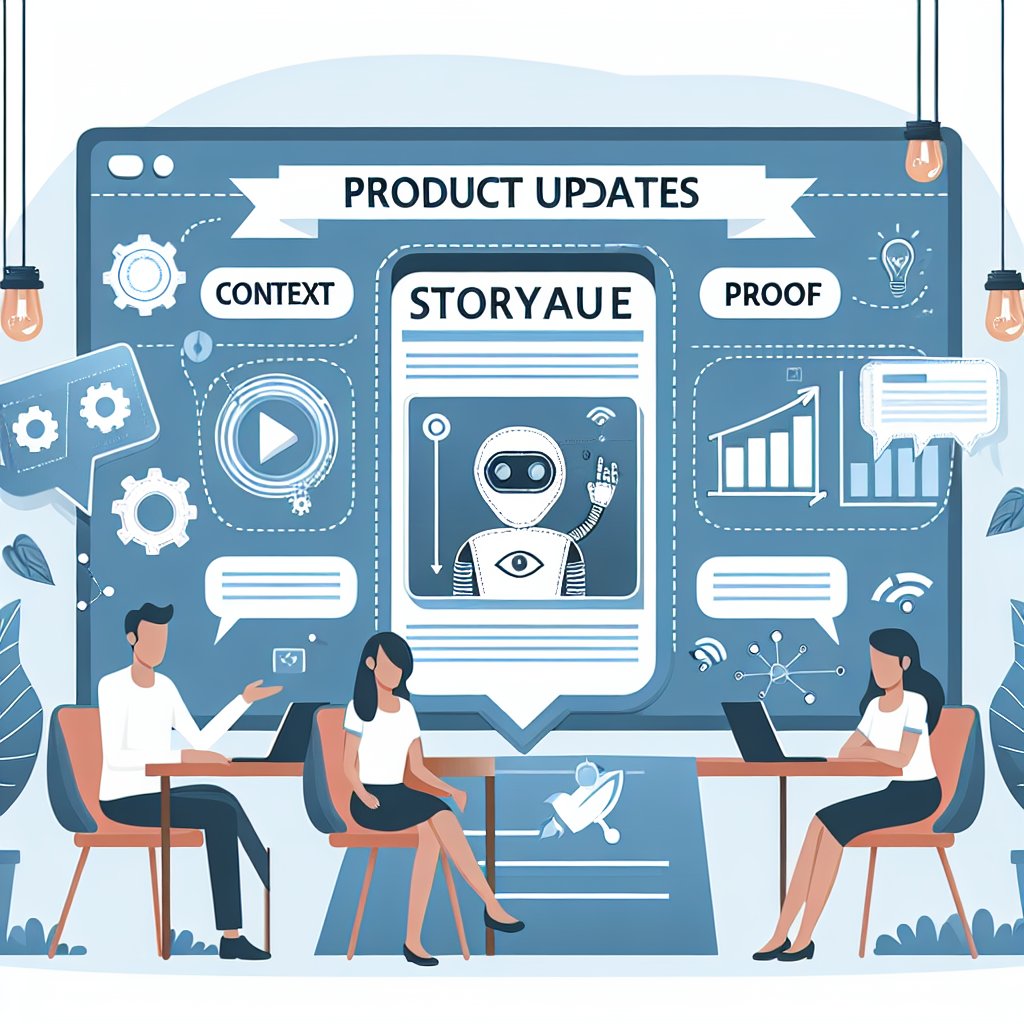

Product updates are not just information, they are behavior change. This guide shows how to announce announcements, improvements, and new features with clarity, relevance, and measurable adoption, without overwhelming customers or internal teams.
Product updates are one of the most underused growth levers in software and service businesses. Teams ship meaningful improvements, publish a list of bullets, and then wonder why customers do not adopt the change, why support volume spikes, or why sales still struggles to explain the difference. The issue is rarely the update itself. It is the way the change is framed, delivered, and reinforced across channels.
This post is a practical blueprint for communicating product updates so people understand what changed and why, then actually use it. You will learn how to choose the right level of detail, how to tailor the message to different audiences, and how to turn release communication into a repeatable system that reduces confusion and increases adoption.
Most update announcements begin with what shipped. Customers usually care more about what improves in their day-to-day workflow. A strong update narrative leads with an outcome, then ties the change back to a specific pain point.
Use this simple structure:
Example: Instead of “We added message routing rules,” try “Faster replies during peak hours: route WhatsApp leads to the right team automatically.” Then explain what changed, why it matters, and how to enable it.
Not every update is the same, and users read them differently. Treat each category as a different promise:
Why this matters: announcements need trust and clarity, improvements need proof and specificity, and new features need onboarding. If you blend them into one list, customers miss what is urgent and ignore what is valuable.
One update needs multiple versions. The same change can be framed differently depending on who reads it.
Users need “how it affects my daily work.” Keep it concrete. Mention where to click, what will look different, and what they should do next. Include a short example.
Buyers want outcomes and risk reduction. Tie the change to ROI, compliance, uptime, or scale. Avoid deep UI detail. Mention what it enables at the business level.
Internal teams need talk tracks and edge cases. Provide: who is impacted, what questions will come up, how to troubleshoot, and what to say if a customer is upset by change.
If you use Staffono.ai (https://staffono.ai) to manage customer conversations across WhatsApp, Instagram, Telegram, Facebook Messenger, and web chat, this multi-audience split becomes even more important. Your update messaging is not just a blog post. It is also a set of responses that your AI employee and human team will repeat hundreds of times in real conversations.
Customers vary in how deeply they want to read. Give everyone a path.
This makes your announcement skimmable while still serving power users. It also reduces support tickets because the “deep dive” answers questions before they are asked.
Customers often resist change when they cannot see the reasoning. The goal is not to justify every decision, but to provide enough context to feel safe. Good “why” statements are specific and user-centered.
Avoid vague claims like “to enhance the user experience.” If you cannot name the user pain, you cannot convincingly explain the change.
Updates are remembered when users can picture themselves using them. Include a short scenario that mirrors real work.
Scenario: A customer messages on Instagram asking for available times. The new flow automatically offers time slots, confirms the booking, and sends a reminder.
This is where Staffono.ai naturally fits: if your product update includes new messaging or booking steps, you can implement them as automated conversational flows with a 24/7 AI employee. That turns “we shipped it” into “customers are using it tonight,” especially on high-velocity channels like WhatsApp.
Many teams rely on one channel, usually email or a changelog page. But your users live in multiple places. A modern update distribution plan typically includes:
If your customers frequently ask “What changed?” through chat, consider making the update itself conversational. With Staffono.ai, you can deploy an AI employee that answers update questions consistently across WhatsApp, Instagram, Telegram, Messenger, and web chat, and can also guide users through setup steps using your approved documentation and rules.
The most fragile period for an update is right after release. Even positive changes can create confusion. Prepare for the spike with a small checklist:
This is also where automation helps. Instead of pushing every question to humans, Staffono can handle common “how do I” questions instantly and escalate edge cases with context, reducing response time while keeping your team focused on true issues.
It is easy to measure opens and clicks. It is harder, and more important, to measure usage. Before announcing, define one primary adoption metric and one secondary quality metric.
Then connect the communication to the outcome. If adoption is low, the fix might not be the feature. It might be the message, the onboarding, or the channel mix.
Use this template for a clean, outcome-first update announcement:
The highest-performing teams treat updates as the start of a dialogue. They invite questions, watch confusion points, and improve the message. This is especially powerful in messaging-first businesses, where customers expect fast answers and personal guidance.
If you want your next product update to land across every channel, consider using Staffono.ai (https://staffono.ai) to operationalize the communication. You can equip an AI employee with your release notes, FAQs, and setup steps so customers get instant explanations of what changed and why, plus guided help to adopt the new workflow. When your update becomes a conversation instead of a broadcast, adoption becomes easier to earn and easier to measure.
Publish less noise, deliver more clarity, and let your product updates do what they are supposed to do: move customers forward.