
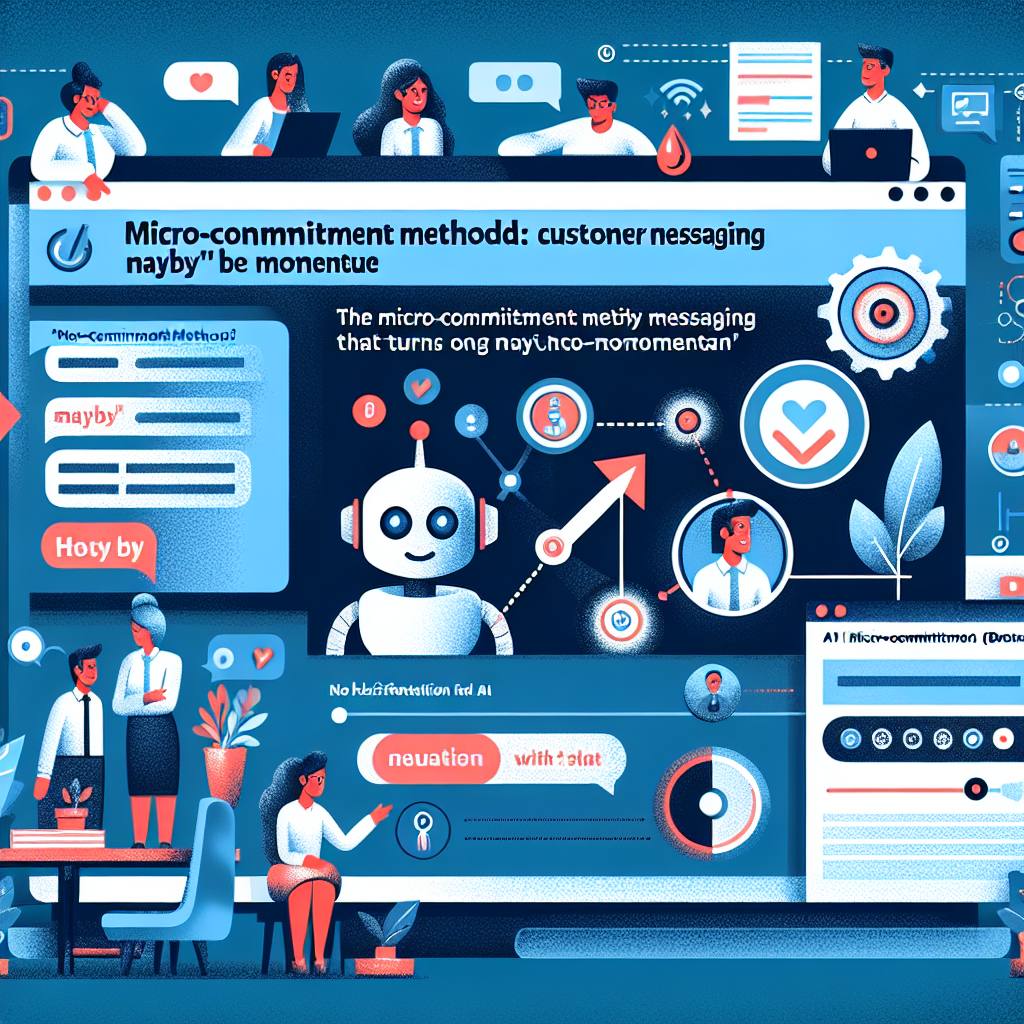
Most customer conversations do not fail because of objections, they fail because nothing concrete happens next. This guide shows how to design messages that earn small, low-friction commitments, keep customers moving, and make follow-ups feel helpful instead of pushy.
Messaging is where modern customers make decisions. Not in your pricing page, not in your brochure, and not in a long email thread. It happens inside WhatsApp, Instagram DMs, Telegram, Facebook Messenger, and web chat, in short bursts between meetings, commutes, and family time. The businesses that win are not the ones that write the cleverest lines. They are the ones that reliably convert uncertainty into the next small step.
That is the core idea behind micro-commitments: instead of asking customers to leap from “Hi” to “Buy now,” you guide them through tiny yeses that feel easy, safe, and specific. Each message reduces effort, increases clarity, and makes the next action obvious. Below you will find a practical framework, best practices, and ready-to-use templates you can adapt across channels.
A micro-commitment is any low-friction action that advances the conversation: answering one question, choosing between two options, sharing a detail, picking a time, confirming a preference, or approving a next step. They work because they reduce cognitive load and decision anxiety.
In messaging, customers typically hesitate for three reasons:
Micro-commitments address all three. A good micro-commitment message is short, concrete, and reversible. It feels like progress, not pressure.
People respond when the message makes it easy to answer. Instead of “Let me know if you have questions,” use a specific prompt that can be answered in seconds.
Open-ended questions invite silence. Two options invite replies. The key is to make both options reasonable so the customer does not feel manipulated.
In chat, long paragraphs look heavier than they are. Use short sentences, line breaks, and compact lists. If you must send information, send the minimum needed to unlock the next micro-commitment.
Customers cooperate when they feel heard. Paraphrase their need in one sentence, then ask for confirmation. This creates a clean pivot into recommendations.
Example: “Got it, you need weekend appointments and a fixed monthly budget. Is that right?”
When you give customers a non-threatening path, they are more likely to continue. “No worries if not” can be powerful when used sparingly and sincerely.
Example: “If it is not a fit, I will tell you quickly, no pressure.”
Think of your messaging flow as a sequence of small decisions. Here is a universal map that works for sales, bookings, and support.
Your first reply should do two things: reassure the customer and ask a question that takes less than 10 seconds to answer.
Ask only what you need to route, price, or book. Use progressive profiling: gather details over multiple messages rather than in one interrogation.
Do not dump three packages and ask “What do you think?” Recommend one option and give a simple next step.
When someone is ready, the biggest risk is delay. Offer immediate scheduling options, simple payment links, or a short form only if required.
Confirm what was agreed, what happens next, and when they will hear from you.
Adapt these templates to your industry. Keep the brackets for internal use and replace them before sending.
“Thanks for reaching out about [topic]. To point you to the right option, is this for [Option A] or [Option B]?”
Alternative: “Quick one so I can help fast: what is your timeline, this week or later?”
“Happy to help. When you say [their word], do you mean [interpretation 1] or [interpretation 2]?”
“It depends on [key variable]. Most customers land between [range] for [common scenario]. If you tell me [one detail], I can confirm the exact number.”
“Based on what you shared ( [summary] ), I would start with [recommended option]. Want me to set it up for [time A] or [time B]?”
“I can book that now. Which works better: [day/time 1] or [day/time 2]? And what name should I put on the booking?”
“Checking in, do you still want help with [goal]? If yes, tell me which matters more: [priority 1] or [priority 2], and I will tailor the next step.”
“Just making sure I did not miss you. Should I close this out for now, or would you like me to send two options you can choose from later?”
“Totally fair. What is the main thing you want to be sure about before deciding: [fit], [timing], or [price]?”
“I can help with this. To fix it quickly, please share [one item]. If it needs a specialist, I will route it and keep you updated here.”
Great messaging is not just talent. It is a system with standards, templates, and measurement.
For each common intent (pricing, booking, availability, refund, product fit), write:
Micro-commitments sound simple until your inbox volume grows, replies slow down, and different team members message in different styles. Staffono.ai (https://staffono.ai) helps businesses keep conversations moving by using 24/7 AI employees to respond quickly, ask the right micro-commitment questions, and guide customers toward bookings or purchases across WhatsApp, Instagram, Telegram, Facebook Messenger, and web chat.
For example, instead of leaving a lead waiting overnight, Staffono can instantly confirm what the customer needs, collect the one or two details required to quote accurately, and propose two appointment times. It can also maintain consistent tone and structure across your channels, so customers get the same clarity whether they message you on Instagram or your website.
Because Staffono.ai centralizes and automates routine conversation steps, your human team can focus on complex cases, high-value negotiations, and relationship building. The result is fewer stalled chats and more completed next steps, which is the real currency of messaging.
If you want these improvements to run consistently, even when your team is offline or busy, Staffono.ai (https://staffono.ai) is built for exactly that: AI employees that keep conversations moving, capture the right details, and convert interest into clear next steps across every major messaging channel. When your messaging is engineered for micro-commitments and supported by automation, “Maybe” stops being a dead end and starts becoming momentum.