
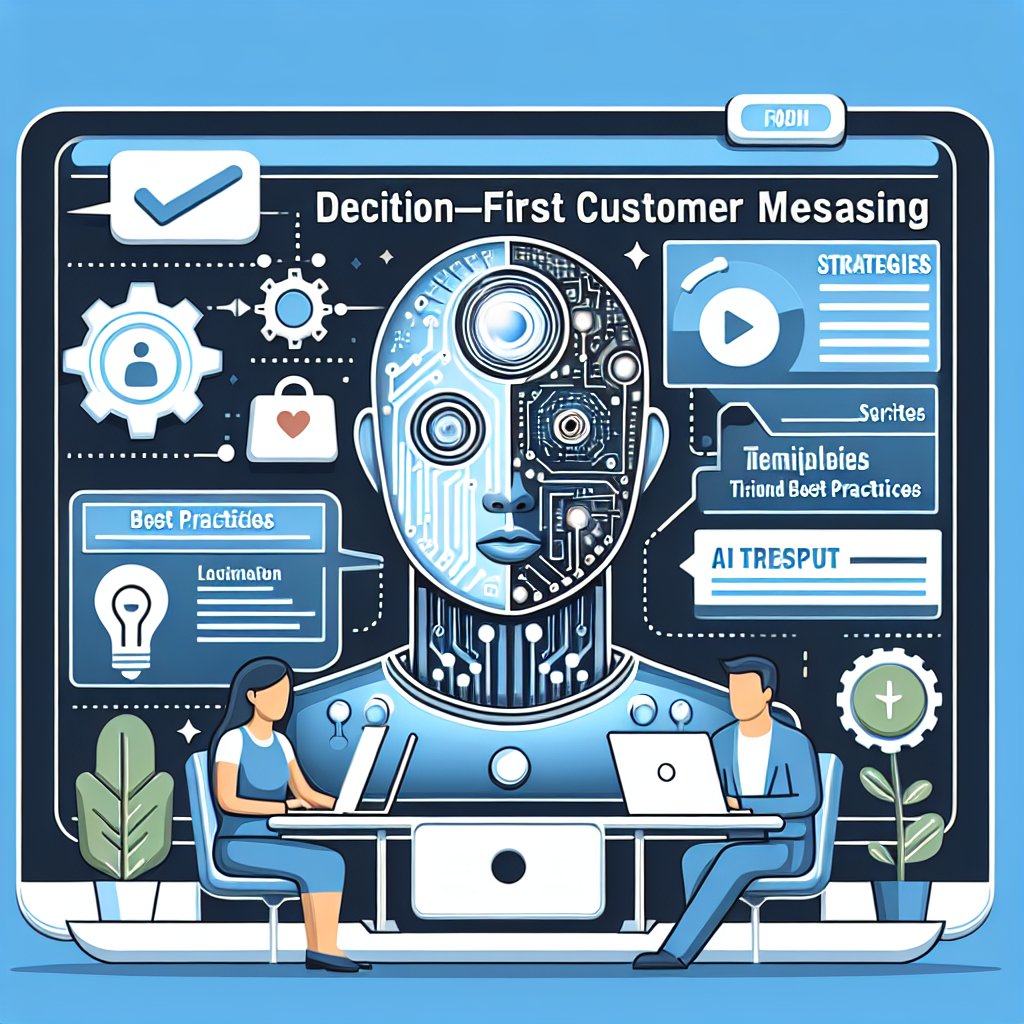
Great customer messaging is not just friendly, it is designed to help customers make the next decision with minimal effort. This guide shows how to structure conversations, choose the right templates, and apply best practices across channels while staying human, fast, and consistent.
Most customer messaging advice focuses on tone, personalization, and speed. Those matter, but the fastest way to improve outcomes is to treat messaging as decision architecture: every message should reduce uncertainty and make the next step obvious. Whether you are answering a pricing question on Instagram, confirming an appointment on WhatsApp, or rescuing a stalled lead in web chat, your job is to help the customer decide.
This article breaks down practical strategies, reusable templates, and best practices you can apply across channels. You will also see where automation fits naturally, including how Staffono.ai (https://staffono.ai) can run consistent, 24/7 conversations that book meetings, qualify leads, and answer questions without losing the human feel.
Before you type anything, ask: what decision does the customer need to make next? Examples include choosing a time slot, selecting a package, sharing a detail you need to proceed, or confirming they understood a policy. If you design your message around that decision, your replies become shorter, clearer, and more effective.
Use this quick checklist:
People skim. Break messages into small blocks: one sentence for context, one for options, one for the question. This keeps you readable on mobile and reduces back-and-forth.
Example structure:
When customers face too many possibilities, they pause. Bounded choices reduce cognitive load and increase replies.
Instead of: “When would you like to meet?”
Try: “Would you prefer today at 4:00 pm or tomorrow at 11:30 am?”
When a customer is unhappy, you need two different lines: one for empathy, one for resolution. Mixing them often sounds defensive. Lead with empathy, then move to the next decision.
Customers share messages with partners, managers, or friends. If your message is screenshot-friendly, it becomes a sales asset. That means clear terms, minimal jargon, and no hidden conditions.
Templates are not meant to be copy-pasted blindly. They are decision frameworks you can personalize in seconds. Replace bracketed text and keep the structure.
Goal: Establish trust and collect one key detail.
“Hi [Name], thanks for reaching out about [topic]. I can help with that. Quick question so I point you to the right option: are you looking for [Option A] or [Option B]?”
Goal: Give a usable range and guide to the right tier.
“Great question. For [service/product], most customers land between [range] depending on [1-2 drivers]. If you tell me [key detail], I will recommend the best-fit option and share the exact price. Which describes you: [choice 1], [choice 2], or [choice 3]?”
Goal: Convert “I need help” into a clear plan.
“Understood. To get you a solid answer, I need two details: [detail 1] and [detail 2]. If it is easier, just reply with a quick ‘A/B’ style choice: [A option] or [B option]?”
Goal: Offer two times and confirm channel.
“Perfect, let’s book it. I have [time 1] or [time 2] available. Which works better? And should I send the confirmation to this chat or to [email/phone]?”
Goal: Restart the conversation with a helpful nudge.
“Hi [Name], checking in in case it helps. Based on what you shared, the fastest path is usually [recommendation]. If you want, I can set it up for you, would you prefer [option 1] or [option 2]?”
Goal: Reframe value and offer a smaller commitment.
“Totally fair. To make sure we are comparing the right thing, is the main concern the upfront cost or the monthly spend? If you want, we can start with [smaller package/pilot] at [price] and upgrade later. Would that solve it?”
Goal: Say no while keeping momentum.
“I want to be transparent: we do not provide [out-of-scope item]. What we can do is [closest alternative]. If you share [detail], I will confirm whether it fits your situation.”
Instead of organizing templates by channel (WhatsApp vs Instagram), organize by intent: new lead, pricing, availability, objection, escalation, renewal. Your team will find the right reply faster, and your brand voice stays consistent.
Multi-question messages get partial answers, which increases back-and-forth. If the customer is close to buying or already frustrated, ask one question, then proceed.
A one-line confirmation prevents misunderstandings:
“Just to confirm, you want [X] for [Y date], and you prefer [channel]. Is that right?”
If your process takes time, say so. Uncertainty creates follow-ups and distrust.
“I will check availability and reply within 20 minutes. If it is not available, I will send two alternatives.”
Not every conversation should be automated or handled by junior staff. Define triggers for escalation: legal issues, refunds, safety, high-value enterprise deals, or emotionally charged complaints.
Automation wins when the conversation follows predictable intents: FAQs, lead qualification, scheduling, order status, basic troubleshooting, and collecting details for a quote. It can also win at night, on weekends, and during spikes, when humans cannot respond quickly enough.
This is exactly where Staffono.ai can help. Staffono.ai provides 24/7 AI employees that communicate with customers across WhatsApp, Instagram, Telegram, Facebook Messenger, and web chat. Instead of building fragile scripts, you can deploy an AI teammate that handles common questions, collects the right information, books appointments, and hands off complex cases to your team with a clean summary.
Automation should pause when nuance matters: sensitive complaints, legal or billing disputes, or enterprise negotiations. The goal is not to replace humans, but to reserve human attention for the moments where it creates the most value.
Here is a simple flow you can implement in a week:
With Staffono.ai, this flow can run automatically across channels, so every lead gets a fast response and every booking request gets handled even outside office hours. Your team receives only the conversations that truly require human judgment.
To improve messaging, track outcomes that reflect decisions:
Use these metrics to refine templates and identify where automation should capture details earlier.
Customer messaging improves fastest when you stop trying to craft the perfect reply and start guiding the next decision. Use bounded choices, keep messages skimmable, confirm understanding, and build a template library organized by intent. Then automate the repeatable parts so your team can focus on the conversations that actually need a human.
If you want to make this operational across WhatsApp, Instagram, Telegram, Facebook Messenger, and web chat, Staffono.ai (https://staffono.ai) is a practical way to deploy AI employees that answer instantly, qualify leads, and book appointments 24/7 while keeping your tone consistent. When you are ready, you can start with one channel and one workflow, then expand as you see results.