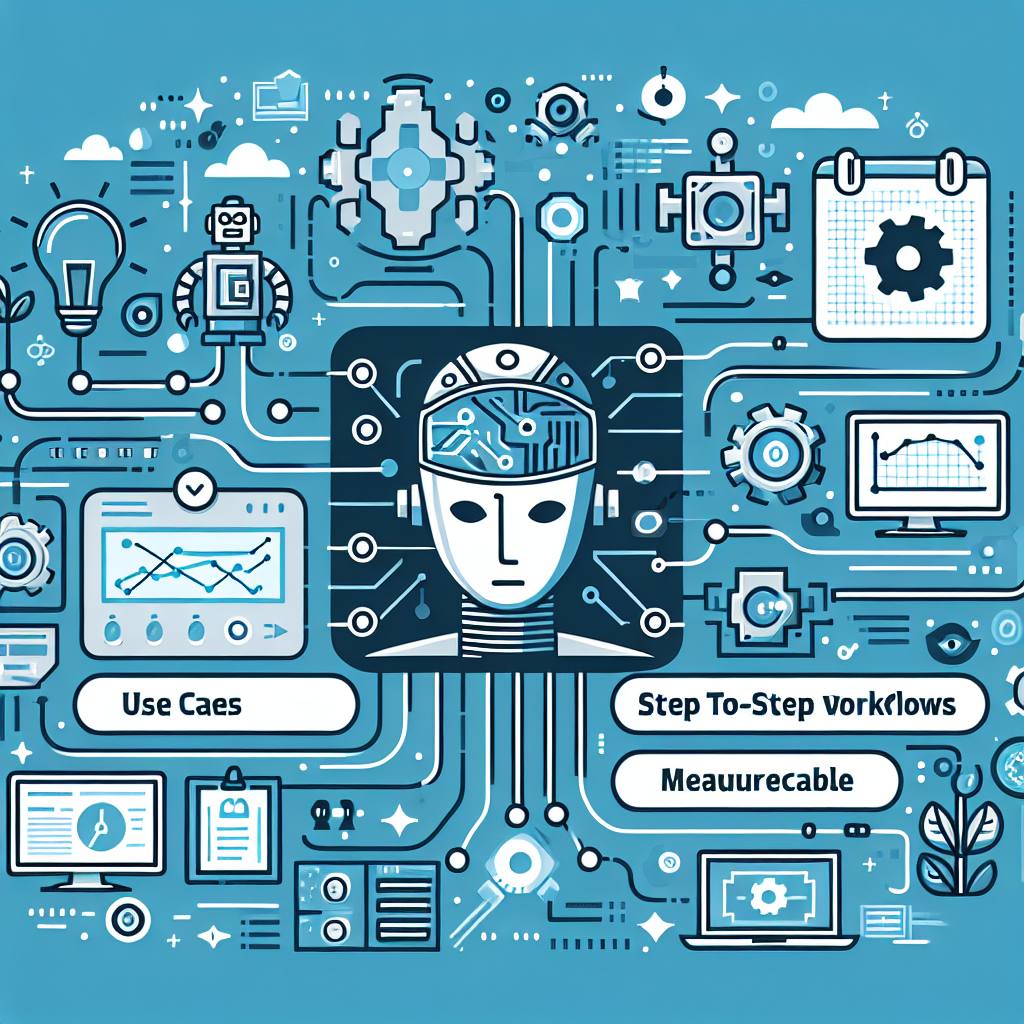
Use cases are only useful when they become repeatable workflows your team can run without thinking. In this guide, you will see real scenarios, the exact steps to implement them, and the metrics to track so automation improves revenue, speed, and customer experience.
“Use cases” often sound like a planning artifact, but in practice they are the fastest way to move from AI curiosity to operational impact. The difference between a nice demo and a revenue-producing system is simple: a use case becomes valuable when it is turned into a step-by-step workflow with clear triggers, required data, decision rules, and a measurable outcome.
This post is a practical playbook. You will find real scenarios you can implement in messaging-first businesses and service teams, plus the exact workflow steps, what to automate first, what to keep human, and how to measure results. Where it fits naturally, you will also see how Staffono.ai (https://staffono.ai) can act as the 24/7 AI employee that runs these workflows across WhatsApp, Instagram, Telegram, Facebook Messenger, and web chat.
How to turn a “use case” into a workflow you can ship
Before diving into scenarios, lock in a repeatable structure. A workflow that works in production has five parts:
- Trigger: an event like “new message,” “missed call,” “link clicked,” or “no reply in 2 hours.”
- Inputs: what the system needs, such as product catalog, availability, prices, policies, CRM fields, or location.
- Steps and decision rules: how the conversation and actions progress, including when to escalate to a human.
- Outcome: booking confirmed, lead qualified, invoice paid, ticket created, or follow-up scheduled.
- Metrics: response time, conversion rate, deflection rate, average handle time, and revenue per conversation.
Staffono.ai is designed to sit directly on the message channels where these triggers happen, respond instantly, collect structured data, and pass clean handoffs to humans when needed. That makes it a practical foundation for shipping workflows instead of writing one-off scripts.
Scenario 1: “Instant lead capture” for ads and social DMs
Who it’s for: companies running ads or getting inbound Instagram and WhatsApp inquiries that currently go cold after hours.
Goal: capture contact details, qualify intent, and route hot leads to sales within minutes.
Step-by-step workflow
- Trigger: a new inbound message that includes “price,” “cost,” “how much,” “interested,” or comes from an ad click.
- Auto-reply: acknowledge and set expectations: “I can help with pricing and availability. What are you looking for?”
- Qualification questions: ask only what you need to route correctly, such as budget range, timeline, location, and product/service category.
- Contact capture: confirm name, phone/email (if not already available), and preferred channel.
- Lead scoring rule: mark as “hot” if timeline is within 14 days and budget matches, “warm” otherwise.
- Routing: hot leads get immediate notification to a salesperson with conversation summary; warm leads go into a nurture sequence.
- Outcome: a qualified lead record, assigned owner, and a scheduled next step (call, demo, visit).
What to measure
- Time to first response
- Lead-to-meeting rate
- Percentage of leads captured outside business hours
With Staffono.ai, this workflow can run 24/7 across the channels where your ads and social traffic land, ensuring no lead waits until morning to get basic answers and a next step.
Scenario 2: Appointment booking with policy-aware confirmations
Who it’s for: clinics, salons, consultancies, and any business where messaging is the main booking channel.
Goal: convert chat into a confirmed booking while enforcing rules like deposits, cancellation windows, and required details.
Step-by-step workflow
- Trigger: “book,” “appointment,” “available,” or a user selecting “Book” in a menu.
- Collect constraints: service type, preferred date/time, staff member (optional), location, and first-time vs returning.
- Check availability: show 3 to 5 time options, not an open-ended question.
- Policy check: if the service requires a deposit, the assistant explains the rule and provides a payment link.
- Confirm details: customer name, phone, any required notes (for example, symptoms or preferences).
- Finalize: send confirmation message, calendar invite (if applicable), and a reminder schedule.
- Escalation: if the customer requests an exception to policy, route to a human with a concise summary.
What to measure
- Chat-to-booking conversion
- No-show rate (before and after reminders)
- Average number of messages to confirm
Staffono.ai is particularly effective here because it can handle the repetitive booking steps instantly, keep the conversation moving, and still hand over edge cases to your team without losing context.
Scenario 3: “Quote-to-checkout” for product and service inquiries
Who it’s for: businesses that frequently answer “how much is it?” but struggle to close in chat.
Goal: turn pricing questions into a guided purchase or a sales-ready quote.
Step-by-step workflow
- Trigger: pricing request or product question.
- Discovery: ask two to three questions that determine the right package (quantity, size, delivery date, usage).
- Offer: present a recommended option plus one alternative, each with clear inclusions.
- Handle objections: shipping, warranty, timelines, and compatibility.
- Checkout step: provide payment link or “reserve now” option; capture delivery details.
- Post-payment message: confirm order, set expectations, and open a support channel for updates.
What to measure
- Quote acceptance rate
- Revenue per conversation
- Drop-off step (where people stop replying)
This is where consistent messaging matters. Staffono.ai helps standardize offers and ensures every inquiry gets the same high-quality product guidance, even during peak hours.
Scenario 4: After-hours support triage that reduces tickets
Who it’s for: teams overwhelmed by repetitive support questions and night-time requests.
Goal: resolve common issues instantly and create clean tickets only when necessary.
Step-by-step workflow
- Trigger: any inbound support message outside business hours or tagged “help,” “problem,” “not working.”
- Identify category: billing, delivery, login, technical issue, returns.
- Self-serve resolution: provide step-by-step instructions and request confirmation: “Did this solve it?”
- Collect evidence: order number, screenshot, device type, and short description.
- Decision rule: if unresolved after two attempts, create a ticket with all details.
- Update: send an expected response time and keep the customer informed.
What to measure
- Deflection rate (issues solved without a human)
- First contact resolution
- Customer satisfaction score after resolution
Because Staffono.ai operates as an always-on AI employee across messaging channels, customers get immediate help and your team starts the day with well-structured cases instead of messy chat threads.
Scenario 5: “No response” recovery for leads and customers
Who it’s for: businesses losing revenue because prospects stop replying mid-conversation.
Goal: recover stalled conversations without sounding pushy or robotic.
Step-by-step workflow
- Trigger: no reply after a set window (for example, 2 hours for hot leads, 24 hours for others).
- Message 1: a helpful nudge with a single question: “Do you want option A or B?”
- Message 2: add value, such as a short FAQ, policy, or delivery timeframe.
- Message 3: “close the loop” politely, offering to pause messages and saving the quote.
- Stop rule: if no response after three touches, mark as inactive and schedule a future check-in.
What to measure
- Recovered conversation rate
- Incremental bookings or payments from follow-ups
- Unsubscribe or negative feedback rate
Staffono.ai can run this recovery sequence consistently while respecting timing rules and channel norms, which is difficult to do manually at scale.
Implementation checklist: ship one workflow in a week
To avoid endless planning, implement one scenario end-to-end with minimal complexity.
Day 1-2: Define boundaries
- Pick one channel and one scenario.
- List required inputs (pricing, schedule, policies, FAQs).
- Write escalation rules for edge cases.
Day 3-4: Build the conversation path
- Create message templates for the top 10 questions.
- Define the minimum data to capture.
- Decide what gets written to your CRM or sheet.
Day 5-7: Launch and measure
- Go live with a limited audience or time window.
- Review transcripts and refine the questions.
- Track one primary metric (conversion, deflection, or speed).
If you want to move faster without rebuilding your stack, Staffono.ai (https://staffono.ai) can help you deploy these workflows directly in the channels where customers already message you, with 24/7 coverage, structured data capture, and clean handoffs to your team. The simplest next step is to pick one scenario above, map your trigger and outcome, and let an AI employee handle the first response and routine steps while your people focus on exceptions and closing.
Stop losing customers
Your competitors reply in seconds. Do you?
Staffono.ai replies to every customer message on WhatsApp, Instagram, and Telegram instantly - 24/7. Automate support, bookings, and sales while you sleep.