
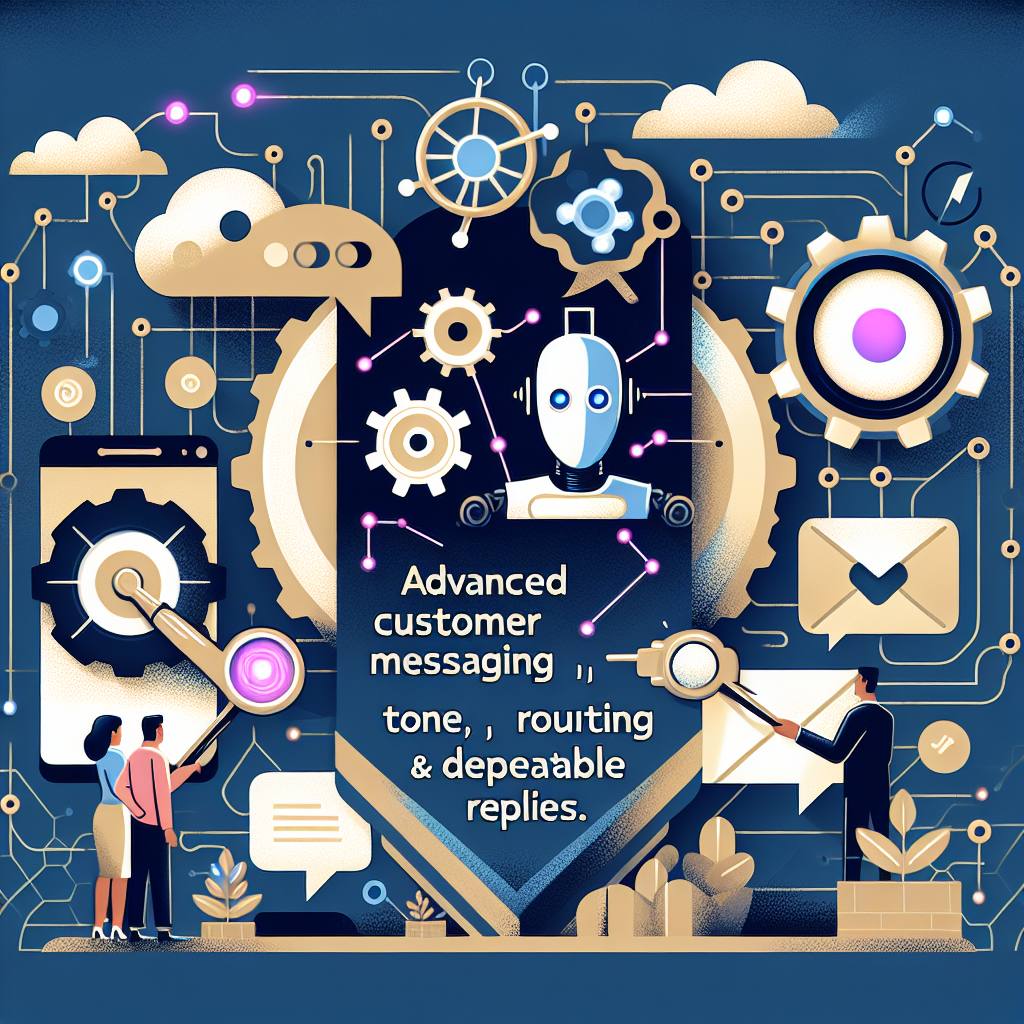
Most messaging problems are not about writing better sentences, they are about choosing the right tone, sending the message to the right place, and using repeatable replies without sounding robotic. This guide gives you a usable system, ready-to-copy templates, and best practices for consistent customer conversations across channels.
Customer messaging is one of the few business activities that touches marketing, sales, support, operations, and retention at the same time. Yet most teams treat it like an improv show: every agent writes from scratch, tone changes from one chat to the next, and important questions get lost in a busy inbox. The result is predictable: slow replies, repeated follow-ups, and customers who feel unsure.
Strong customer messaging is a system. It includes tone rules, routing logic, reusable templates, and a feedback loop that improves the scripts over time. When you build those elements intentionally, you get faster resolution, higher conversion, and fewer escalations, even if you manage WhatsApp, Instagram, Telegram, Facebook Messenger, and web chat all at once.
Below is a practical playbook you can implement in days, including templates you can adapt to your business and examples that work across industries.
Before templates, you need clarity. Most inbound messages fall into a small set of intents. Create a messaging map that lists your top intents and what “success” looks like for each.
For each intent, define the next best action: a booking link, a short qualification question, a knowledge-base answer, or an escalation path. This prevents conversations from drifting.
Platforms like Staffono.ai (https://staffono.ai) help here because they can categorize incoming messages by intent across multiple channels and trigger the appropriate workflow, which reduces manual sorting and missed messages.
Tone is not “friendly” versus “formal.” Tone is a set of choices that creates a consistent customer experience. Document these as rules so any person, or AI assistant, can follow them.
Write two examples of “on-brand” messages and two examples of “off-brand” messages. This makes tone coaching easier than abstract guidelines.
Routing is a messaging strategy, not just a support feature. If the wrong person answers, the conversation becomes slow and inconsistent. Create routing rules based on what matters most: intent, customer value, urgency, and risk.
If you operate on multiple channels, routing becomes harder because each platform has its own inbox. Staffono.ai centralizes messaging across WhatsApp, Instagram, Telegram, Facebook Messenger, and web chat, and can route to the right AI or human path automatically based on your rules.
Many chats stall because the customer has to do too much at once: answer five questions, read a long explanation, or make a big decision with incomplete information. Instead, ask for small next steps that are easy to complete.
This approach reduces back-and-forth and keeps the customer feeling progress.
Good templates do not copy-paste a wall of text. They anticipate the next question and include a clear action. Below are adaptable templates you can use immediately.
Hi [Name], thanks for reaching out. I can help with that. To point you to the right option, can you tell me [one key detail]?
Thanks, [Name]. Our pricing depends on [driver, for example: size, number of users, service scope]. Most customers choose one of these:
Which one sounds closest, or should I recommend based on your goal?
Got it. So I recommend correctly, what matters most to you: [speed], [cost], or [premium quality]? And when do you want to start?
Perfect. I can book this for you. What day and time works best, and what is the best phone number or email for confirmation?
Thanks for checking, [Name]. This item is currently unavailable until [date]. If you want, I can:
Which would you prefer?
I’m sorry this happened, [Name]. I understand why that’s frustrating. If you share [order number / screenshot], I’ll check what went wrong and tell you the next step within [timeframe].
Hi [Name], quick follow-up in case it’s helpful. Based on what you shared, the best next step is [action]. If you want, I can also answer one question: what are you hoping to achieve with [product/service]?
In chat, aim for responses that fit on one screen on a phone. If you need more detail, break it into two messages: summary first, then details.
Replace multi-question interrogations with one high-signal question. Example: instead of asking budget, timeline, and requirements, ask: “What does success look like for you in the next 30 days?” Then branch based on the answer.
A single line like “Just to confirm, you need [X] for [Y], correct?” prevents misquotes, wrong bookings, and refunds.
Policies should be summarized in chat, with a link to the full policy if needed. Customers rarely read long blocks of legal text in messaging.
When you must escalate, the transition matters. Use: “I’m looping in our [team] so we can resolve this correctly. You won’t need to repeat yourself. Here’s what I’m sending them: [one-line summary].”
Staffono.ai can support this by capturing context automatically, summarizing the conversation, and passing it to a human teammate so customers do not have to repeat details.
Messaging performance is measurable. Choose a small set of metrics you can influence and review them weekly.
Create a simple habit: every week, pick the top two intents and improve one template each. Small improvements compound quickly.
Imagine a home services business receiving messages across Instagram and WhatsApp. Without a system, the team replies inconsistently: some quote prices without details, others ask too many questions, and bookings fall through. With a messaging map, they route “availability” to a booking workflow, “pricing” to a package explainer, and “complaints” to a senior queue. They use micro-commitments like “Which day works best?” and confirm details before scheduling.
With Staffono.ai, they can offer 24/7 coverage, capture key details automatically, book appointments, and hand off complex cases with a clean summary. The team stays focused on exceptions, while customers get instant, consistent progress.
The best customer message is the one that makes the customer’s next step obvious. If you build tone rules, routing logic, micro-commitments, and a template library, you reduce confusion and increase momentum across every channel.
If you want to operationalize this faster, Staffono.ai (https://staffono.ai) can act as an always-on AI employee across WhatsApp, Instagram, Telegram, Facebook Messenger, and web chat, using your templates and rules to qualify leads, answer FAQs, and book or escalate requests. Start by automating one high-volume intent, measure the results, then expand your workflows as you see consistent wins.