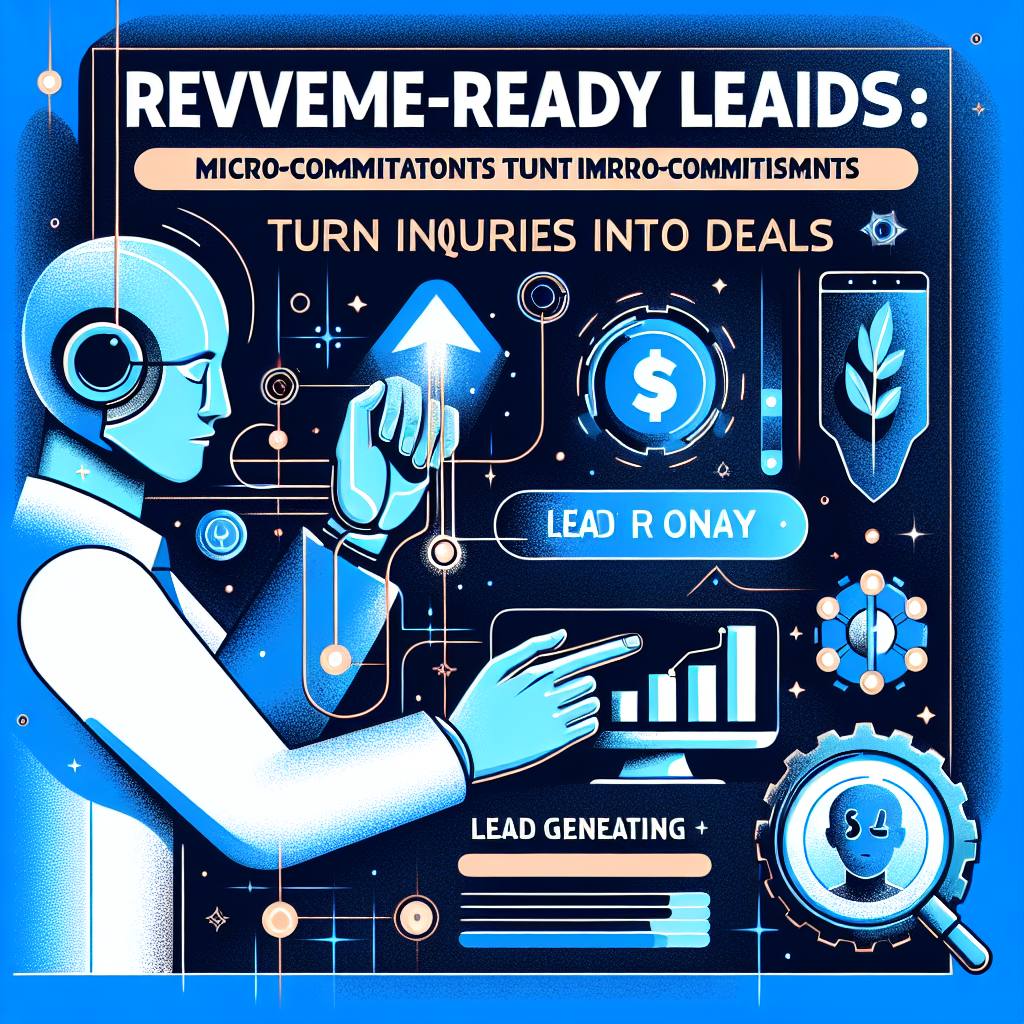


Most leads do not need a harder sell, they need a clearer path of tiny decisions that feel safe. This guide shows how to capture, qualify, and convert leads by designing micro-commitments across every message, form, and follow-up until buying becomes the obvious next step.
Lead generation and sales often break down for one simple reason: we ask prospects for a big commitment too early. A demo request, a discovery call, a proposal, a credit card. For many buyers, that leap feels risky or time-consuming, even if they are genuinely interested.
The alternative is a micro-yes system: a sequence of small, low-friction agreements that progressively increase intent. Each micro-yes makes the next step easier, while quietly qualifying the prospect. When done well, you capture more leads, waste less time on poor-fit conversations, and convert more revenue without sounding pushy.
A micro-yes is any action that signals interest and reduces uncertainty. It can be as small as answering a single question in a chat or choosing a preferred time window. The key is that each step delivers value to the prospect and gives you a usable signal.
These are small agreements, but together they build momentum and clarity. They also create structured data you can route, score, and follow up on.
Capture is not just “getting more inquiries.” It is reducing friction at the moment of interest and meeting prospects where they already communicate.
Many prospects will not fill out long forms. They will, however, ask a quick question on WhatsApp, Instagram, Telegram, Facebook Messenger, or web chat. If your response is slow or inconsistent, intent evaporates.
Staffono.ai (https://staffono.ai) helps businesses capture leads 24/7 across these messaging channels with AI employees that respond instantly, gather details, and keep the conversation moving. That speed alone can change your funnel because the first reply often determines whether the lead stays engaged.
Generic CTAs attract low-intent clicks. Specific entry points create self-selection and better fit.
These CTAs are micro-yes invitations. They promise an immediate payoff, so more people start the conversation.
A strong pattern for messaging and web chat is: value first, contact second.
This keeps the interaction buyer-friendly and improves conversion to identifiable leads.
Qualification fails when it feels like an interrogation. You want fewer questions, but better questions, asked at the right moment.
You can qualify most leads with five signals that are easy to collect naturally:
Each signal can be captured as a micro-yes question. For example: “Is this for a single location or multiple?” can hint at budget and complexity without asking budget directly.
Messaging is perfect for progressive qualification because you can space questions between helpful answers. A simple flow:
Staffono.ai can automate this progression with consistent logic and tone. An AI employee can ask the right next question, capture the response into structured fields, and route the lead based on rules you set, such as “enterprise goes to sales immediately” or “low urgency goes into nurture.”
Many teams over-engineer lead scoring and then ignore it. Keep it simple with three levels: Hot, Warm, Cold.
Your job is not to force cold leads into calls. Your job is to move warm leads to hot through micro-yes steps.
Conversion is often framed as persuasion. In practice, conversion is mostly removing uncertainty and making the next action easy.
When you give one option, you create friction for anyone not ready. Provide a small menu:
Each option is a micro-yes that moves the relationship forward. You also learn what they value: speed, detail, or reassurance.
Generic testimonials rarely close deals. Use proof that mirrors the buyer’s context.
If you are selling automation, show what gets automated and what results look like in operational terms: response time, booking rate, lead-to-call conversion, and cost per qualified lead.
Most prospects do not ghost because they dislike you. They ghost because they get busy or overwhelmed. A progress recap resets the thread:
Staffono.ai can send these summaries automatically after a chat, including a booking link or a tailored resource, so follow-up happens even when your team is offline.
On web chat or messaging, use a prompt that invites a goal, not a generic “How can we help?” Example: “What are you trying to improve right now: more bookings, faster replies, or better lead qualification?”
If they choose “more bookings,” ask: “Which channel brings most inquiries today?” Then provide 2 to 3 tailored suggestions immediately.
“Want me to send a short plan and examples for your channel? Where should I email it?”
If they ask about pricing, timeline, or integration, treat it as Hot. Route to sales or offer a calendar slot. If they are exploring, offer a downloadable one-pager and enroll them in a nurture sequence.
End every conversation with one clear next step and a timeframe. Example: “If you book a 10-minute fit check, we can confirm whether automation can handle your channels and how long setup typically takes.”
Track metrics that reflect the journey, not just the finish line:
When these improve, revenue becomes more predictable because pipeline quality rises along with speed.
The best systems are consistent. They show up at night, on weekends, during product launches, and when your team is overloaded. That is where automation becomes a growth lever, not just a cost saver.
If you want to implement a micro-yes system across WhatsApp, Instagram, Telegram, Facebook Messenger, and web chat with consistent qualification and follow-up, Staffono.ai (https://staffono.ai) can act as a 24/7 AI employee that captures leads, asks the right questions, routes high-intent prospects, and books meetings automatically. When every small agreement is tracked and acted on, your lead generation stops being a guessing game and starts behaving like an operating process that produces revenue.