
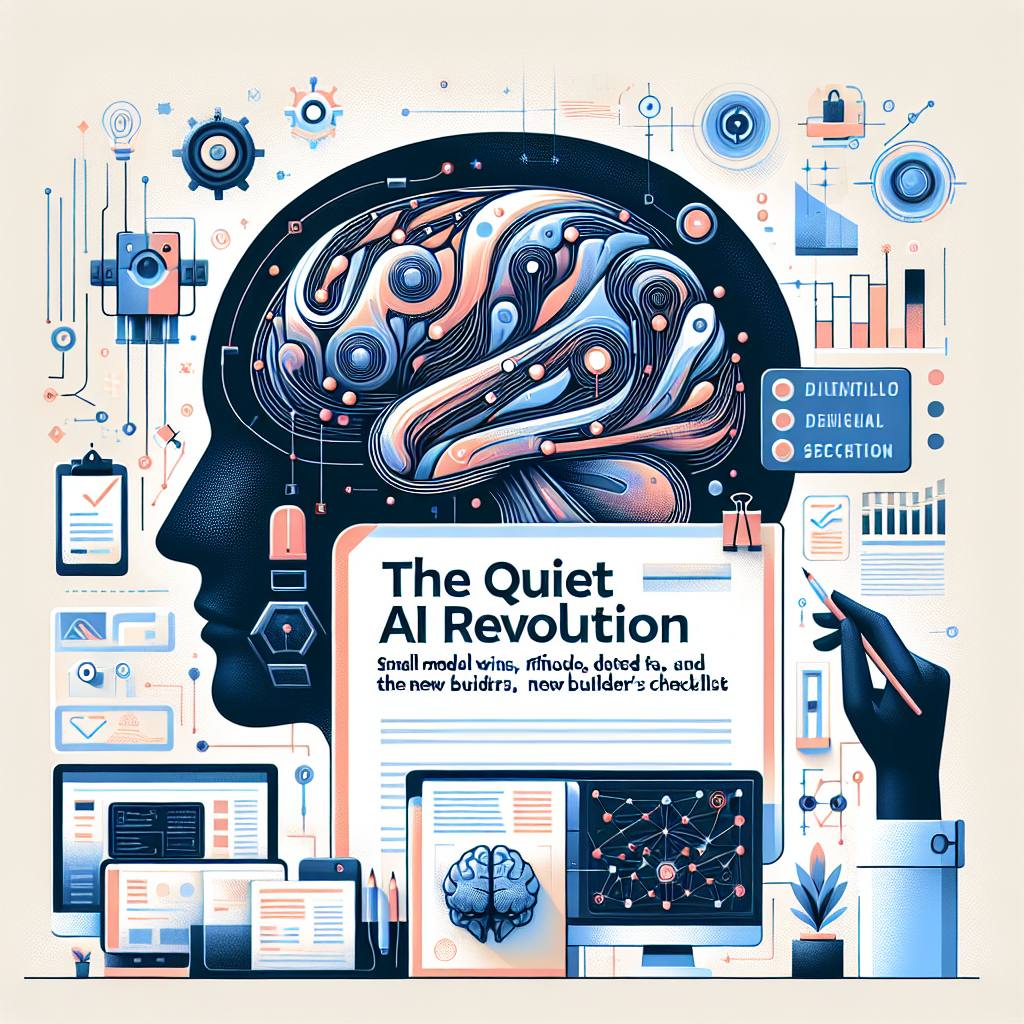
AI progress is no longer only about bigger models and flashy demos. The most important shift is operational: smaller, faster systems, better data practices, and tighter safety controls that make AI reliable in real workflows.
AI technology has entered a phase where the biggest breakthroughs are often the least visible. Instead of competing only on model size, teams are winning by making AI cheaper to run, easier to steer, and safer to deploy. That shift is changing what “building with AI” actually means in 2026: it is less about a single model and more about a system that can retrieve the right context, respect privacy, evaluate quality, and integrate with the tools people already use.
This article reviews practical AI news and trends that matter to builders, then turns them into a hands-on checklist you can apply to real products, especially messaging-heavy workflows like lead qualification, booking, and customer support. Along the way, you will see where platforms like Staffono.ai (https://staffono.ai) fit naturally: not as “AI for AI’s sake”, but as a way to operationalize AI employees across WhatsApp, Instagram, Telegram, Facebook Messenger, and web chat.
In the last year, many teams learned a hard lesson: the best model in a benchmark is not always the best model for a business. Latency, cost per request, privacy constraints, and uptime matter just as much as raw capability. That is why smaller models, distilled models, and specialized models are increasingly used for “everyday” tasks such as classification, extraction, routing, and short-form drafting.
Practical insight: treat “model choice” as a portfolio decision. Use a strong general model only where it truly adds value, and use smaller models for high-volume steps that do not require deep reasoning. This can reduce costs dramatically while improving responsiveness in user-facing experiences.
Imagine a user messages “How much is the consultation and can I come tomorrow?” A small model can reliably detect intent (pricing + booking), extract key entities (service type, preferred time), and route the conversation to the next step. You may only need a larger model if the user’s request is complex or ambiguous. In Staffono.ai deployments, this pattern is natural because the platform focuses on fast, round-the-clock conversations, and you can design flows that escalate only when needed.
As AI systems become more common, users expect them to be correct about specific business details: availability, policies, pricing tiers, delivery regions, and the status of an order. The practical answer is not a longer prompt. It is a better context pipeline: retrieve the right data, format it consistently, and keep it current.
News and trend takeaway: “RAG” has matured from a buzzword into a standard architecture, but the competitive advantage is in the details. Teams are investing in content chunking strategies, metadata, freshness rules, and permission-aware retrieval.
If your customers primarily interact through messaging channels, context mistakes feel worse because the conversation is fast and personal. Staffono.ai is built for multichannel messaging, which makes it a strong fit when you want the same up-to-date business knowledge reflected across WhatsApp, Instagram DMs, Messenger, Telegram, and web chat without maintaining separate scripts for each channel.
High-quality labeled data remains a bottleneck, especially for niche industries or multilingual operations. Synthetic data is increasingly used to bootstrap classifiers, train rerankers, generate conversation variants, and stress-test edge cases. The key trend is that teams are moving from “generate lots of data” to “generate controlled, realistic data” with clear distributions and constraints.
Synthetic conversations are great for increasing coverage of phrasing, tone, and user behavior. They are not a replacement for ground-truth business facts. A good workflow is to generate synthetic user messages, but keep the expected answers grounded in your real policies and documentation.
If your business receives inquiries in English, Armenian, and Russian, you can generate diverse message variants for each intent: “reschedule,” “refund policy,” “book for two,” “send location,” and more. That dataset can improve routing accuracy and reduce the number of conversations that require human intervention. In platforms like Staffono.ai, stronger routing and intent detection translates directly into faster replies and fewer dropped leads.
AI teams are growing up fast. Instead of asking “Is the model smart?”, leaders ask “Did this reduce response time, increase conversion, or lower support costs without harming customer trust?” This changes how you evaluate. You still need technical metrics, but you also need workflow metrics.
Because Staffono.ai is designed around business automation, it aligns naturally with outcome-based evaluation. You are not deploying an AI toy, you are deploying AI employees that should measurably improve bookings, sales follow-up, and customer satisfaction.
Regulation and customer expectations are pushing AI systems toward clearer boundaries: what the system can do, what it cannot do, and how it handles sensitive data. Many teams now treat policy enforcement as an engineering problem, not a legal afterthought.
This is where messaging automation can either shine or fail. When a system is connected to booking calendars and sales pipelines, you need predictable rules. Staffono.ai deployments often start with clearly scoped tasks like answering FAQs, capturing lead details, and scheduling, then expand once the business is confident in controls.
If you are building with AI right now, here is a pragmatic sequence that works across industries.
Pick a workflow with clear inputs and outputs, such as “capture and qualify inbound leads.” Define what success looks like: for example, collecting name, service interest, budget range, and preferred time, then booking a slot or handing off to sales.
Great AI chat experiences do not interrogate users, and they do not ramble. They ask the smallest useful question next. They confirm important details. They summarize before taking action.
Use small models for intent detection and extraction, and reserve larger models for complex objections, nuanced explanations, or high-value prospects. This reduces cost and improves speed.
Hook the assistant into the calendar, CRM, inventory, or helpdesk so it can give accurate answers and complete tasks. If you cannot connect yet, start with read-only context and move to actions later.
Every week, review a small set of transcripts, identify failure patterns, and update your retrieval content, routing rules, and prompts. Most “model problems” are actually product design problems: unclear policies, missing data, or ambiguous escalation criteria.
Consider a local service business receiving 50 to 200 inquiries per week through Instagram and WhatsApp. The goal is simple: respond instantly, answer common questions, and convert interest into booked appointments.
This is a strong fit for Staffono.ai because the platform is built to run these conversations 24/7 across multiple channels, so you do not lose leads that arrive at night, during weekends, or when the team is busy.
Looking forward, expect these developments to matter for builders:
The common theme is operational maturity. AI products that win will be the ones that behave consistently, respect user data, and drive measurable outcomes.
If you want to turn these trends into working automation quickly, start with your highest-volume conversation channel and one workflow you can measure. Many businesses begin with lead capture and booking because the ROI is immediate and easy to track. Staffono.ai (https://staffono.ai) can help you deploy AI employees across WhatsApp, Instagram, Telegram, Facebook Messenger, and web chat, keep responses consistent, and scale customer communication without adding headcount. When you are ready, expand from answering questions to completing actions like scheduling, follow-ups, and sales handoffs, while keeping guardrails and performance metrics in place.