
AI headlines move fast, but product teams still have to ship reliable experiences that protect customers and revenue. This guide covers the practical engineering and operational patterns that help you build AI features that can adapt to model changes, policy shifts, and unexpected edge cases without downtime.
AI technology is advancing at a pace that makes weekly roadmaps feel outdated. New model releases, pricing changes, safety updates, and capability leaps can be exciting, but they also create a new kind of product risk: your AI feature can change behavior without your code changing. If you are building customer-facing automation, that risk shows up as confusing replies, compliance issues, or broken handoffs to humans.
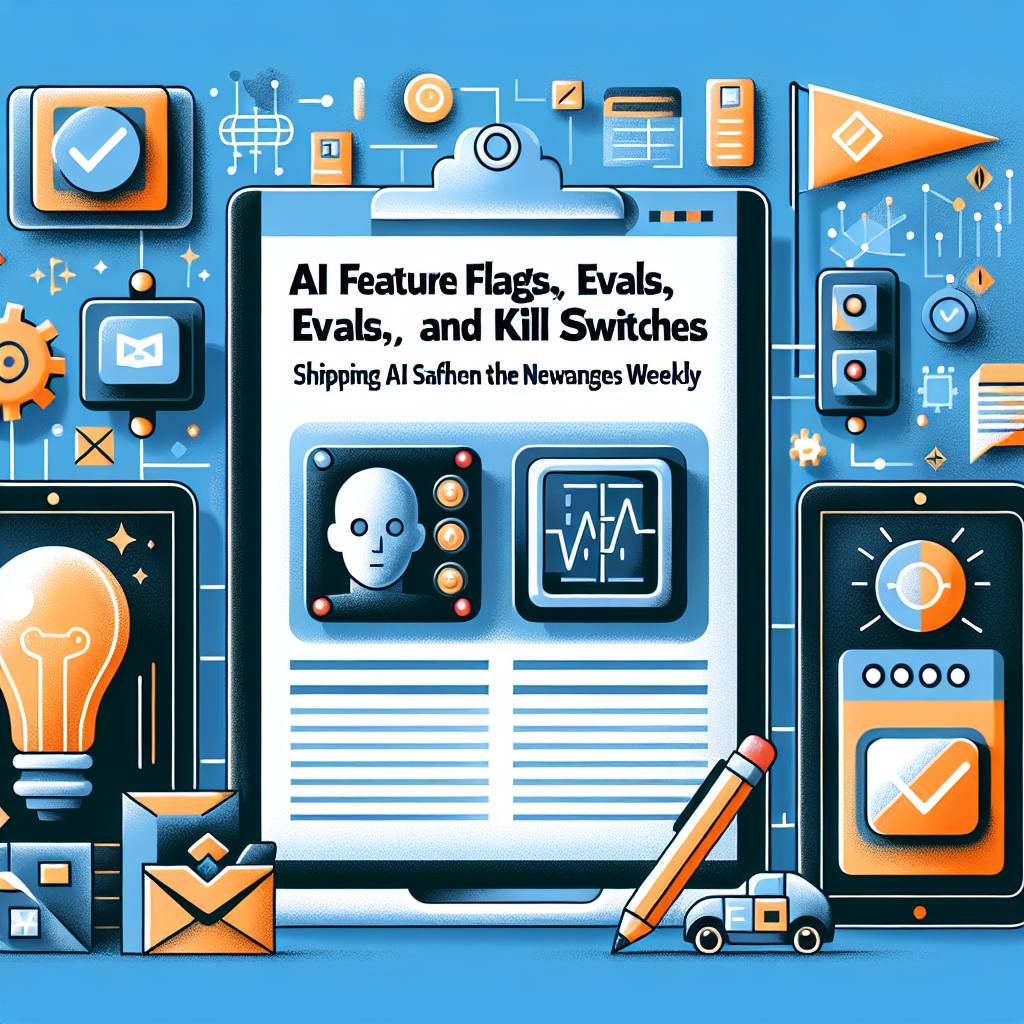
The good news is that you do not need to “predict the future” to build with AI. You need an operating approach that assumes change and controls it. In practice, that means three things: feature flags to control exposure, evaluations (evals) to measure quality continuously, and kill switches to stop harm quickly.
This article summarizes the AI news and trends that matter for builders and turns them into a pragmatic playbook. You will see concrete examples and a checklist you can adopt even if you are a small team.
Most AI product instability comes from changes in dependencies and context, not from your UI. Here are the trends behind that volatility and why they matter.
New model variants appear frequently: smaller “cheap and fast” models, larger “reasoning” models, and multimodal models that handle voice and images. Providers also tune models over time. That means the same prompt can yield different tone, different formatting, or different decisions a month later.
Builder takeaway: treat model behavior as a versioned dependency. If your product relies on consistent outputs, you need a way to pin versions, test upgrades, and roll back quickly.
AI is increasingly connected to tools: calendars, CRMs, inventory systems, payment links, and internal knowledge bases. This brings big value, but it also creates new failure modes: incorrect tool calls, wrong parameters, repeated retries, or actions taken with incomplete context.
Builder takeaway: any AI that can act must have constraints, audit trails, and a “safe mode” that degrades to suggestions or human approval.
Across industries, customers expect transparency, data protection, and predictable escalation to a human when needed. Regulations and platform policies are also evolving, especially for messaging channels.
Builder takeaway: quality is not only “does it answer correctly,” but also “does it answer safely, politely, and within policy.” Your evals should reflect that.
When AI behavior can drift, you need to limit the impact of any change. The simplest mental model is “blast radius.” A new model, new prompt, or new tool should not affect all users at once. This is where feature flags, evals, and kill switches work together.
Feature flags let you enable AI functionality for specific segments: internal users, one region, one channel, or one workflow. Instead of launching “AI replies” globally, you can start with low-risk conversations and expand only when metrics look good.
Practical ways to flag AI features:
If you use Staffono.ai for messaging automation, this maps naturally to how real businesses work. Many teams want 24/7 coverage, but they also want control over which conversations can be fully automated. Staffono.ai’s AI employees can be rolled out by channel and workflow, so you can start with bookings and lead qualification, then expand to more complex support once your quality bar is proven.
AI evaluations are not a one-time benchmark. They are an ongoing measurement system that tells you whether you are improving or silently degrading.
Think of evals in three layers:
What should you measure? Not just “accuracy.” For business automation, include:
A practical example: imagine a clinic using messaging to handle appointment requests. An offline eval might include 200 real questions (anonymized) across languages. Your pass criteria could be: confirms date and time correctly, captures name and contact, asks for missing details, and avoids medical advice. If a new model improves speed but starts giving treatment suggestions, your eval should catch that before rollout.
Teams using Staffono.ai can apply the same approach by defining “done” outcomes for each automated workflow, like “booking confirmed” or “lead qualified,” and monitoring how often the AI employee reaches that outcome without human intervention. This turns AI from a novelty into a measurable operations system.
A kill switch is a fast, reversible control that disables a risky behavior. It is not a failure, it is a safety feature. In AI products, you want multiple kill switches, each scoped to a different layer.
Useful kill switches include:
Set clear triggers. For instance, if refund requests get an unusual spike in negative sentiment, or if booking errors exceed a threshold, flip the autonomy kill switch for that intent while you investigate. Staffono.ai is particularly relevant here because messaging operations often span multiple channels. Having the ability to pause or downgrade automation on WhatsApp while keeping web chat running can protect revenue during incidents.
Prompts should be explicit about inputs, outputs, and constraints. Avoid vague instructions like “be helpful.” Use structured output formats and clear refusal rules. If the AI needs to call tools, define required fields and validation rules.
Tip: store prompts in version control with change notes and link each change to eval results. Treat prompt edits like code.
When you mix knowledge and reasoning in one prompt, debugging becomes hard. Use a retrieval layer (knowledge base, FAQ snippets, policies) and pass only relevant chunks to the model. Log what was retrieved so you can trace why an answer happened.
For messaging-heavy businesses, this matters because product details, pricing, and availability change frequently. With Staffono.ai, you can keep business information updated and ensure AI employees pull from the latest approved content, reducing hallucinations and inconsistent answers across channels.
Many AI failures happen when the system guesses missing details. Build a policy: if required fields are missing, ask a short question instead of guessing. In bookings, ask for date, location, party size. In sales, ask for budget range or timeline. In support, ask for order ID.
If you operate in multiple markets, you need language-specific evals and tone guidelines. Translation can introduce subtle policy violations or misleading certainty. Create a small “golden set” per language and run it every time you change models or prompts.
Customers increasingly send screenshots, photos, and voice notes. A safe way to adopt multimodal is to start with classification, not action. For example:
Smaller models can cut costs, but they may be weaker at complex reasoning. A practical approach is a routing strategy:
Instead of letting an agent freely plan and act, define “bounded agents” with narrow permissions. Example: a “Booking Agent” can read availability and create bookings, but cannot cancel without confirmation. A “Sales Agent” can qualify leads and schedule calls, but cannot promise pricing outside rules.
This is where Staffono.ai fits naturally: many businesses do not need a general AI assistant, they need specialized AI employees for messaging, bookings, and sales. Building bounded workflows makes automation safer and easier to scale.
The most important AI trend is not a new model name. It is the shift from “AI as a demo” to “AI as an operational dependency.” That requires controls that software teams already know: gradual rollouts, measurement, and incident response.
If you want to put these patterns into practice for customer conversations, bookings, and sales across WhatsApp, Instagram, Telegram, Facebook Messenger, and web chat, Staffono.ai is designed for exactly that kind of real-world automation. You can start small, keep humans in the loop where needed, and expand coverage as your evals prove reliability. Explore Staffono.ai at https://staffono.ai to see how AI employees can help you ship automation that stays stable even as the AI landscape keeps changing.